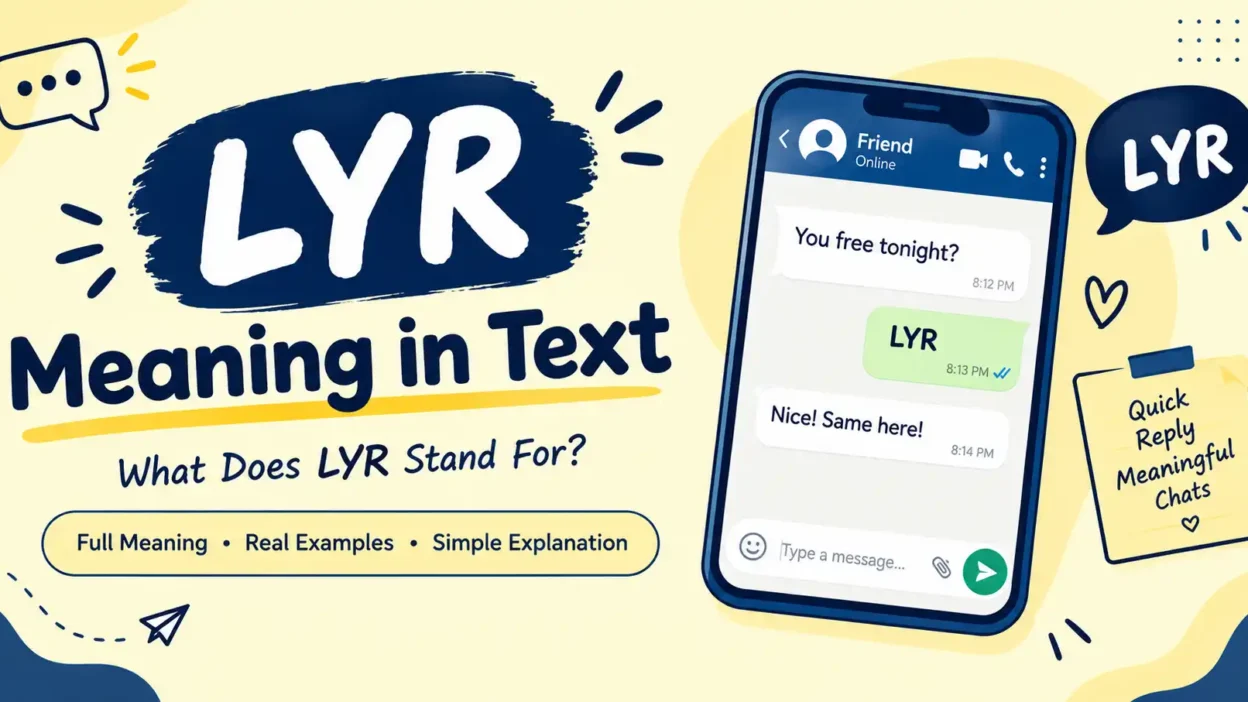
Type LYR with no slash, and it means “Love You Really,” a casual, affectionate way to close out a message or take the sting out of a joke. Add a slash before or after it, and /LYR becomes a tone tag that flags the words right before it as song lyrics, not a personal confession.
The rest of this guide walks through how each version actually gets used in real conversations, the fastest way to tell them apart without overthinking it, where each one tends to show up, and a couple of situations where reaching for LYR Meaning in Text at all isn’t the best call.
LYR = “Love You Really”
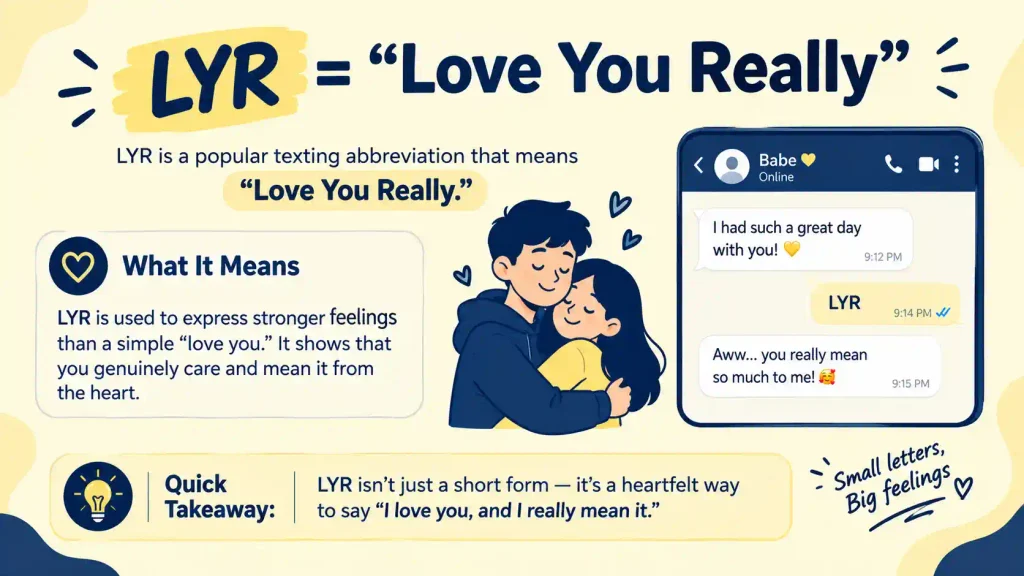
Without a slash, LYR is almost always shorthand for “Love You Really.” LYR Meaning in Text works like a cushion. Someone sends a message that could sting a little on its own “you never text back first” and then adds LYR so the other person knows it’s coming from affection, not annoyance.
It’s closer to “no hard feelings” or “I’m just teasing” than to a genuine romantic declaration. The letters carry weight because of who sends them, not because of the words themselves.
Where you’ll usually see it
LYR Meaning in Text shows up most in:
- Group chats between friends who already tease each other
- Sibling or family texts, especially after a complaint or joke
- Early-stage texting with a romantic interest, where someone wants to hint at feelings without saying “I like you” outright
Is LYR flirty?
It can be, depending on who’s sending it. Between two people who’ve been friends for years, LYR Meaning in Text after a joke is rarely romantic; it’s just a habit, the texting equivalent of a nudge on the shoulder. Between two people who are newly talking or dating, LYR can act as a low-risk trial balloon: enough warmth to signal interest, but vague enough that neither person has to commit to saying something bigger first.
If you’re trying to figure out whether someone means it romantically, look at the conversation as a whole rather than the abbreviation itself. LYR Meaning in Text rarely carries meaning on its own; it inherits its tone from everything said around it.
A quick example
Maya: You left your fries at my house again; I had to eat them for you
Maya: LYR though
Nothing about “LYR” here is romantic. It’s a joke wrapped in reassurance. Maya is teasing Sam, then confirming there’s no real annoyance behind it.
/LYR: the Tone Tag for Song Lyrics
Add a forward slash, and LYR Meaning in Text turns into something entirely different: a tone tag. Specifically, it marks the text immediately before it as a quoted song lyric rather than something the sender is saying about their own life.
This matters more than it might seem. Plenty of song lyrics sound alarming or deeply personal when they’re pulled out of a song and posted alone. A line like “I can’t feel my face when I’m with you” reads very differently as a caption with no context than it does once you recognize it as a lyric. The /LYR tag closes that gap immediately.
What a tone tag actually does
Text has no tone of voice. A sarcastic comment, a joke, and a sincere statement can all look identical typed out, which is exactly why tone tags exist. They’re short labels, usually a slash followed by an abbreviation, that tell the reader how to read the words that came before them.
/ LYR Meaning in Text isn’t an isolated invention. It belongs to a small, informal system of tags that grew mainly out of Discord servers and other online communities where written messages were being regularly misread. A few of the most common ones:
| Tag | Meaning |
| /j | Joking |
| /s | Sarcastic |
| /gen | Genuine “I actually mean this” |
| /nm | Not mad |
| /lh | Light-hearted |
| /LYR | Lyrics this line is a song quote |
These tags are especially common in communities with a lot of neurodivergent members, where sarcasm and tone can be harder to infer from text alone, and where clarity is treated as a courtesy rather than an inconvenience. Compared to tags like /j or /s, /LYR is less universally recognized; plenty of people who use tone tags daily have never encountered it, so don’t assume everyone reading your message will automatically know what it means.
How to Tell the Two Meanings Apart
In practice, you rarely need more than a glance to know which LYR you’re looking at.
| Signal | LYR = “Love You Really” | /LYR = Lyrics tag |
| Slash | Not used | Placed right before or after |
| Follows | A personal comment or tease | A quoted line or fragment |
| Sentence shape | Full, casual sentence | Often poetic or rhythmic phrasing |
| Common setting | Private texts, DMs | Discord, X/Twitter, TikTok, Instagram captions |
| Tone | Warm, personal | Neutral, purely informational |
If you’re still unsure, ask yourself one question: does the line before it sound like it belongs in a song? If yes, it’s almost certainly the lyrics tag. If it reads like a normal sentence about the conversation you’re having, it’s the affectionate version.
LYR by Platform
LYR Meaning in Text run into shifts depending on where you’re reading it.
- Discord: Almost always the tone tag, /LYR, since this is where tone tags as a category originated and are most actively used.
- TikTok and Instagram: You’ll see both. Comments between friends often use the affectionate LYR, while captions under a song clip or “lyric edit” typically use /LYR.
- X (Twitter): /LYR shows up frequently under quoted lyrics, especially when someone is posting about a song they’re currently obsessed with.
- SMS and private group chats: This is the home turf of “Love You Really.” The lyrics tag is far less common here simply because people quote songs less often in one-on-one texting.
When Not to Use LYR
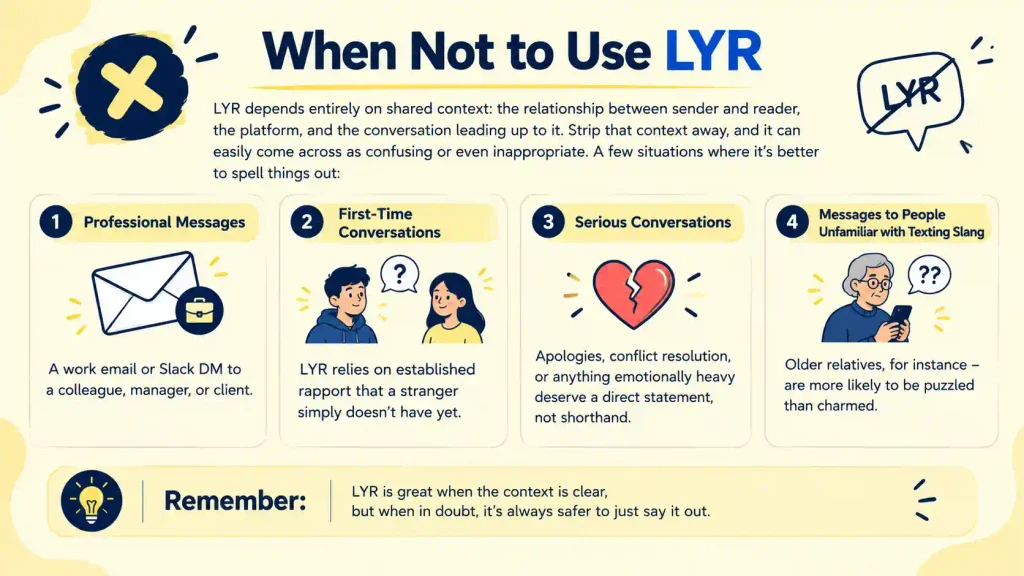
LYR depends entirely on shared context: the relationship between sender and reader, the platform, and the conversation leading up to it. Strip that context away, and it can easily come across as confusing or even inappropriate. A few situations where it’s better to spell things out:
- Professional messages: a work email or Slack DM to a colleague, manager, or client
- First-time conversations: LYR relies on established rapport that a stranger simply doesn’t have yet.
- Serious conversations apologies, conflict resolution, or anything emotionally heavy deserve a direct statement, not shorthand.
- Messages to people unfamiliar with texting slang older relatives, for instance- are more likely to be puzzled than charmed.
When there’s any doubt about whether the other person will understand the tone you’re going for, the clearer choice is almost always to just say what you mean.
LYR vs. Similar Abbreviations
LYR sits inside a broader family of texting shorthand built around affection. Here’s how it compares:
| Term | Meaning | Typical Feel |
| LYR | Love You Really | Playful, teasing, low-pressure |
| ILY | I Love You | Direct and sincere |
| ILYSM | I Love You So Much | Intensified version of ILY |
| LY2 | Love You Too | Quick reciprocal reply |
| ISLY | I Still Love You | Reassurance after an argument |
The key difference between LYR and ILY is intent. ILY is a plain, sincere statement there’s no joke attached, no cushion needed. LYR almost always shows up after something else was said, softening or contextualizing it rather than standing on its own.
Other Meanings of LYR (Outside of Texting)
A few unrelated meanings sometimes confuse, mostly because the letters overlap:
- Longyearbyen, Norway: LYR is the IATA airport code for the main airport serving this Arctic town on the Svalbard archipelago. If you see LYR on a flight ticket or boarding pass, this is what it refers to, not a text abbreviation.
- Llŷr a figure from Welsh mythology, sometimes referenced in fantasy or fandom contexts. Occasionally confused with “LYR” purely because of spelling, though the two aren’t connected.
- Last Year Rate an uncommon piece of business shorthand occasionally used in sales or finance discussions to compare current figures against the prior year’s numbers. It’s a niche term rather than a widely recognized one, and you’re unlikely to encounter it outside of specific internal reports.
None of these overlap meaningfully with texting slang; the context alone (a boarding pass vs. a group chat) almost always makes it obvious which LYR you’re dealing with.
Frequently Asked Questions
What does LYR Meaning in Text message?
Without a slash, LYR most commonly stands for “Love You Really.” It’s used to soften a joke or a lighthearted complaint, showing the other person that no real annoyance is behind it.
What’s the difference between LYR and /LYR?
The slash is the whole difference. LYR on its own is an affectionate sign-off. /LYR is a tone tag that marks the previous line as a quoted song lyric rather than the sender’s own words.
Is it rude to send someone LYR after criticizing them?
Not usually, as long as there’s already trust between you. LYR is designed to take the edge off a comment, similar to saying “just kidding, love you” out loud. Between strangers or in a serious disagreement, though, it can come across as dismissive rather than warm.
Why do people add /LYR after posting song lyrics?
Because lyrics taken out of context can sound like a personal statement, sometimes an alarming one. The tag reassures readers that the words belong to a song, not to the poster’s own feelings, and helps prevent the message from being misread as a cry for help or a hidden confession.
Does LYR mean the same thing on every platform?
No. On Discord and X, LYR is almost always the slashed tone tag for lyrics. In private texts and group chats, it’s far more likely to mean “Love You Really.” When in doubt, check whether the line before it reads like a quote or like a personal comment.
Can LYR be used between people who aren’t close?
It’s best avoided. Because LYR relies on the reader already trusting the sender’s tone, using it with someone you don’t know well a new coworker, an acquaintance, or a stranger online risks being misunderstood rather than appreciated.
The Bottom Line
At its core, LYR is really two small tools wearing the same three letters. Without a slash, it softens a joke or a tease into something warmer, and works best between people who already know each other’s sense of humor. With a slash, /LYR does something more practical: it flags a line as a song lyric so it isn’t mistaken for a personal statement or a cause for concern.
Neither version carries much weight in isolation; both depend heavily on who’s sending the message, where it’s being sent, and what came right before it. Once you get in the habit of checking for that slash and reading the surrounding context, you’ll never have to guess which LYR you’re looking at again.
Read More: Awe Meaning in Text: Avoid This Simple Mistake in 2026