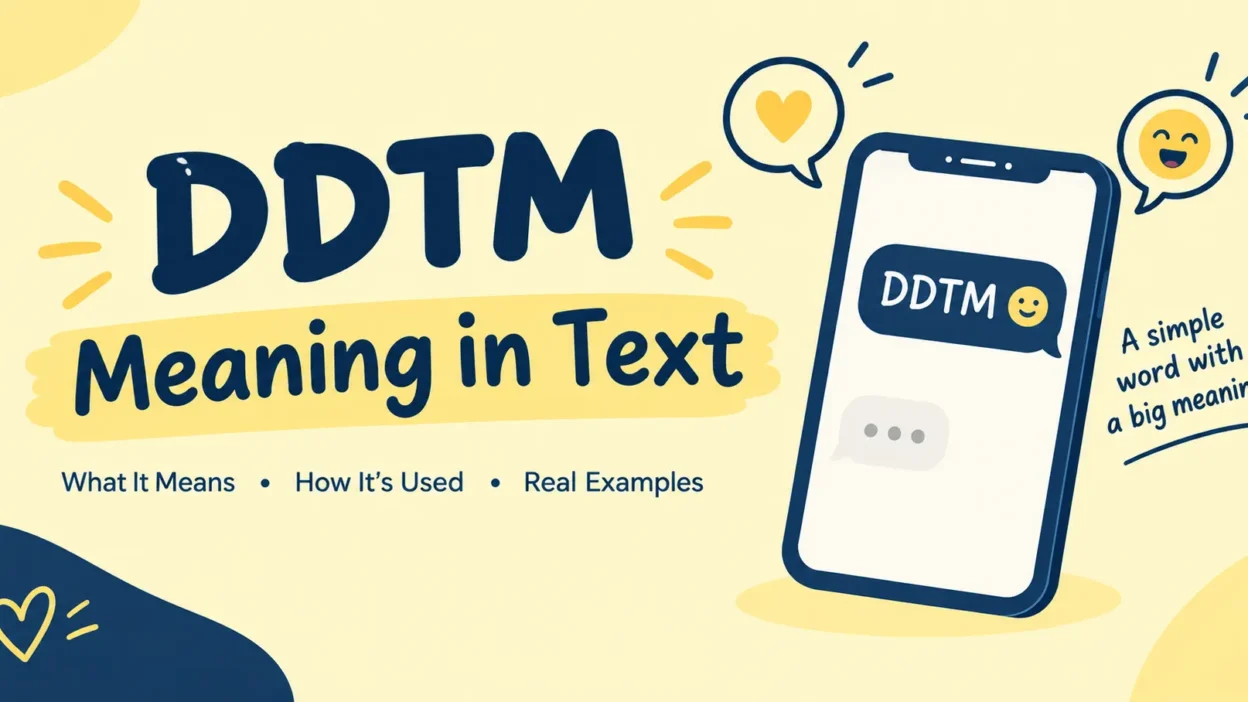
DDTM Meaning in Text stands for “Don’t Do Too Much.” People send it when they think someone is overreacting, exaggerating, or putting more energy into a small situation than it deserves. It’s casual, it’s usually good-natured, and once you understand how it’s actually used, you’ll start noticing it everywhere because it is everywhere, from Instagram comments to sibling group chats.
This guide goes further than just defining the term. You’ll learn where it came from, how to tell whether someone means it playfully or seriously, when it can backfire, and exactly how to respond in any situation.
Quick Answer
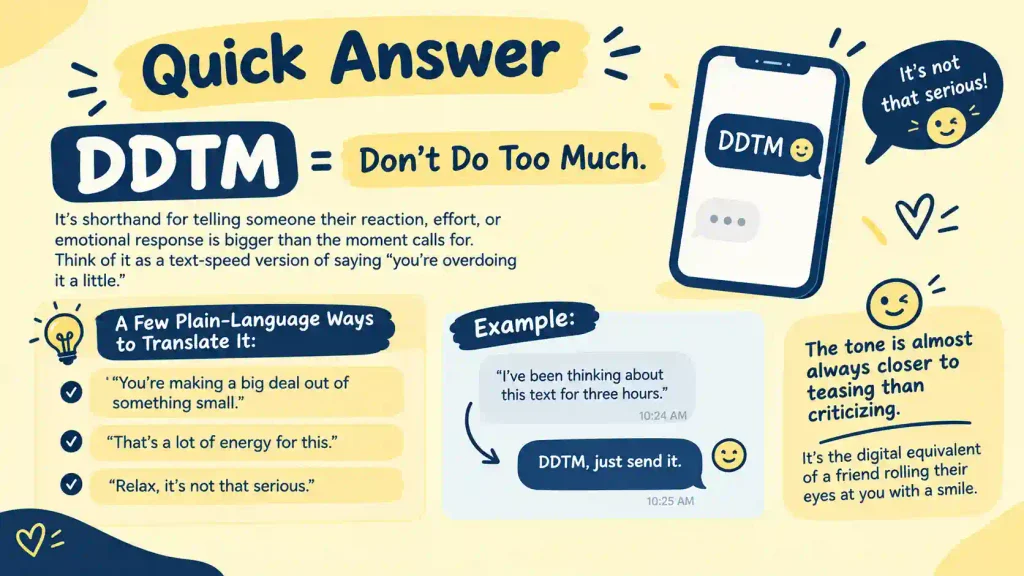
DDTM = Don’t Do Too Much.
It’s shorthand for telling someone their reaction, effort, or emotional response is bigger than the moment calls for. Think of it as a text-speed version of saying “you’re overdoing it a little.”
A few plain-language ways to translate it:
- “You’re making a big deal out of something small.”
- “That’s a lot of energy for this.”
- “Relax, it’s not that serious.”
Example:
“I’ve been thinking about this text for three hours.” → “DDTM, just send it.”
The tone is almost always closer to teasing than criticizing. It’s the digital equivalent of a friend rolling their eyes at you with a smile.
DDTM vs. Look-Alike Abbreviations
Because DDTM Meaning in Text is short and unfamiliar to a lot of people, it’s easy to confuse with other acronyms that look or sound similar. Here’s how to tell them apart so you don’t misread a message.
| Term | What It Actually Means | Where You’ll See It |
| DDTM | Don’t Do Too Much | Texts, TikTok/IG comments, group chats |
| DTM | Varies by context sometimes used loosely for “down to meet” or as a standalone reaction in comment sections; not a fixed phrase | Comments, casual chat |
| DDT | A chemical pesticide banned in many countries for environmental reasons nothing to do with texting | Science, agriculture, history |
| NGL | Not gonna lie | Honest or blunt statements |
| IYKYK | If you know, you know | Inside jokes, niche references |
The mix-up matters because reacting to “DTM” as if it were “DDTM” or vice versa can leave you replying to the wrong message entirely. If you’re ever unsure which one someone meant, the surrounding conversation almost always makes it clear within a sentence or two.
Where DDTM Came From
DDTM Meaning in Text isn’t a term someone invented specifically for texting. It’s a shortened version of a phrase people have said out loud for decades: “don’t do too much.” Parents, coaches, and friends have used some version of this line long before smartphones existed, usually to nudge someone away from overreacting or overperforming.
What changed is the platform. As conversations moved from in-person to comment sections and DMs, the phrase got compressed the same way “to be honest” became “tbh” and “if you know you know” became “iykyk.” Short-form platforms reward brevity: a four-letter reply fits neatly under a TikTok comment or a quick text reply, while a full sentence can feel like too much explanation for a small moment.Its the same reason we use ykw meaning in text or hm meaning in text instead of full sentences.
This is part of a broader pattern in internet language: full phrases with a clear social function get compressed into initials as soon as they’re used often enough. DDTM followed the same path as “smh” (shaking my head) and “ngl” (not gonna lie) phrases that describe a reaction rather than a fact, which is exactly why they spread through comment culture rather than formal writing.
How to Tell If Someone’s Being Playful or Actually Annoyed
This is the part most guides skip, and it’s the part that actually matters when you’re staring at a text wondering how to feel about the DDTM Meaning in Text.
DDTM carries almost no tone on its own; the four letters are neutral.Understanding the ddtm meaning in text fully depends on context. What tells you the real intent is everything around them. Use this quick framework:
Signs it’s playful:
- It’s followed by a laughing emoji, “lol,” or a joke.
- The conversation has been light-hearted the whole time.
- You’ve teased each other like this before
- It comes right after something genuinely small (a like, a slow reply, a minor opinion)
Signs it might be dismissive:
- It’s the only thing they say, with no emoji or follow-up.
- It comes after you’ve explained something that clearly matters to you.
- The conversation had already turned tense.
- It’s from someone you don’t know well or don’t have that kind of rapport with
If you get a flat “DDTM” with nothing else attached, it’s fair to ask for clarification instead of guessing: “Wait, are you saying I’m overreacting? I actually mean this.” That one line does more to clear up confusion than trying to decode tone from four letters alone.
Real Conversation Examples
Text between friends:
A: I’m never speaking to them again.
B: DDTM 😂 What actually happened?
Instagram DM:
A: You didn’t like my post?
B: DDTM, it’s a picture of a sandwich lol
TikTok comment:
“This show ruined my whole week.” → “bro DDTM, it’s a TV show”
Sibling group chat:
A: I’m leaving this family group chat forever.
B: DDTM, we get it, you’re annoyed 😭
Notice the pattern: DDTM shows up almost exclusively as a reaction to someone else’s reaction. It’s rarely the opening line of a conversation; it’s a response to something that already felt slightly overblown.
When DDTM Can Go Wrong
DDTM works well between people who already tease each other. It works badly in a few specific situations:
During a real problem. If someone is talking about a breakup, a job loss, a health scare, or anything genuinely difficult, DDTM will land as dismissive no matter how it’s meant. A simple test: if you wouldn’t say “you’re overreacting” to someone’s face in that moment, don’t send DDTM instead. Typing it doesn’t make it gentler; it just makes it shorter.
With someone you don’t know well. Between close friends, DDTM Meaning in Text is a shared joke. Between acquaintances or new coworkers, it can come across as presumptuous, since you haven’t earned the kind of familiarity that makes teasing feel safe.
In professional settings. DDTM has no place in work messages. It reads as unprofessional and can undercut a colleague’s legitimate concern. If you want to convey the same idea at work, something like “let’s not overcomplicate this” or “I think we can simplify this” gets the point across without the slang.
When someone is anxious rather than dramatic. There’s a real difference between someone being theatrically extra and someone genuinely spiraling with anxiety. DDTM assumes the first. If you’re not sure which one you’re looking at, it’s worth checking in directly instead of assuming.
How to Respond to DDTM
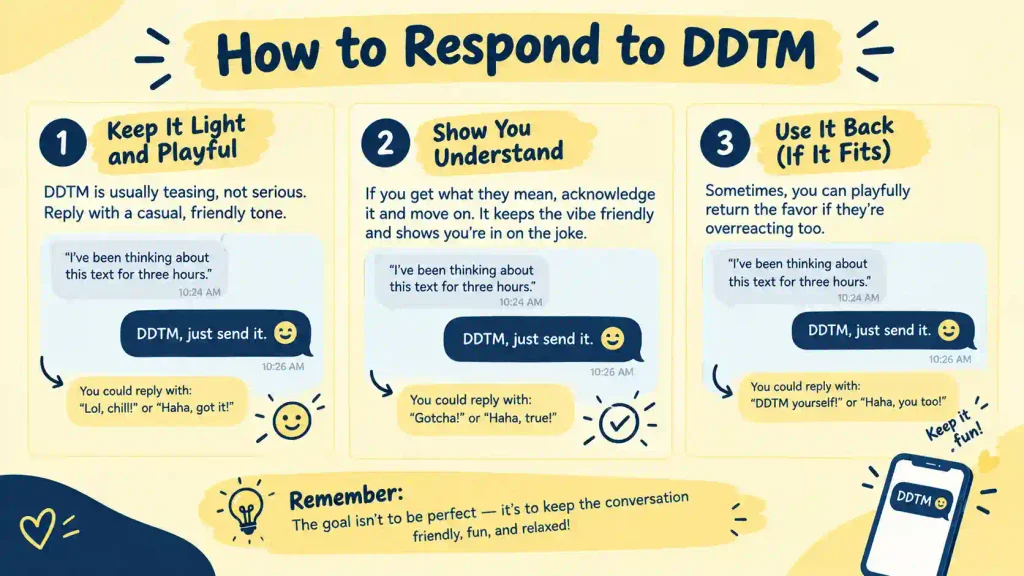
Your reply should match your actual reaction, not just the tone of the message you received.
If you agree and want to laugh it off:
- “Fair enough, lol”
- “Okay, okay, I’ll relax”
- “Caught in 4K, my bad”
If you want to keep the joke going:
- “Let me be dramatic in peace”
- “Too late, I’m already committed”
If it actually stings a little:
- “Haha maybe, but this one actually got to me”
- “I hear you, but it matters to me. Can we talk about it for a sec?”
If you think they misread the situation:
- “It’s not really about the small thing; it’s about the pattern”
- “I get why it looks like that, but here’s what’s actually going on…”
None of these need to be long. The goal is just to make sure the conversation reflects how you actually feel, rather than letting a four-letter reply decide the tone for you.
DDTM in Comment Sections vs. Private Messages
The way DDTM Meaning in Text functions changes depending on where it shows up.
In public comments (TikTok, Instagram, X), DDTM is almost always aimed at the original poster’s reaction to something minor: a movie, a song, a minor inconvenience. Because it’s public, it tends to be blunter and more joking, since the commenter usually has no relationship with the person they’re replying to and isn’t worried about hurting feelings.
In private messages, DDTM carries more weight because it’s directed at you specifically, from someone who knows you. That’s why the same four letters can feel harmless in a comment section and slightly loaded in a DM; the relationship changes what the words are doing.
A Quick Note on Generational Use
DDTM Meaning in Text sits firmly in Gen Z and younger millennial texting culture, alongside terms like “it’s giving,” “not that deep,” and “the audacity.” If you’re texting with someone older who isn’t familiar with current slang, there’s a real chance they’ll either misread it or not understand it at all worth keeping in mind if you’re using it with parents, older relatives, or in a mixed-age group chat.
Frequently Asked Questions
What does DDTM Meaning in Text?
It means “Don’t Do Too Much.” Someone is usually telling you, lightly, that your reaction feels bigger than the situation.
Is DDTM the same as DTM?
No. DDTM is a full phrase abbreviation (“Don’t Do Too Much”). DTM doesn’t have one fixed meaning and depends heavily on context.
Is DDTM rude?
Not inherently. Among friends, it’s typically playful. It can feel dismissive if sent flatly during a serious conversation or by someone you don’t know well.
Can DDTM be used at work?
It’s best avoided. It reads as too casual and can come across as dismissive of a coworker’s concern. A phrase like “let’s keep this simple” works better in professional settings.
How do I know if someone means it as a joke?
Look at what surrounds it emojis, the history of your conversation, and whether the topic is genuinely small. A bare “DDTM” with nothing else, especially after something that matters to you, is more likely to be a real note than a joke.
What should I say if DDTM feels dismissive?
Say so directly: “I hear you, but this actually matters to me.” It’s a short line, but it resets the conversation without escalating it.
Where did DDTM come from?
It’s a shortened version of the long-standing phrase “don’t do too much,” compressed for fast-paced texting and social media the same way phrases like “not gonna lie” became “ngl.”
The Bottom Line
DDTM means “Don’t Do Too Much,” a quick, usually friendly nudge that someone’s reaction has outgrown the situation. Among close friends, it’s a shared joke. Outside that context, tone and timing decide whether it lands as funny or careless.
The real skill isn’t memorizing the definition; it’s reading the four letters in context: who sent it, what came before it, and whether the moment actually called for a joke. Once you can do that, you won’t just know what DDTM means. You’ll know exactly how to use it, and when to leave it out entirely.
Read More: YKW Meaning in Text Warning | Common Mistake 2026