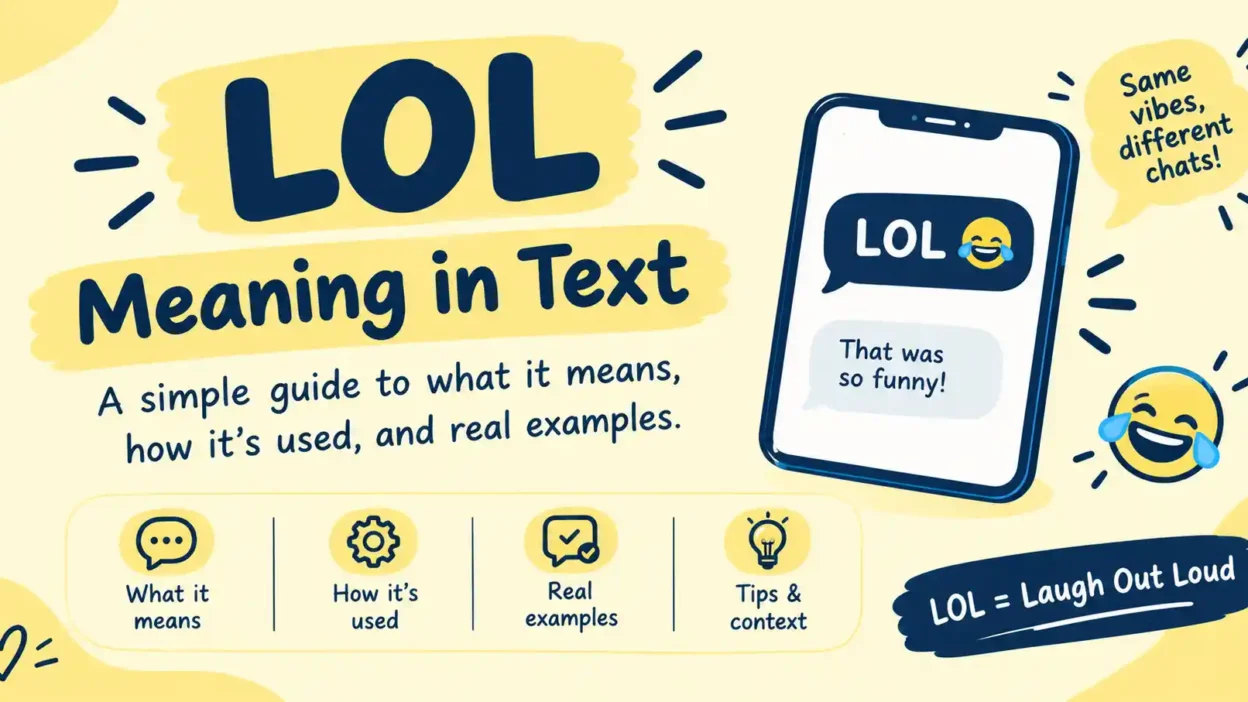
LOL Meaning in Text has quietly become one of the most flexible, most misunderstood words in modern English. It shows up in breakups, apologies, jokes, work chats, and awkward silences alike, and it rarely means the same thing twice. What started as literal shorthand for laughter has evolved into something closer to a tone of voice: invisible, but impossible to ignore once you notice it.
This guide goes further than the usual “LOL means laughing out loud” explanation. You’ll learn why LOL rarely reports real laughter anymore, the six distinct ways people use it in everyday texting, and how it compares to LMAO and ROFL, including why those two never drifted the same way. You’ll also see why a missing LOL can quietly cause tension between generations, how the rest of the world laughs in text, and whether LOL Meaning in Text still belongs in 2026. By the end, you’ll never read a plain “lol” the same way again.
Quick Answer
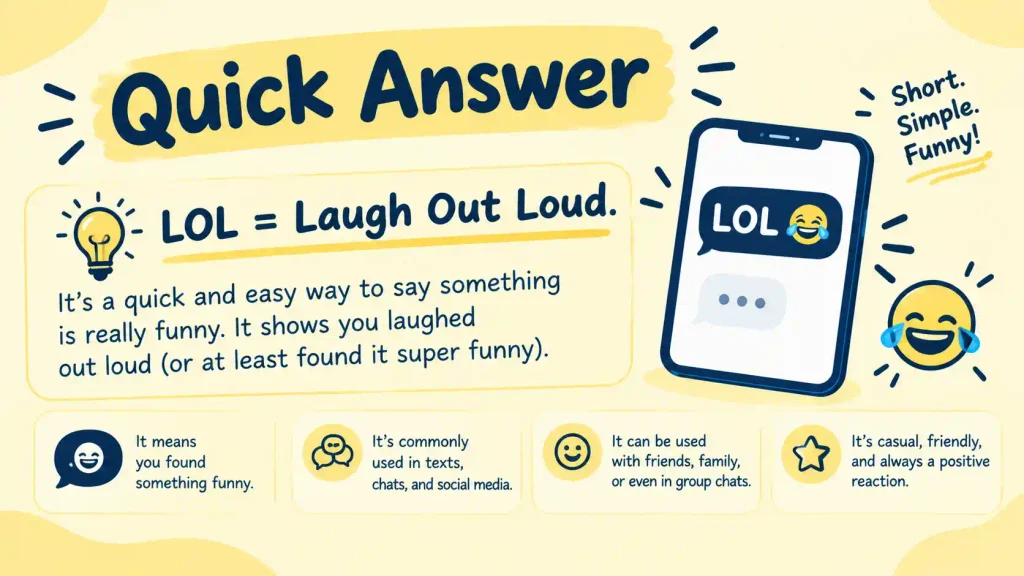
LOL is short for “laughing out loud” (some say “laugh out loud”; both are accepted). It’s typically pronounced by spelling it out, “el-oh-el,” though some people say it as a word, “lawl.”
The Oxford English Dictionary made it official in 2011, adding LOL Meaning in Text as a real entry after decades of informal use. Its formal definition is close to “ha ha,” a way of drawing attention to something funny or expressing amusement.
That’s the textbook meaning. What actually happens in your group chat is a different story.
Why “LOL” Rarely Means Someone Is Literally Laughing
Here’s the thing most guides skip: LOL Meaning in Text stopped being a literal report of laughter a long time ago, and there’s a real linguistic explanation for it.
Linguist John McWhorter, who has studied the evolution of texting language extensively, argues that LOL functions less like a word and more like a piece of grammar. Instead of describing something (a laugh), it does something: it sets a tone, the same way raising your eyebrows or softening your voice does in person. Words that work this way are sometimes called “pragmatic particles.” They don’t carry information; they carry attitude.
This isn’t unusual. English already has plenty of words that behave the same way think of how often people say “well,” “like,” or “I mean” without adding any actual content. LOL Meaning in Text became the texting equivalent: a small verbal gesture that keeps a conversation feeling warm, even when nothing is objectively funny.
That’s why you’ll see “lol” attached to messages that have nothing to do with humor:
- “Running 20 minutes late, lol” an apology cushion
- “Guess I’ll just redo the whole thing then, lol” dry sarcasm.
- “lol yeah I know” plain acknowledgment.
- “Sorry, just saw this, lol” smoothing over an awkward gap.
None of these are jokes. In each one, LOL is doing social work, signaling “I’m not upset,” “I’m still friendly,” or “this isn’t a big deal” rather than reporting laughter.
The Six Ways People Actually Use LOL
Understanding LOL Meaning in Text means recognizing which of these modes someone is in. Context and the message right before it usually make it obvious.
1. Genuine amusement
The original, still-alive use. Something is actually funny, and LOL is the fast way to say so.
“My cat just fell off the windowsill trying to catch a fly 😂”
“LOL no way, is she okay?”
2. Sarcasm or irony
LOL can flip a sentence’s literal meaning into its opposite.
“Oh great, another mandatory Saturday meeting, lol.”
3. Softening bluntness
Attaching LOL to a direct or slightly critical statement takes the edge off it.
“You definitely parked over the line lol”
4. Acknowledgment without content
Sometimes LOL is just filler that shows you’re engaged, even when there’s nothing to react to.
“Ugh, Mondays.”
“Lol tell me about it”
5. Defusing an awkward moment
LOL frequently shows up right after someone admits a mistake, forgets something, or feels embarrassed.
“Sorry, totally spaced and forgot to reply, lol”
6. Buying time or hedging
In murkier situations declining plans, dodging a question, ending a conversation LOL can act as a soft exit that avoids sounding cold.
“Lol maybe next time, I’m swamped this week”
Most people move between these six modes without thinking about which one they’re in. That’s exactly why misreadings happen: the sender knows which mode they meant, but the reader has to guess.
LOL vs. LMAO vs. ROFL: Why They Didn’t Evolve the Same Way
If LOL drifted so far from its literal meaning, why didn’t LMAO and ROFL follow the same path? They’re still fairly reliable signals of real, strong amusement.
| Term | Stands for | Typical intensity | Common use today |
| LOL | Laughing out loud | Mild to moderate | General amusement, tone-softening, filler |
| LMAO | Laughing my ass off | Strong | Genuinely funny reactions, occasional sarcasm |
| LMFAO | Laughing my f***ing ass off | Very strong | Intensified LMAO |
| ROFL | Rolling on the floor laughing | Strongest | Reserved for the biggest reactions |
| ROFLMAO | Combination of ROFL and LMAO | Strongest | Rare, exaggerated combination |
The likely reason for the split: LMAO and ROFL describe extreme, specific physical reactions. That specificity keeps them tied to real intensity you don’t say “rolling on the floor laughing” about something mildly amusing without it reading as obvious hyperbole.
LOL, by contrast, is short, mild, and used constantly. That combination of brevity and frequency is exactly what allowed it to wear down into something closer to punctuation. A word people type dozens of times a day rarely keeps its full original weight; it gets worn smooth, the way “goodbye” wore down from “God be with ye.”
You’ll also come across a few less common relatives: LOLZ (a playful or sarcastic spin), LULZ (laughing at someone else’s expense, common in trolling contexts), and older spellings like “lawl” or “lel.”
Does Capitalization or Spelling Change the Meaning?
Somewhat, though there’s no official rulebook. Among people who vary their capitalization, a rough pattern tends to hold:
- “LOL” (all caps) often reads as a slightly bigger reaction than lowercase.
- “lol” (lowercase) tends to feel more offhand, casual, or automatic.
- Stretched versions like “lolll” or “lololol” typically signal playfulness or teasing rather than a different meaning entirely.
Not everyone follows this pattern plenty of people type “LOL” out of habit regardless of context. But if you’re trying to gauge intensity from someone who does vary their capitalization, it’s a reasonable clue. The same idea can apply to other texting shortcuts, such as YKW, where the way a phrase is written can sometimes affect how casual or emphatic it feels.
Why Some People Read a Missing “LOL” as a Bad Sign
This is the part most articles on this topic never mention, and it’s arguably more useful than the definition itself: for a lot of younger texters, LOL Meaning in Text (and similar softeners) aren’t optional decoration; they’re load-bearing.
Therapists who study digital communication point to a pattern: because tone of voice and facial expression are missing from text, some people often those on the more anxious end, and disproportionately younger texters scan short or unembellished messages for signs of anger. A blunt “ok” with no LOL, emoji, or exclamation point can genuinely read as cold or upset, even when the sender meant nothing by it.
This is also where a lot of cross-generational friction comes from. Older texters, especially those who grew up treating text messages as short, functional notes, are far more likely to leave a message plain and mean nothing by it. Younger texters, more used to reading emotional subtext into every character, may interpret that same plainness as a problem.
There’s also a real historical quirk worth knowing: some Baby Boomers, in the early days of texting and email, used LOL to mean “lots of love,” a warm sign-off rather than a laugh, before the “laughing out loud” meaning became the universal standard. If you’ve ever gotten a confusing “Talk soon, lol, Mom,” that’s likely why.
The practical takeaway: if you’re texting across a generational or personality gap and the other person seems to read a lot into short messages, an occasional LOL costs you nothing and can prevent a misunderstanding that would otherwise take three follow-up texts to clear up.
LOL Around the World: Every Language Has One
LOL isn’t a uniquely English phenomenon; it’s one solution to a universal problem: showing tone in text without a voice or a face. Nearly every texting culture has developed its own version.
| Language | Term | Where it comes from |
| Thai | 555 | The number 5 is pronounced “ha” in Thai, so “555” reads as “hahaha” |
| Korean | ㅋㅋㅋ | A repeated consonant that mimics laughter (“kekeke”) |
| French | mdr | Short for mort de rire — “dying of laughter” |
| Japanese | w / www | Short for warai (“laughter”); repeated w’s resemble grass, jokingly called “grass laughing” |
| Portuguese | kkkk | A repeated “k” sound that imitates laughing |
| Chinese | 233 | Linked to a laughing-emoji number popularized on a Chinese forum |
| Spanish | jajaja | Laughter spelled out, with “j” pronounced like an English “h” |
These aren’t translations of LOL; they’re independent inventions that solve the same communication gap. That’s a good sign this isn’t a fluke of English; it’s a basic feature of how humans adapt language to text.
Is It OK to Use LOL at Work?
It depends on the relationship and the setting, but there’s a useful rule of thumb: if you wouldn’t end that sentence with an exclamation point in a professional message,LOL Meaning in Text probably doesn’t belong there either.
Generally fine:
- Casual Slack or chat messages with close teammates
- Informal check-ins where the relationship is already relaxed
Better to avoid:
- Emails to clients or senior leadership
- Formal written communication (proposals, official notices)
- The first few messages with someone you don’t know well professionally
If you want the same softening effect without the casual tone, phrases like “that’s funny,” “I enjoyed that,” or “that made me laugh” do the same job more formally.
What to Say Instead of LOL
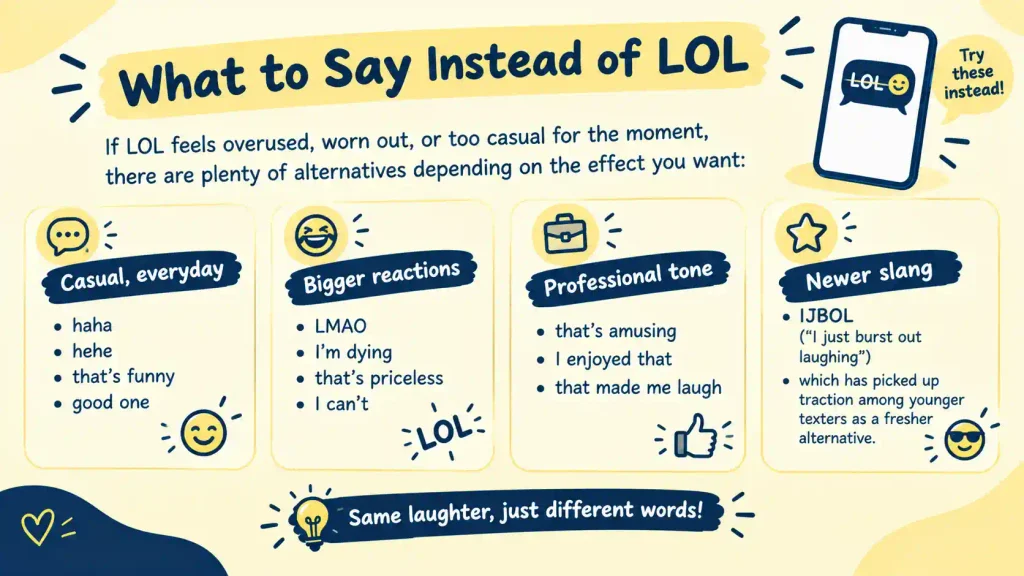
If LOL feels overused, worn out, or too casual for the moment, there are plenty of alternatives depending on the effect you want:
- Casual, everyday: haha, hehe, that’s funny, good one.
- Bigger reactions: LMAO, I’m dying, that’s priceless, I can’t
- Professional tone: that’s amusing, I enjoyed that, that made me laugh
- Newer slang: IJBOL (“I just burst out laughing”), which has picked up traction among younger texters as a fresher alternative
Is LOL Dying Out?
Not exactly, but it’s not the default it once was. A widely cited 2015 Facebook study found that only around 1.5–1.9% of people actually typed “lol” in their posts; “haha” and laughing emoji were already far more common even then.
That trend has only continued. Many younger texters now reach for the skull emoji (💀), the crying-laughing face (😭), or phrases like “I’m deceased” instead of typingLOL Meaning in Text. Interestingly, some of those symbols are undergoing the same drift LOL did decades ago; the skull emoji, for instance, is increasingly used to mean “hilariously funny” rather than anything related to death, which is a near-perfect repeat of how LOL detached from literal laughter.
So LOL isn’t disappearing so much as sharing space with a rotating cast of replacements, all doing roughly the same job: signaling tone when your voice and face aren’t in the conversation.
Frequently Asked Questions
Does LOL Meaning in Text always mean someone is actually laughing?
Does LOL Meaning in Text always mean someone is actually laughing?
No. It’s far more often used as a tone marker to soften a statement, show friendliness, or acknowledge something than as a literal report of laughter.
What’s the difference between LOL and LMAO?
LOL usually signals mild-to-moderate amusement or general friendliness. LMAO (“laughing my ass off”) signals a stronger, more genuine reaction. ROFL sits above both, reserved for the biggest reactions.
Is it rude to reply to someone with just “lol” and nothing else?
Not inherently, but it depends on the conversation. If someone shared something emotionally significant, a bare “lol” can come across as dismissive. In casual banter, it’s usually read as neutral or friendly.
Why do older generations sometimes use LOL differently?
Some Baby Boomers adopted LOL early on to mean “lots of love,” a holdover from earlier informal writing conventions, before “laughing out loud” became the standardized meaning across all age groups
What does LOL Meaning in Text mean in other languages?
Most languages have their own version rather than borrowing LOL directly; examples include “555” in Thai, “mdr” in French, and “kkkk” in Portuguese, all mimicking laughter in different ways.
Is LOL still used in 2026?
Yes, though usage has declined from its peak. It remains universally understood, but many younger texters now favor emojis like 💀 or 😭, or phrases like “I’m deceased,” for the same purpose.
The Bottom Line
LOL still technically stands for “laughing out loud,” but that’s only half the story now. Most of the time, it’s doing something else entirely: softening a blunt sentence, keeping a conversation warm, smoothing over an awkward pause, or letting someone know you’re still there. It’s less a report of laughter and more a small, invisible gesture of tone that says more about how you feel than what you find funny.
Once you notice how often “lol” appears where nothing is funny, you can’t unsee it. The next time you type it, or read it in someone else’s text, you’ll know exactly what those three quiet letters are doing, and why they’ve earned such a lasting place in how we talk.
Read More: Awe Meaning in Text: Avoid This Simple Mistake in 2026

Daniel is a former English literature teacher turned digital educator. He believes that grammar rules stick best when tied to real-life stories, which is why his articles focus on practical usage, antonyms, metaphors, and word meanings explained the way you’d actually use them in conversation.