
HT Meaning in Text usually means one of two things, and which one applies depends entirely on where you’re reading it:
- In a text message or DM, HT almost always means “heard that, “ a quick way of saying “got it.”
- On Twitter/X, Reddit, or in a blog post, HT (often written H/T) almost always means “hat tip,” a way of crediting someone else for a story, idea, or link.
There’s also a smaller, less common use of HT Meaning in Text as a casual greeting (“hi there”), mostly in gaming chats. And in a handful of unrelated contexts, HT stands for things like height or hectotesla, but those won’t come up in a normal conversation, so you can mostly ignore them.
What makes HT genuinely confusing isn’t that it has too many meanings. It’s that the two most common ones point in almost opposite directions: one is a passive acknowledgment, the other is an active credit. Getting it wrong changes how you read the whole message. So instead of just listing definitions, this guide gives you a quick three question test to figure out which meaning applies to the exact message you’re looking at, plus the etiquette around using HT yourself.
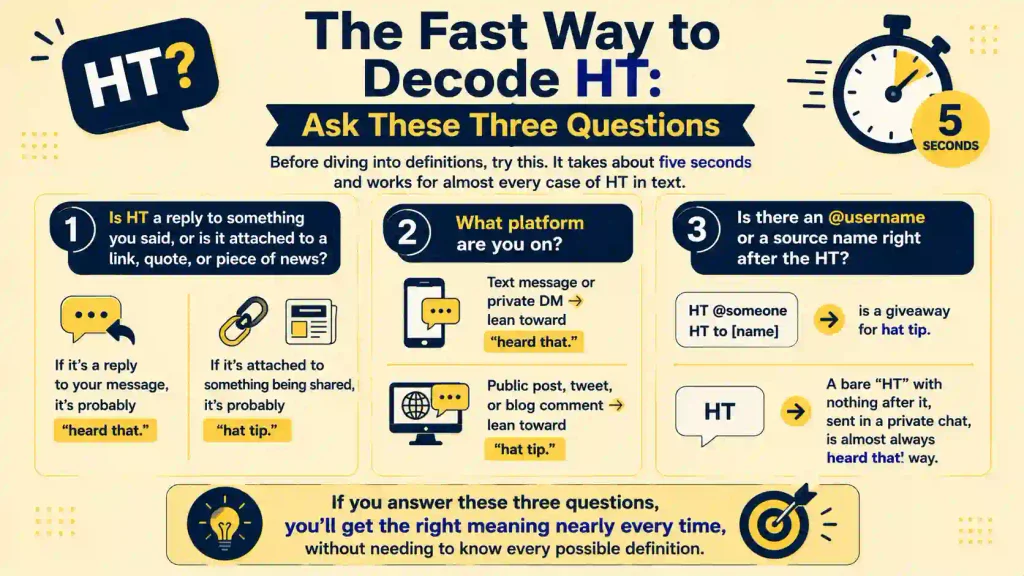
The Fast Way to Decode HT: Ask These Three Questions
Before diving into definitions, try this. It takes about five seconds and works for almost every case of HT Meaning in Text.
1. Is HT a reply to something you said, or is it attached to a link, quote, or piece of news?
If it’s a reply to your message, it’s probably “heard that.” If it’s attached to something being shared, it’s probably “hat tip.”
2. What platform are you on?
Text message or private DM → lean toward “heard that.” Public post, tweet, or blog comment → lean toward “hat tip.”
3. Is there an @username or a source name right after the HT?
“HT @someone” or “HT to [name]” is a giveaway for hat tip. A bare “HT” with nothing after it, sent in a private chat, is almost always heard that way.
If you answer these three questions, you’ll get the right meaning nearly every time, without needing to know every possible definition.
HT = “Heard That” (Everyday Texting)
This is the version you’ll run into most in one-on-one or group texts. It functions like “ok,” “got it,” or a thumbs-up reaction a low-effort way to confirm a message landed.
Examples:
- “Meeting moved to 3 pm.” → “HT”
- “Don’t forget to grab milk.” → “HT”
- “Running 10 minutes late.” → “HT, no worries”
Notice that none of these carry strong emotion either way. That’s the point of the abbreviation. It closes the loop on practical information without asking for more conversation. It’s not agreement, disagreement, or excitement. It’s just confirmation that the message was received.
HT = “Hat Tip” (Crediting a Source)
Outside of casual texting,HT Meaning in Text almost always works as a citation. Writers, tweeters, and Redditors use it to point at the person or account that gave them an idea, a link, or a piece of news, instead of taking credit themselves.
Examples:
- “Wild stat about remote work productivity (HT @dataguy)”
- “This recipe idea came from a Reddit thread, HT to the original poster”
- “Interesting take on the housing market, HT @journalist”
Why People Use It Instead of Just Saying “Thanks”
Two reasons, and both are practical rather than stylistic:
- It’s short. On platforms with character limits or a scannable feed, “HT @person” says in five characters what “I found this thanks to” says in twenty.
- It signals origin, not just gratitude. “Thanks” can mean almost anything. “HT” specifically means “this idea did not start with me; here’s who it started with.” That distinction matters more in journalism, blogging, and social media than in casual conversation, where getting credit for spotting something first is part of the culture.
If You’re Going to Use “HT” Yourself, Do It Properly
If you’re writing a post and want to credit a source with HT, a few small habits keep it clear and fair.using HT mening in text correctly builds trust just like cf meaning in text or wip meaning in text properly.
- Tag the actual account or name, not a vague “HT to whoever posted this.”
- Put it close to the claim it’s crediting, not buried at the very end of a long post where it’s easy to miss.
- If you got the information secondhand (someone else’s HT led you to it), credit the source if you can find it, not just the person who shared it with you.
- Don’t use HT Meaning in Text for something you found through basic searching yourself; save it for cases where someone specifically pointed you to it.
Skipping these doesn’t break any rule, but it’s the difference between a hat tip that reads as genuine credit and one that reads as an afterthought.
HT = “Hi There” (A Minor, Situational Use)
In some gaming lobbies and forums, people type “HT” as a quick greeting, usually when joining an ongoing conversation or match.
Example: “HT! Just hopped in, what did I miss?”
This use of HT Meaning in Text far less common than the other two, and it’s almost always obvious from context. It shows up at the start of someone joining a conversation, not as a reply in the middle of one.Think of it like sying hyy mening in text or WHY mening in text when you enter the group.
How the Meaning Shifts by Platform
| Platform | Likely meaning | Why |
| Text message / iMessage / WhatsApp | Heard that | Private, conversational, replying to a specific message |
| Twitter/X | Hat tip | Character limits and a culture of crediting sources |
| Hat tip | Same crediting culture, often written “HT to u/username” | |
| Blog posts and newsletters | Hat tip | Standard way to attribute where a story or idea came from |
| Instagram/TikTok captions | Hat tip (less frequent) | Crediting the original creator of a trend or photo |
| Gaming chats / Discord / forums | Hi there (occasional) | Used as a greeting when joining |
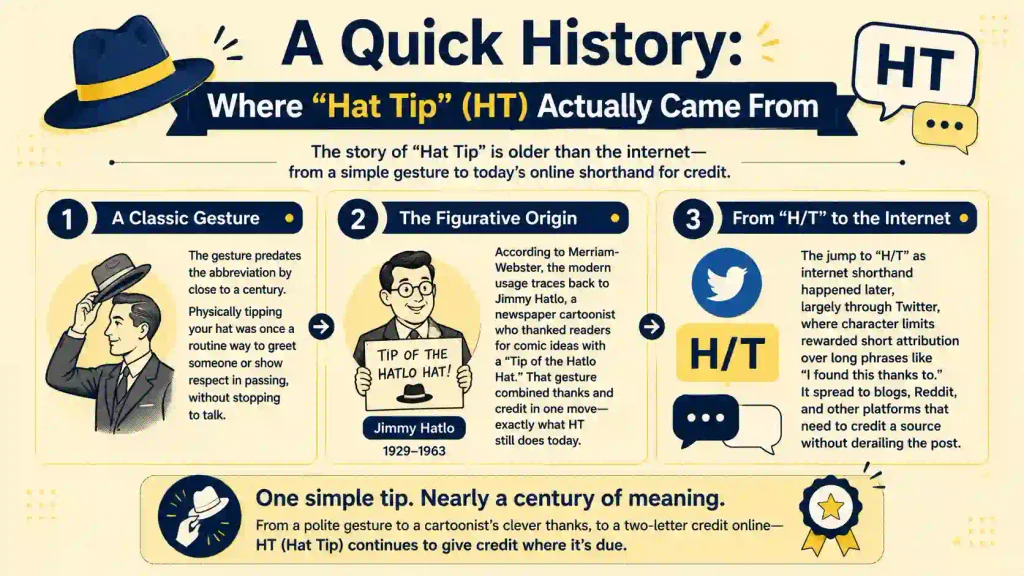
A Quick History: Where “Hat Tip” HT Meaning in Text Actually Came From
The gesture predates the abbreviation by close to a century. Physically tipping your hat was once a routine way to greet someone or show respect in passing, without stopping to talk.
The figurative phrase has a documented origin, too. According to Merriam-Webster, the modern usage traces back to Jimmy Hatlo, a newspaper cartoonist active from 1929 to 1963, who publicly thanked readers who sent him comic ideas with a “Tip of the Hatlo Hat.” That gesture combined thanks and credit in one move, which is exactly what the online HT Meaning in Text still does today.
The jump to “H/T” as internet shorthand happened later, largely through Twitter, where the platform’s old character limits rewarded short attribution over long phrases like “I found this thanks to.” Once it caught on there, it spread naturally to blogs, Reddit, and other text-based platforms that share the same need: crediting a source without derailing the post.
Is Getting an “HT” Text Rude?
Not inherently. But it can land as cold, and it’s worth understanding why.
HT is efficient by design. It confirms a message without adding warmth, humor, or elaboration. That’s genuinely useful for logistics (“running late,” “meeting moved”) where a full sentence back would be overkill. It becomes a problem only when it’s used as the entire reply to something that clearly needed more: a piece of good news, something upsetting, or a question that deserved an actual answer.
If you’ve sent something that mattered to you and got only “HT” back, it’s reasonable to feel a little brushed off. That reaction doesn’t necessarily mean the other person wasn’t paying attention. Short replies are often just a texting habit, not a judgment of your message. If it happens repeatedly in situations that call for more, it’s worth saying so directly rather than guessing at what it means.
Does It Mean Something Different Coming From a Specific Person?
No, despite what some quizzes or forum threads imply, “HT” doesn’t carry a hidden romantic or emotional signal based on who sends it. It’s the same acknowledgment whether it comes from a friend, a coworker, or someone you’re dating. What actually tells you something is the pattern: does this person always reply briefly, or is this a change from how they usually text you? The second case is worth noticing. The abbreviation itself isn’t.
How to Respond When Someone Sends You “HT”
Since HT is already an acknowledgment, you don’t owe a long reply. A few reasonable options:
- Leave it; the conversation may simply be over.
- Add one more short line if there’s a genuine next step (“HT, see you at 3 then”).
- Ask directly if you wanted more of a reaction and didn’t get one: “all good?” is enough to invite a fuller response without being confrontational.
Should You Use “HT” in Professional Messages?
Generally, no. The core problem is that HT is genuinely ambiguous outside of casual texting and social media; a colleague reading it in a work email has no reliable way to know if you mean “understood” or “credit goes to someone else.” In professional writing, that ambiguity costs more than the two seconds it saves.
Use the plain version instead:
| Instead of HT for… | Write |
| Acknowledging a message | “Noted” or “Got it, thanks” |
| Crediting an idea or source | “Credit to [name] for this” or “Thanks to [name] for flagging this” |
HT Compared to Similar Short Replies
| Abbreviation | Meaning | Typical use |
| HT | Heard that / Hat tip | Texting or crediting a source |
| RT | Retweet | Reposting content as-is |
| MT | Modified tweet | Reposting with small edits |
| TY | Thank you | General gratitude |
| NP | No problem | Casual acknowledgment |
| FYI | For your information | Sharing info, no reply expected |
| HTH | Hope that helps | Ending a helpful reply |
The clearest contrast is HT versus RT: an RT reposts someone’s content directly, while an HT credits them for an idea without repeating their exact words.
Uncommon Meanings Worth Knowing
Outside texting and social media, HT occasionally stands for something else entirely:
- Height: shorthand used in profiles, forms, or game character stats.
- Home time: British slang for the end of the workday or school day.
- Hold tight: older, now largely outdated texting shorthand for “wait a moment.”
These rarely show up in normal conversation, but if a message clearly isn’t about acknowledgment or credit, one of these may be the intended meaning.
Frequently Asked Questions
What does HT Meaning in Text message?
In texting,HT Meaning in Text almost always means “heard that” a short way of confirming you received and understood a message.
What does HT mean on Twitter or X?
On Twitter/X, HT (or H/T) means “hat tip.” It credits whoever originally shared the news, link, or idea being posted, usually written as “HT @username.”
Is HT the same as H/T?
Yes. “HT,” “H/T,” and “h/t” are the same abbreviation written with different punctuation. The meaning doesn’t change based on the formatting.
Is it rude to reply with just “HT”?
Not by default, but it can feel dismissive if it’s the only response to something emotionally significant. For routine logistics, it’s a perfectly normal reply.
Does HT mean something different depending on who sends it?
No. The abbreviation means the same thing regardless of who’s texting you. What matters more is whether it’s a change from how that person usually replies to you.
What’s the fastest way to tell which meaning is intended?
Check whether the HT is replying to your message (likely “heard that”) or attached to a shared link, story, or username (likely “hat tip”). That single check resolves most cases.
Key Takeaways
- HT Meaning in Text has two dominant meanings: “heard that” in texting, and “hat tip” (crediting a source) on social media and blogs.
- The fastest way to tell them apart: check if HT is replying to a message (heard that) or attached to a shared link or username (hat tip).
- A less common “hi there” greeting shows up mainly in gaming and forum chats.
- HT isn’t inherently rude, but it can read as cold when used as the sole reply to something significant.
- Avoid HT in professional writing spell out “noted” or “credit to [name]” instead, since the ambiguity isn’t worth the two characters saved.

Rachel is a passionate linguist and content writer with a love for the English language’s hidden nuances. With years of experience in teaching ESL students, she specializes in breaking down idioms and similes into simple, everyday examples. Her mission is to make English learning fun, not intimidating.