
HM Meaning in Text is just text shorthand for “hmm,” the sound people make when they pause to think. But the real meaning always lives in the context around it, not in the two letters themselves. This guide breaks down exactly how to read it, where it comes from, how punctuation and platform change its tone, and what actually to reply.
The Short Answer
HM Meaning in Text is a written version of “hmm,” the vocal sound people make when they pause to think.
In texting, it usually signals one of a few things: thinking, hesitation, mild doubt, quiet acknowledgment, or occasionally a soft, low-effort agreement. It is not an acronym and does not stand for a fixed phrase.
The tone of an HM message comes almost entirely from the context around it, not from the letters themselves.
| Aspect | Detail |
| Core meaning | Thinking, hesitation, or mild uncertainty |
| Word type | Interjection (a sound-word, not an acronym) |
| Full form | None it’s a shortened spelling of “hmm” |
| Typical tone | Neutral by default; shifts with context |
| Common platforms | WhatsApp, Snapchat, Instagram, TikTok, Discord, SMS |
| Formal alternate meanings | His/Her Majesty, HM Revenue & Customs, Honorable Mention |
Where HM Actually Comes From
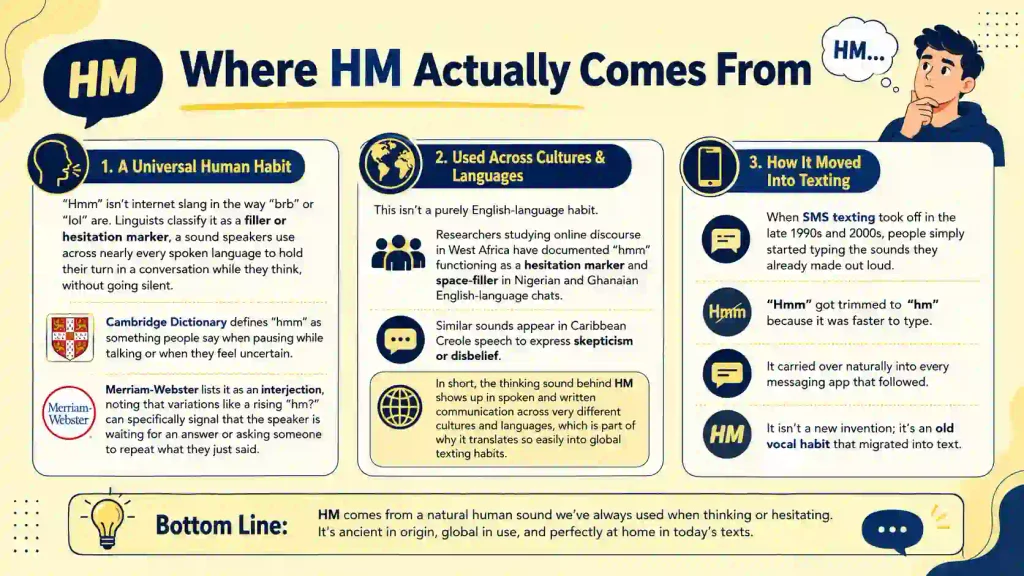
“Hmm” isn’t internet slang in the way “brb” or “lol” are. Linguists classify it as a filler or hesitation marker, a sound speakers use across nearly every spoken language to hold their turn in a conversation while they think, without going silent. Cambridge Dictionary defines “hmm” as something people say when pausing while talking or when they feel uncertain, and Merriam-Webster lists it as an interjection, noting that variations like a rising “hm?” can specifically signal that the speaker is waiting for an answer or asking someone to repeat what they just said.
What’s interesting is that this isn’t a purely English-language habit. Researchers studying online discourse in West Africa have documented “hmm” functioning as a hesitation marker and space-filler in Nigerian and Ghanaian English-language chats, and similar sounds appear in Caribbean Creole speech to express skepticism or disbelief. In other words, the thinking sound behind HM Meaning in Text shows up in spoken and written communication across very different cultures and languages, which is part of why it translates so easily into global texting habits rather than staying confined to one region or generation.
When SMS texting took off in the late 1990s and 2000s, people simply started typing the sounds they already made out loud. “Hmm” got trimmed to “hm” because it was faster to type, and it carried over naturally into every messaging app that followed. It isn’t a new invention; it’s an old vocal habit that migrated into text.
What HM Actually Signals in a Conversation
Because HM Meaning in Text Meaning in Text has no single fixed meaning, it’s more useful to think of it as a small set of possible signals. The words around it decides which one applies.same as how context decides HT meaning in text or WHG meaning in text.
Thinking or processing. The most common use. The sender needs a beat before answering.
“What should we get for dinner?”
“Hm, let me check what’s in the fridge.”
Uncertainty or mild doubt. The sender isn’t fully convinced by what you said.
“I really think he’s being honest.”
“Hm, I’m not so sure.”
Neutral acknowledgment. Roughly equivalent to “okay” or “I see,” with little emotional weight attached.
“I’ll be about 15 minutes late.”
“Hm.”
Mild distance or disapproval. A bare, standalone HM after something emotional or disappointing can read as cold, especially with no follow-up.
“I forgot to call you back last night.”
“Hm.”
Soft, low-energy agreement. Less common, but it happens when someone is fine with a plan but not enthusiastic about typing more.
“Let’s leave at six.”
“Hm, works for me.”
Notice that the same two letters appear in all five examples. What changes the reading each time is the sentence before it, not the word itself.
HM, HMM, and HMMM: Does Adding Letters Change Anything?
Yes, and this is one detail most quick guides skip over: length functions almost like punctuation in texting. Each added letter tends to signal more weight behind the thought.
- Hm: a light, quick reaction. Often used almost reflexively, without much behind it..Like replying p meaning in text or CF meaning in text.
- Hmm: a more deliberate pause. Suggests the person is actually turning something over in their head.
- Hmmm: stronger doubt, suspicion, or a longer moment of consideration. This version is far more likely to make the recipient feel judged or second-guessed.
How Punctuation Changes the Tone
Punctuation does more work in a two-letter message than almost anywhere else in texting, because there’s so little else to signal tone.
- “Hm.” with a period tends to read as flat, final, or slightly closed-off.
- “Hm…” with a trailing ellipsis reads as genuinely thoughtful, like the sender is still working something out.
- “Hm?” with a question mark usually means the sender wants clarification or is questioning what you just said; this lines up with how Merriam-Webster describes the rising, question-like use of the interjection.
- “Hm!” is rare, but when it appears, it usually signals surprise or a sudden realization rather than plain hesitation.
How HM Shows Up Differently Across Platforms
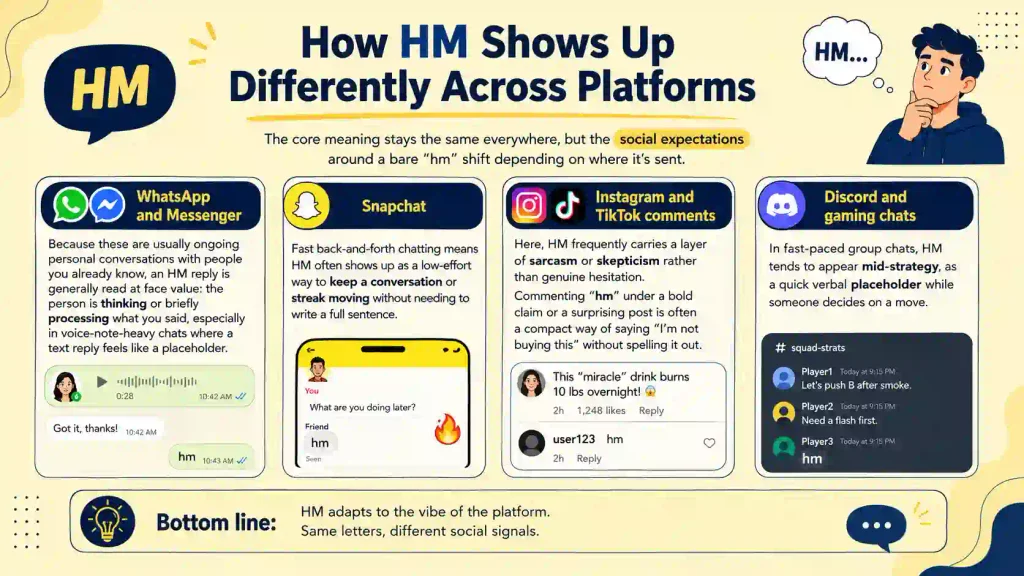
The core meaning stays the same everywhere, but the social expectations around a bare “hm” shift depending on where it’s sent.
WhatsApp and Messenger. Because these are usually ongoing personal conversations with people you already know, an HM reply is generally read at face value: the person is thinking or briefly processing what you said, especially in voice-note-heavy chats where a text reply feels like a placeholder.
Snapchat. Fast back-and-forth chatting means HM often shows up as a low-effort way to keep a conversation or streak moving without needing to write a full sentence.
Instagram and TikTok comments. Here, HM Meaning in Text frequently carries a layer of sarcasm or skepticism rather than genuine hesitation. Commenting “hm” under a bold claim or a surprising post is often a compact way of saying “I’m not buying this” without spelling it out.
Discord and gaming chats. In fast-paced group chats, HM tends to appear mid-strategy, as a quick verbal placeholder while someone decides on a move.
Is HM Rude, Cold, or Flirty? A Practical Way to Check
Instead of guessing, it helps to run through a short checklist, because tone in a two-letter word is almost entirely contextual.
- What came right before it? A warm conversation tends to keep its warmth through an HM. A tense one tends to keep its tension.
- Does more follow, or does it just stop there? “Hm, actually that reminds me…” reads completely differently from “hm” with nothing after it for twenty minutes.
- How quickly did it arrive? A near-instant HM in an active chat usually just means quick, casual acknowledgment. A slow HM Meaning in Text after a long gap can suggest discomfort or hesitation about how to respond.
- Has this happened before, repeatedly? One HM is rarely meaningful. The same flat reply showing up again and again, especially to things that deserved more, is a much stronger signal of real disengagement.
- What’s the relationship? A close friend’s HM and a new match’s HM don’t carry the same social weight, even if the words are identical.
How to Reply When Someone Sends You Just “HM”
Matching your reply to what you think they meant keeps the conversation moving instead of stalling out.
- If they seem unsure: “Take your time, no rush.”
- If you want to invite more: “What are you thinking?”
- If something seemed to confuse them: “Want me to explain that differently?”
- If it felt distant or off: “Everything okay?”
- If the mood is playful: “That’s a suspicious ‘hm’ 👀”
When to Avoid Sending a Bare HM
HM is fine for casual, low-stakes texting, but it works against you in a few specific situations:
- Anything urgent. A vague pause reply slows down decisions that need a clear answer.
- Emotional or vulnerable moments. If someone shares something difficult and gets a bare “hm” back, it can land as dismissive even if that wasn’t the intent.
- Formal or work instructions. If your manager asks you to confirm a deadline, “hm” signals uncertainty you probably don’t want to project.
- New or early conversations. People you’ve just started talking to don’t have enough context with you yet to read an ambiguous reply generously.
- Conversations with older relatives or in family group chats. Text-shorthand habits aren’t always shared across generations, so a reply that reads as neutral to you might read as cold or confusing to someone else.
Other Meanings of HM (Outside of Texting)
A handful of other, well-established meanings exist outside casual chat, and it’s worth knowing them so you’re not caught off guard in a different context:
- His Majesty / Her Majesty: used in formal and royal writing, typically placed before a monarch’s name.
- HM Revenue & Customs (HMRC): the United Kingdom’s tax authority.
- Honorable Mention: used in contests, awards, and rankings, just below the top placements.
- Heavy Metal: shorthand used in some music discussions and forums.
- Home Minister: a government title used in several countries.
- Hectometre: a metric unit equal to 100 meters, used in some technical or scientific contexts.
Common Myths About HM, Cleared Up
“HM always means someone is upset.” Not true. Most of the time it simply signals a pause for thought, with no negative charge attached.
“HM is an official acronym.”HM Meaning in Text isn’t. There’s no fixed phrase it stands for in everyday texting; it’s a spelled-out sound, not an abbreviation of words.
“HM always signals disinterest.” Also not accurate. Interest or disinterest comes from the surrounding conversation and follow-up messages, not from the letters “hm” in isolation.
“Only younger people use HM.” People across age groups use hesitation sounds like this in text; what differs more is how each generation interprets tone and punctuation, not whether they use the word at all.
FAQs
What does HM Meaning in Text message?
It’s short for “hmm,” the sound people make when pausing to think. It signals hesitation, consideration, or mild uncertainty, and its exact tone depends on the messages sent around it.
Is HM rude?
Not inherently. It usually reads as neutral. It can feel dismissive when it’s the only reply to something emotional or urgent, but that’s about context, not the word itself.
What’s the difference between HM, HMM, and HMMM?
HM is the lightest, quickest version. HMM suggests a more deliberate pause. HMMM tends to signal stronger doubt or suspicion. Extra letters generally add emotional weight to the message.
Does HM mean yes or no?
Neither. It signals that the person is still deciding rather than giving a direct answer. Look at what follows it for a clearer read.
Is HM flirty?
Not by default. HM Meaning in Text can read as flirty only when it’s paired with playful emojis or a teasing tone that already existed earlier in the conversation. On its own, it’s neutral.
Does HM mean something different depending on who sends it?
The core meaning stays the same regardless of gender. What actually shifts the tone is the relationship between the two people and the conversation’s overall mood, not who typed the message.
Can HM mean something other than “hmm”?
Yes, but only in specific formal contexts, for example, “His Majesty” in royal writing or “Honorable Mention” in competitions. In casual texting, those meanings rarely apply.
The Bottom Line
HM Meaning in Text will show up in your messages again, probably soon. The two letters themselves don’t carry a fixed verdict; they’re a placeholder for a thought still forming. What actually tells you the meaning is everything around it: the conversation’s tone before it arrived, the punctuation attached to it, how quickly it showed up, and whether anything followed. Read those signals together, and a message that once felt impossible to interpret becomes something you can read with real confidence.
Read More Blogs:
- IFL Meaning in Text: The Essential Mistake to Avoid in 2026
- HT Meaning in Text: Avoid This Common Mistake (2026)

Rachel is a passionate linguist and content writer with a love for the English language’s hidden nuances. With years of experience in teaching ESL students, she specializes in breaking down idioms and similes into simple, everyday examples. Her mission is to make English learning fun, not intimidating.