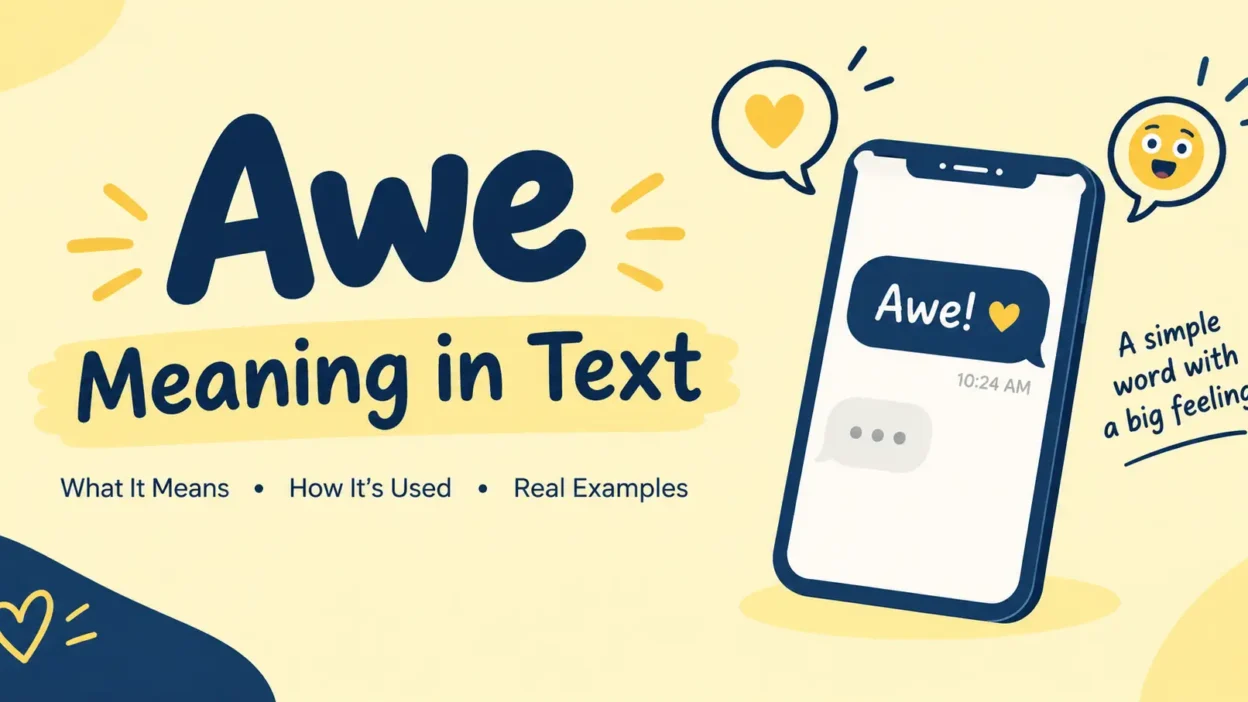
In texting, “awe” almost always stands in for “aww,” a soft reaction to something cute, kind, or touching. But that’s not the whole story, and treating it as a fixed rule will get you the wrong read more often than you’d think.
The real Awe Meaning in Text depends on where the word landed in the conversation, what came right before it, and a few small details most people never think to check.
This guide breaks down what “awe” means in a text, how it differs from the dictionary word “awe” and the interjection “aww,” why your phone keeps swapping one for the other, and, unlike most explainers on this topic, what’s actually going on emotionally when someone uses it. That last part comes from real research into awe as an emotion, and it explains a few things that pure slang guides can’t.
The Quick Answer
When someone texts “awe” by itself, they’re reacting to something you said, sent, or did. It’s a stand-in for “aww,” used to express:
- Warmth (“Awe, that’s so kind of you”)
- Sympathy (“Awe, I’m sorry you’re dealing with that”)
- Admiration for something cute or sweet (“Awe, your niece is precious”)
- Occasionally, a flat or sarcastic brush-off (“Awe. Okay.”)
It is a reaction, not a request for information and not really a full thought. That’s part of why it’s so easy to misread; there’s no sentence structure to lean on, just tone.
“Awe” vs. “Aww” vs. “Aw”: The Actual Difference
These three look and sound almost identical, but when it comes to awe meaning in text, only one of them is a real dictionary word.
Awe (noun or verb) means a powerful feeling of wonder, reverence, or amazement, usually toward something that feels bigger than you: a landscape, an achievement, a piece of music. “She watched the eclipse in awe.” As a verb: “The performance awed the audience.” This is the version you’d find in a novel or a news article, and it’s the one recognized by dictionaries like Merriam-Webster.
Aww (interjection) isn’t a formal word at all; it’s a written-out sound, the text equivalent of cooing at something cute. “Aww, your dog is adorable.” It functions more like “oh” or “wow” than like a noun describing an emotion.
Aw (interjection, one w) usually leans toward mild sympathy or disappointment. “Aw, that’s a bummer” or “Aw, I’m sorry that happened.”
| Word | Type | What it expresses | Example |
| Awe | Noun / verb | Deep wonder or reverence | “I was in awe of the view.” |
| Aww | Interjection | Reaction to something cute or touching | “Aww, that’s adorable.” |
| Aw | Interjection | Mild sympathy or disappointment | “Aw, that stinks.” |
In practice, almost nobody texting “awe” means the dictionary definition. They mean “aww,” and the spelling just didn’t come out that way, which brings up the autocorrect question everyone asks when trying to understand text meanings.
Why Your Phone Keeps Turning “Aww” Into “Awe”
This mix-up isn’t really a typing mistake. It’s a side effect of how phone dictionaries work. “Awe” is a recognized English word, so keyboards leave it alone. “Aww” isn’t in most standard dictionaries, so some keyboards’ autocorrect or spell-check features are more likely to flag or “fix” it, especially the first time you type it on a given device.
That’s why understanding awe meaning in text is tricky. Autocorrect behavior varies by phone, keyboard app, language settings, and how many times you’ve typed “aww” before (most keyboards learn from repetition).
If you want to stop the swap on an iPhone, you can add “aww” to your Text Replacement list in Settings so it never gets flagged again; on Android, tapping the suggested correction to reject it a few times usually trains the keyboard to leave it as-is.
Either way, the result is the same in practice: when you see “awe” in a casual text, don’t assume the sender meant the dictionary word. Assume “aww” first, then check the context to confirm.
In casual texting, people often use SZN and LJS alongside reactions like “aww” or “awe,” depending on the conversation and their usual texting style. Understanding the Awe Meaning in Text therefore requires looking at the words around it rather than assuming that every short reaction has the same meaning. The tone, message, and relationship between the people texting can all help you understand what the sender actually meant.
Where “Awe Meaning in Text” Comes From
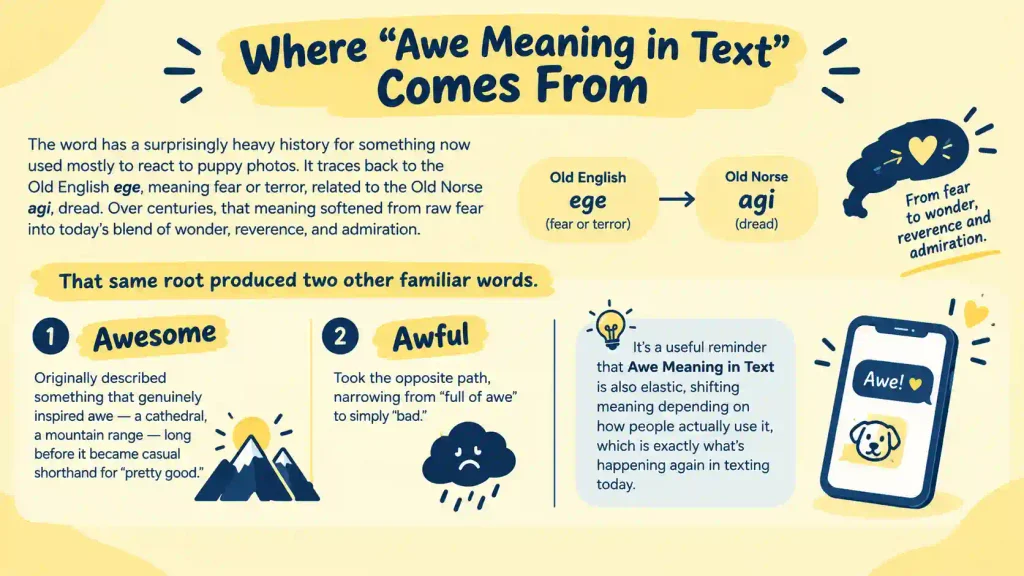
The word has a surprisingly heavy history for something now used mostly to react to puppy photos. It traces back to the Old English ege, meaning fear or terror, related to the Old Norse agi, dread. Over centuries, that meaning softened from raw fear into today’s blend of wonder, reverence, and admiration.
That same root produced two other familiar words. “Awesome” originally described something that genuinely inspired awe a cathedral, a mountain range long before it became casual shorthand for “pretty good.” “Awful” took the opposite path, narrowing from “full of awe” to simply “bad.” It’s a useful reminder that Awe Meaning in Text is also elastic, shifting meaning depending on how people actually use it, which is exactly what’s happening again in texting today.
The Psychology Behind Why We Text “Awe” So Often
Here’s something most guides to this word skip entirely: awe isn’t just internet slang; it’s one of the more studied human emotions in modern psychology, and understanding the real emotion helps explain why the texting version spreads the way it does.
Psychologist Dacher Keltner, who directs the Greater Good Science Center at UC Berkeley, has spent years researching awe specifically. He and colleague Jonathan Haidt describe it as the feeling of encountering something vast that doesn’t immediately fit your existing understanding of the world something that makes you feel smaller and more connected to something bigger at the same time.
Their research has found that Awe Meaning in Text is unusual among emotions because it can be triggered by an enormous range of things: nature, live music, a moving story, even watching someone act with unexpected kindness. Studies from this research area have also linked frequent awe experiences to lower inflammation markers and greater reported well-being weeks later.
The texting version of “awe” is obviously a much smaller, quicker thing than standing at the edge of the Grand Canyon. But it taps the same basic instinct: something just registered as touching, impressive, or bigger than a normal moment, and the brain’s shorthand for that is the same word psychologists use for the full-scale experience. That’s part of why “awe” feels warmer than a plain “ok” or “nice”; it’s borrowing language from one of the more emotionally loaded words in English, even in its most casual, three-letter form.
How “Awe Meaning in Text” Shows Up on Different Apps
The word doesn’t behave identically everywhere.
Instagram comments tend to use it short and paired with a compliment: “Awe, you two are the cutest” under a couple’s photo, or a single “awe 🥹” under a pet post.
TikTok comments often stretch it for effect: “aweee,” “awwww,” or “aweeee stop.” The extra letters signal extra emotion, almost always positive, usually reacting to something wholesome or funny.
Snapchat and WhatsApp see the most spelling variation. People type fast and don’t correct themselves, so “awe,” “aww,” and even “awh” can all show up in the same thread meaning the same thing. On WhatsApp specifically, it shows up constantly in family group chats reacting to baby photos, milestones, and good news.
Dating apps are where the word carries the most weight. If someone shares something a little vulnerable a childhood memory, a nervous confession and gets an “aww, that’s really sweet” back, it usually reads as genuine warmth, sometimes early interest, not just politeness.
How to Actually Read the Tone (A Practical Framework)
Most explanations of this word just list examples and hope you pattern-match. It’s more useful to check a few concrete signals in order:
1. What came directly before it? “Awe” after a compliment, a cute photo, or good news is almost always warm. “Awe” after you cancelled plans or said something awkward is more likely flat or sarcastic.This is the first clue for awe meaning in text.
2. Is there punctuation? A period, “Awe.”, reads noticeably colder than no punctuation or an exclamation point. In text, a hard stop often signals the sender is done engaging, not that they’re delighted.
3. Are there extra letters or emoji? “Aweee,” “awwww,” or “awe 🥺🤍” almost always mean more warmth, not less. Bare, unadorned “awe” with nothing else is the version most likely to be ambiguous or mildly dismissive.
4. How fast did they respond, and what came after? A quick “awe” followed by more conversation is a good sign. A slow “awe” that ends the exchange is a soft signal the person is disengaging, regardless of how sweet the word looks on its own.
5. What’s the relationship and history? The same “awe” from a close friend, a parent, and a new match can mean three different things. If you’re unsure, weigh it against how that specific person has used the word with you before.
None of these signals is definitive on its own. Tone in text is genuinely hard to read because there’s no voice behind it, but checking them together gets you much closer to the real meaning than reading the word in isolation.
How to Reply When Someone Texts You “Awe”
Since “awe” is a reaction rather than a question, most replies just need to match the tone back rather than answer anything specific.
Casual: “Haha thanks!” · “You’re too sweet.” · “Glad you liked it!”
Playful: “I know, I’m adorable.” · “Finally, someone appreciates me.”
Possibly flirty (dating context): “Yeah? Tell me more.” · A simple 🥹 or 🩷 back often works better than words.
Professional: “Thank you, I appreciate that.” · “That means a lot, thanks.”
If the “awe” felt cold or sarcastic based on the context, a neutral follow-up question (“everything okay?”) is usually more useful than trying to match a warmth that might not be there.
What “AWE” Means as an Acronym (Not the Emotion)
Written in all capitals, “AWE” is sometimes an acronym rather than the feeling word, and the two are usually easy to tell apart from context alone.
In science: NASA has used Awe Meaning in Text as the name for its Atmospheric Waves Experiment, a mission studying wave patterns in Earth’s upper atmosphere. This is a specific, named project, not a general scientific term.
In medical and aviation contexts: AWE occasionally appears as internal shorthand inside specific hospital systems, charts, research papers, or company documentation. There’s no single standardized meaning in either field; it depends entirely on the organization using it, so the surrounding document is the only reliable way to confirm what it stands for.
The practical rule: if you see “AWE” in capital letters inside a technical or professional document, treat it as a likely acronym and check the surrounding text or a glossary specific to that organization, rather than assuming it means the emotion.
Related Slang You’ll See Alongside It
“Awe” often shows up next to other short reaction words in the same conversations:
| Slang | Meaning |
| OMG | Oh my god surprise or excitement |
| NGL | Not gonna lie |
| FR | For real |
| Lowkey / Highkey | Subtly true / obviously true |
| Bet | Okay, agreed |
| Mood | Something very relatable |
Recognizing a few of these makes it easier to read a whole exchange rather than fixating on a single word.
Frequently Asked Questions
What does Awe Meaning in Text when a girl texts it?
Almost always the same as “aww”: a warm reaction to something sweet, kind, or thoughtful. Whether it leans platonic or flirty depends entirely on context, emojis, and what was said right before it, not on the word itself.
Is “awe” the same as “aww”?
Not technically. “Awe” is a real dictionary word for wonder or reverence, while “aww” is an informal interjection for something cute or touching. In everyday texting, though, people use them interchangeably, usually because of autocorrect.
Why does my phone keep changing “aww” to “awe”?
Because “awe” is a recognized dictionary word and “aww” typically isn’t, some keyboards are more likely to auto-correct the second into the first. You can usually stop this by adding “aww” as a custom text replacement or teaching your keyboard to accept it after a few corrections.
Can “awe” be sarcastic?
Yes. A short, standalone “Awe.” with a period, especially with no emoji and no follow-up, can come across as flat or dismissive particularly if the conversation already felt tense before it appeared.
Is it ever used outside of casual texting?
Yes, though the capitalized version “Awe Meaning in Text” usually functions as an acronym in specific fields, such as NASA’s Atmospheric Waves Experiment, rather than the emotion word.
What’s the best way to respond to “awe” from someone I’m interested in?
Match their energy rather than overanalyzing the single word. If they added emojis or extra letters, it’s a good sign to keep the conversation going with a light follow-up rather than a one-word reply of your own.
The Bottom Line
“Awe” is a small word doing a lot of work in modern texting. Most of the time, it’s simply a shorter, autocorrect-influenced version of “aww,” a quick, genuine reaction to something warm, sweet, or impressive. The skill isn’t memorizing every possible meaning; it’s learning to read the handful of signals around it: what came before, whether there’s punctuation or extra letters, how quickly the reply came, and who’s sending it. Do that, and three letters stop being confusing.
Read More: LJS Meaning in Government: The Complete Guide to Law and Justice Sector (2026)

Rachel is a passionate linguist and content writer with a love for the English language’s hidden nuances. With years of experience in teaching ESL students, she specializes in breaking down idioms and similes into simple, everyday examples. Her mission is to make English learning fun, not intimidating.