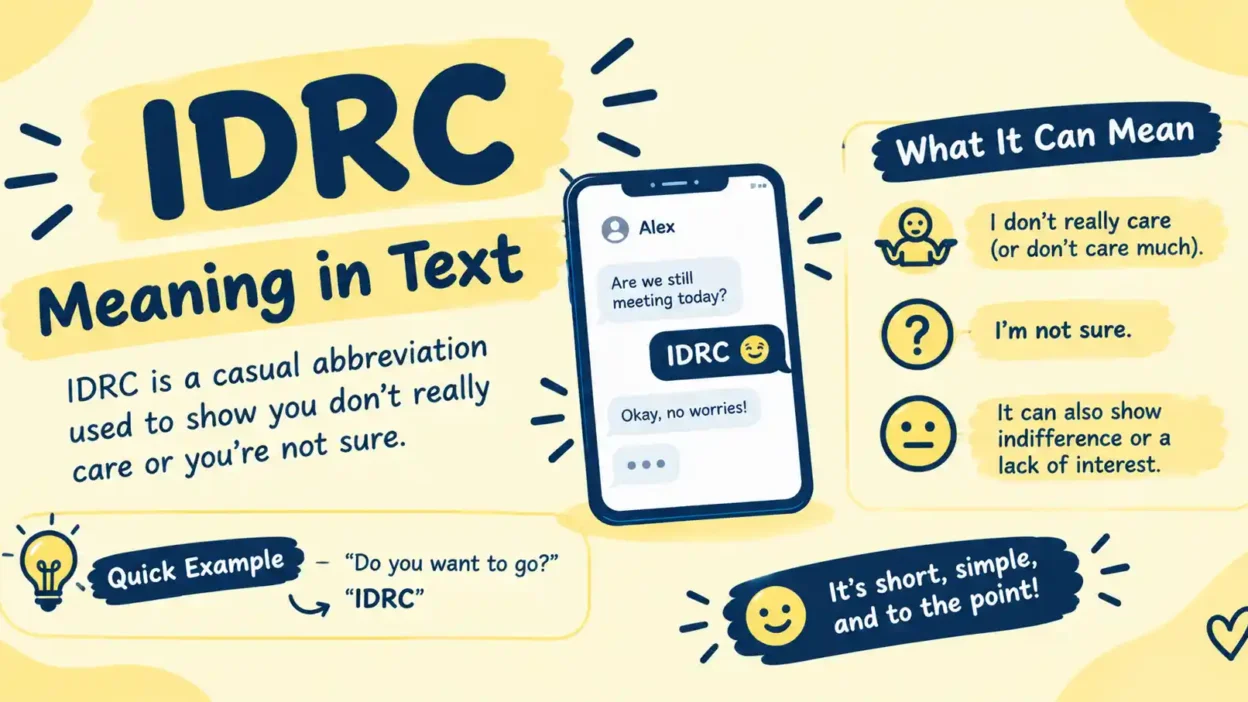
IDRC Meaning in Text means “I don’t really care,” and most of the time it’s exactly as harmless as it looks: someone telling you they’re flexible about the outcome. But the same abbreviation can also come across as cold or dismissive, depending on timing, platform, and what was said right before it. This guide covers what IDRC means, how it differs from similar phrases like IDC and IDK, how to tell a relaxed “idrc” from a not-so-relaxed one, and what to say back once you’ve sent or received one.
Quick Answer
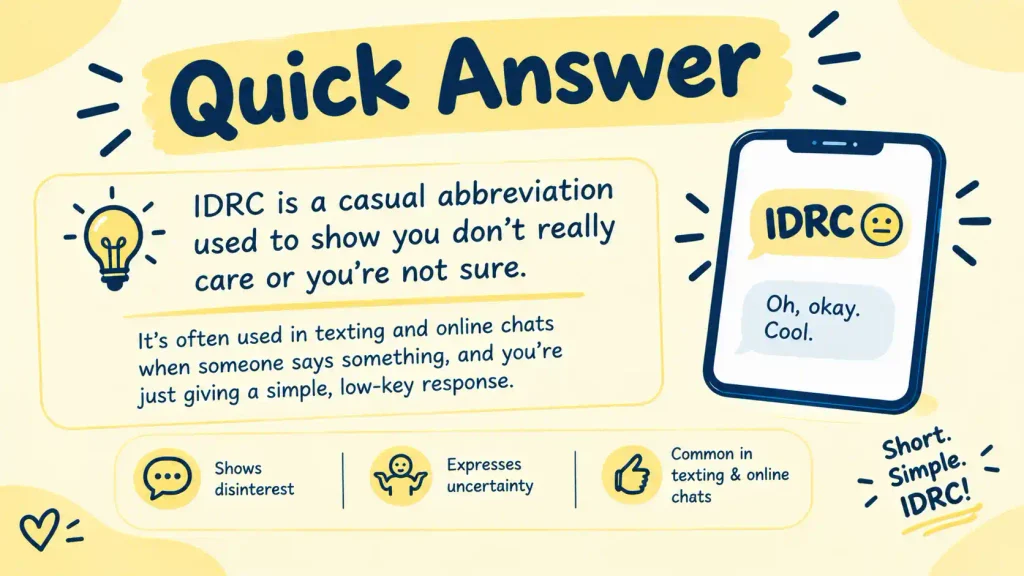
IDRC stands for “I don’t really care.” It’s used when someone is fine with more than one outcome and doesn’t want to make the decision themselves, not usually because they’re upset or trying to shut a conversation down.
Broken down: I–I, D–Don’t, R–Really, C–Care.
The word doing the most work is “really.” Drop it, and you get “I don’t care,” which reads as final and cold. Keep it, and you get something softer, closer to “either option works” than “I have no interest at all.” That’s why IDRC Meaning in Text has become the more commonly typed version, even though IDC saves a letter.
Is IDRC in the dictionary?
Not in the major standard dictionaries; you won’t find it in Merriam-Webster or Cambridge, which generally wait for sustained, widespread use before adding a term. Internet-slang references like Your Dictionary do list it, which is typical for abbreviations that live mostly in texting rather than formal writing. IDRC Meaning in Text is well-established slang; it just hasn’t crossed the bar general dictionaries use. There’s also no single confirmed inventor like IDK and TBH; it most likely spread simply because it’s faster to type than the full sentence.
IDRC vs. IDC vs. IDK vs. Similar Phrases
People mix these up constantly, but they’re not interchangeable:
| IDRC | I don’t really care | Flexible, low-stakes, open to either option |
| IDC | I don’t care | More blunt; can land harder than intended |
| IDK | I don’t know | Lack of information, not indifference |
| Whatever | (no expansion) | Frequently reads as dismissive |
| Up to you | (no expansion) | Polite, clearly hands over the decision |
| No preference | (no expansion) | Neutral and slightly more formal |
If you’re deciding between IDC and IDRC and don’t want to risk sounding cold, IDRC is the safer pick; it says the same thing with less edge.
Reading the Tone: A Three-Part Check
Most guides on this topic tell you “context matters” and leave it there. That’s true, but it’s not something you can actually use. Here’s a more concrete way to check tone before you assume the worst or the best.
1. What came right before it?
If the message before “idrc” was low-stakes, like where to eat or what to watch, the reply is almost certainly neutral. If it followed something emotional or a disagreement, the same three letters carry a lot more weight.
2. Is there anything softening it?
idrc, up to you 😊” and a bare “idrc” aren’t the same message. A softener, an emoji, “hm,” “lol,” or a follow-up is a reliable sign the reply is meant lightly.. Its absence doesn’t prove a bad mood, but it does leave the reader nothing to go on but their own assumptions.
3. Does it match how this person usually texts?
This matters more than the other two, and it’s the one most explainers skip. Some people default to short, clipped replies; for them, “idrc” is just normal texting. If someone who usually sends full sentences suddenly replies with a flat “idrc,” that shift is the real signal.
Two versions of the same three letters
Seeing this side by side makes the difference easier to spot than any explanation of it:
A: pizza or sushi tonight?
B: idrc, both sound good lol
A: I think we need to talk about what happened yesterday
B: idrc
Same abbreviation, same spelling, completely different situation. The first is a relaxed answer to a genuinely low-stakes question. The second, sent cold with no punctuation right after someone raises a real issue, reads as shutting the conversation down, whether or not that’s what B meant.
Where IDRC Meaning in Text Shows Up and Why the Platform Changes the Meaning
The same three letters read differently depending on where they land.
- One-on-one texts and iMessage carry the most weight here, since there’s no group diluting the tone.
- Group chats usually just mean someone’s happy to go along with whatever the group decides; it comes across as agreeable, not distant.
- TikTok and Instagram comments are often a way to acknowledge disagreement without escalating it, rather than keep debating a stranger.
- Discord and gaming chats show up around small in-game calls where speed matters more than discussion.
- Snapchat and fast-moving DMs are often paired with humor, closer to a running joke than a genuine statement of indifference.
When IDRC Meaning in Text Can Actually Come Across as Rude
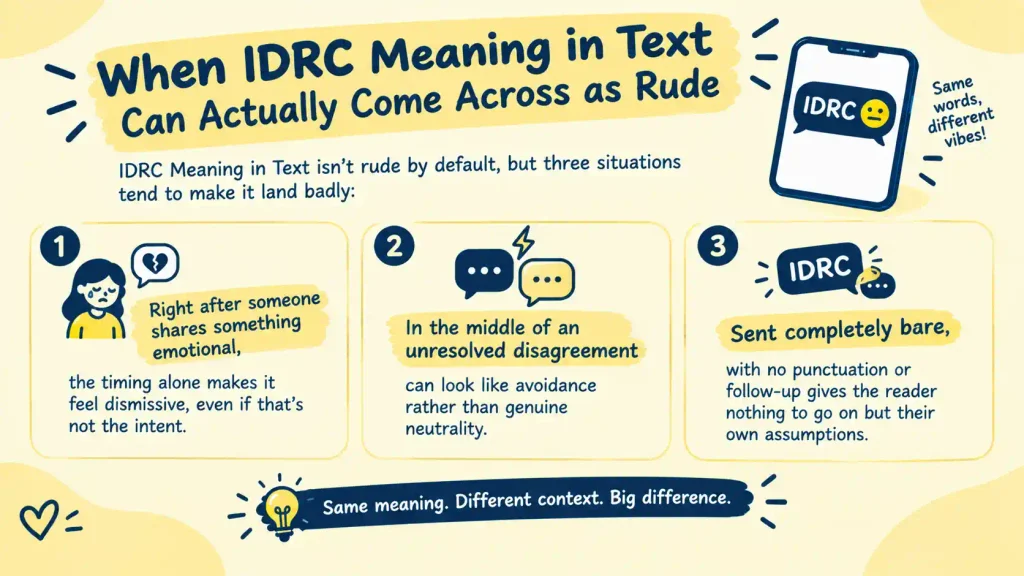
IDRC Meaning in Text isn’t rude by default, but three situations tend to make it land badly:
- Right after someone shares something emotional, the timing alone makes it feel dismissive, even if that’s not the intent.
- In the middle of an unresolved disagreement can look like avoidance rather than genuine neutrality.
- Sent completely bare, with no punctuation or follow-up gives the reader nothing to go on but their own assumptions.
Outside those situations, IDRC is almost always read as casual and low-stakes.
How to Reply When Someone Sends You “IDRC”
This is the part most guides skip, and it’s usually the more useful question.
- Reads as genuinely neutral: Just make the decision: “ok cool, let’s do [X]” keeps things moving.
- Not sure if they actually care: Ask directly, “You sure? I don’t mind switching” gives them an easy opening.
- Followed by something personal or emotional: Don’t take it at face value. “No worries either way, but are you doing okay?” separates the small decision from the bigger issue.
- Came after an argument: A flat “idrc” often means “I don’t want to keep fighting about this detail,” not “I’m over the whole issue.” Check with “okay, but are we good?”
- You’re sending it yourself: A quick softener, “idrc, whatever’s easiest” or “idrc lol, your call,” removes most of the ambiguity for the other person.
Common Variations and What Each One Adds
Plain “idrc” leaves one thing open: how seriously to take it. These add-ons close that gap:
- idrc tbh frames it as an honest admission rather than a brush-off
- idrc lol softens it with humor
- idrc rn makes it temporary (“right now,” not a permanent stance)
- idrc anymore signals a change over time, often after losing interest in something
- idrc either way explicitly confirms both options are genuinely fine
- idrc fr adds emphasis, meaning it more sincerely (“for real”)
- idrc ngl frames it as a candid, slightly reluctant admission (“not gonna lie”)
None of these change the core meaning. They all exist to answer the one question the plain version doesn’t: how much weight should the reader put on it.
Should You Use IDRC Meaning in Text at Work?
No. IDRC is still too casual for professional messages, and it risks making you sound disengaged in writing, where there’s no tone of voice to soften it.
| idrc | “I’m fine with either option.” |
| idrc tbh | “I don’t have a strong preference either way.” |
| idrc either way | “Both options work well for me.” |
| idrc what happens | “I’ll support whatever the team decides.” |
Is Frequent IDRC a Sign of a Bigger Problem in a Relationship?
Usually not on its own; most of the time it just means someone is genuinely flexible about something small. It’s worth paying attention if it becomes the go-to response specifically to things that matter to you, like plans you’re excited about or a feeling you’re trying to share. In that pattern, the issue usually isn’t the three letters; it’s a broader gap in engagement worth raising directly.
Frequently Asked Questions
Is IDRC Meaning in Text rude?
Not inherently. It usually reads as relaxed when it answers a low-stakes question, and rude mainly when it follows something emotional or ends an unresolved argument.
What’s the difference between IDC and IDRC?
IDC (“I don’t care”) is more blunt. The word “really” in IDRC makes it noticeably gentler, which is why most people default to it in casual conversation.
Can I use IDRC Meaning in Text in a work email?
It’s best to avoid it. “I don’t have a strong preference either way” says the same thing in a workplace-appropriate tone.
Does IDRC mean someone doesn’t care about me?
Usually not; it typically applies to one specific, low-stakes decision, not the relationship as a whole. It’s worth discussing directly if it keeps showing up for things that matter to you.
Why do people say IDRC instead of just “I don’t care”?
It lets someone express indifference quickly while sounding less final, fitting the casual, low-friction tone most texting is built around.
Does IDRC mean anything outside of texting slang?
Yes, it’s also used by real organizations, including Canada’s International Development Research Centre. In everyday texting, though, it almost always means “I don’t really care.”
Does capitalization or punctuation change the meaning?
Not the core meaning, but a capitalized “IDRC.” followed by a period can feel more final, while a lowercase “idrc” paired with an emoji feels more casual. It’s a minor signal, not a rule.
The Bottom Line
IDRC means “I don’t really care,” but the letters only tell you what was typed, not what was meant. Checking what came before it, whether anything softens it, and whether it matches how that person normally texts will get you a far more reliable read than trying to interpret three letters in isolation.
Used well, it keeps small decisions moving without unnecessary back-and-forth. Used right after something personal, or to end an argument, it can land harder than intended. And if you’re the one sending it, adding a single soft word, “lol,” “either way,” or an emoji costs almost nothing and removes most of the guesswork for whoever’s reading it.
Read More: LYR Meaning in Text: The Essential Mistake to Avoid in 2026

Rachel is a passionate linguist and content writer with a love for the English language’s hidden nuances. With years of experience in teaching ESL students, she specializes in breaking down idioms and similes into simple, everyday examples. Her mission is to make English learning fun, not intimidating.