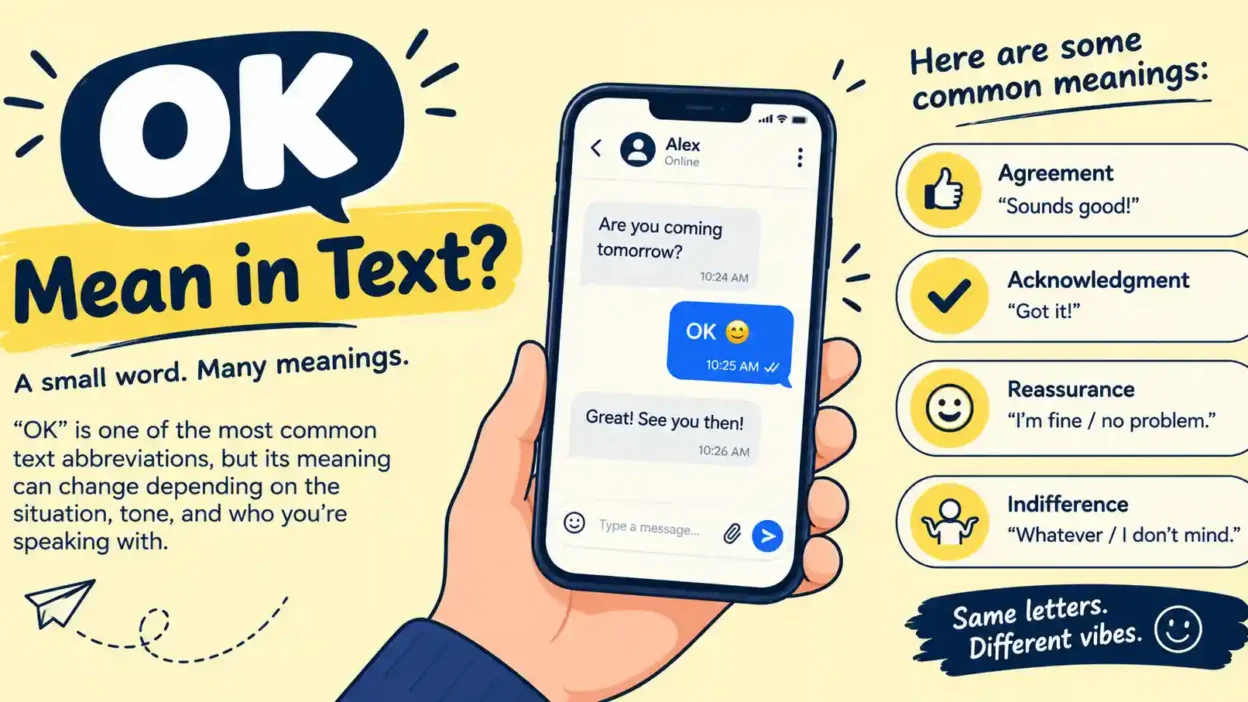
OK, on its own, rarely means anything is wrong. It’s one of the oldest and most efficient words in English for saying “I understand” or “that works for me.” What actually carries emotional weight in a text isn’t the word; it’s the punctuation around it, and there’s real research explaining why. This article covers what OK Mean in Text truly means, where it came from, and how to read the difference between a neutral “OK” and one that’s quietly signaling something more.
The Quick Answer
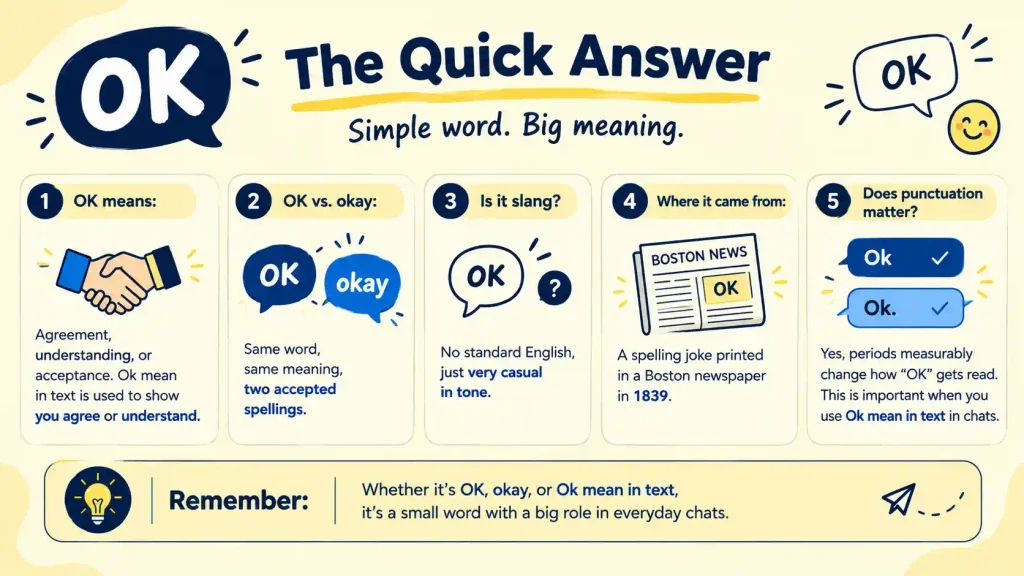
- OK means: agreement, understanding, or acceptance. Ok mean in text is used to show you agree or understand.
- OK vs. okay: same word, same meaning, two accepted spellings
- Is it slang? No standard English, just very casual in tone
- Where it came from: a spelling joke printed in a Boston newspaper in 1839
- Does punctuation matter? Yes, periods measurably change how “OK” gets read. This is important when you use Ok mean in text in chats.
What “OK” Actually Means
Dictionaries define OK simply: approval, agreement, or that something is satisfactory. It can work as several parts of speech: an interjection (“OK, let’s go”), an adjective (“the food was OK”), a noun (“give it your OK”), or a verb (“she OK’d the request”). In texting, OK Mean in Text almost always the interjection: a quick stamp of approval or acknowledgment, whether replying to a plan (“Meet me at 6”), a request (“Can you send that file?”), or an update (“Running 10 minutes late”). In each case, “OK Mean in Text” is doing one job: closing the loop on the message it’s replying to.
Is OK Slang?
No. OK is standard English, listed in every major dictionary, and predates texting, the internet, and mobile phones by well over a century. What makes it feel like slang is simply how casually and constantly it gets typed.
OK vs. Okay vs. O.K. Which One Is Correct?
All three are accepted spellings of the same word, and none changes the meaning; the difference is purely formality and personal style. What surprises most people is which one came first: OK is the original form; okay came later, as a phonetic, spelled-out version of it. It’s a common assumption that “okay” is the “real” word and “OK” is a lazy shortcut, but historically that’s backward. The punctuated form, “O.K.,” is now considered outdated. For formal writing, “OK” is generally the safer choice; it’s what the AP Stylebook recommends over “okay,” though both spellings remain grammatically correct.
Where Did “OK” Actually Come From?
A Newspaper Joke From March 1839
In the late 1830s, a fad swept through Boston newspapers: writers took common phrases, deliberately misspelled them, then abbreviated the misspelling as a 19th-century inside joke. “All right” became “O.W.” (“oll wright”), and “all correct” became “O.K.,” short for “oll korrect.” The word first appeared in print on March 23, 1839, in the Boston Morning Post, in a satirical piece by editor Charles Gordon Greene poking fun at a rival paper. It was meant as a throwaway joke, not a serious addition to the language.
How a Failed Presidential Campaign Made It Permanent
Most fad words from that era faded within a year or two. OK should have too, except in 1840, President Martin Van Buren ran for re-election under the nickname “Old Kinderhook.” Supporters spotted the coincidence: Old Kinderhook, OK, and Democratic clubs rebranded as “OK Clubs,” using “Vote for OK” as a slogan. Van Buren lost the election, but the word rode the national attention straight into everyday American speech, and it never left.
Theories That Turned Out to Be Wrong
For more than a century, nobody could prove where OK came from, and colorful theories tried to fill the gap: a German military rank, a Haitian port town via French sailors, the Choctaw word okeh, even “open key” from telegraph operators. All were eventually disproven. Columbia University linguist Allen Walker Read spent the 1960s tracing the word through newspaper archives and published his findings in the journal American Speech. His conclusion: the Boston newspaper joke is now the accepted, well-documented origin, detailed further in linguist Allan Metcalf’s book OK: The Improbable Story of America’s Greatest Word. Since then, “OK” has spread into dozens of languages as a loanword, often called one of the most recognized words on the planet.
The Real Reason Punctuation Changes How “OK” Feels
Face-to-face conversation carries a layer of information that text can’t: tone of voice, facial expression, pacing, so texting has to communicate all of that through word choice and punctuation instead. Researchers at Binghamton University, led by psychology professor Celia Klin, studied exactly this. Published in the journal Computers in Human Behavior, their work found that one-word text replies ending in a period were consistently rated as less sincere than the same replies without one, and the effect only showed up in texts, not handwritten notes. A period doesn’t carry the same “abrupt” weight on paper that it does in a text thread.
That research lines up closely with how people actually read different versions of “OK”:
| Version | How it typically reads |
| OK | Neutral, simple confirmation |
| OK! | Warm, enthusiastic |
| OK? | Checking in, seeking reassurance |
| OK… | Hesitant or holding something back |
| Ok. | Blunt, final, sometimes cold |
| Okaaay | Playful, teasing, or skeptical |
| K | Short can read as rushed or curt |
Most short replies skip end punctuation entirely, so a period stands out and can read as formal, final, or clipped, even when the sender means nothing by it. An ellipsis feels different: three trailing dots suggest a pause rather than a hard stop, so “OK…” after “I can’t make it tonight” tends to read as quiet disappointment rather than plain agreement. And a lone “K” strips away the small warmth “OK” carries, which is why it can come across as curt between people who don’t know each other well.
Is It Rude When Someone Just Says “OK”?
Almost always, no. On its own, a plain “OK Mean in Text” simply confirms the message was received. Complications arise when punctuation, timing, or a shift from someone’s usual pattern suggests otherwise sometimes be read as passive-aggressive, where a feeling is implied rather than stated outright.
A quick “OK Mean in Text” in casual back-and-forth barely registers as anything beyond agreement. It’s harder to read after a heavier conversation; a bare “OK” as the only reply can feel colder than it probably is. The most reliable approach is to judge it in context, not in isolation.
Rather than reading meaning into a single reply, look for a pattern: replies growing shorter than usual, emojis or exclamation points disappearing, response times stretching out, or several flat one-word answers in a row. A single short “OK” rarely proves anything by itself; a consistent shift away from someone’s normal texting habits tells you far more.
Does “OK” Mean Something Different Depending on the App?
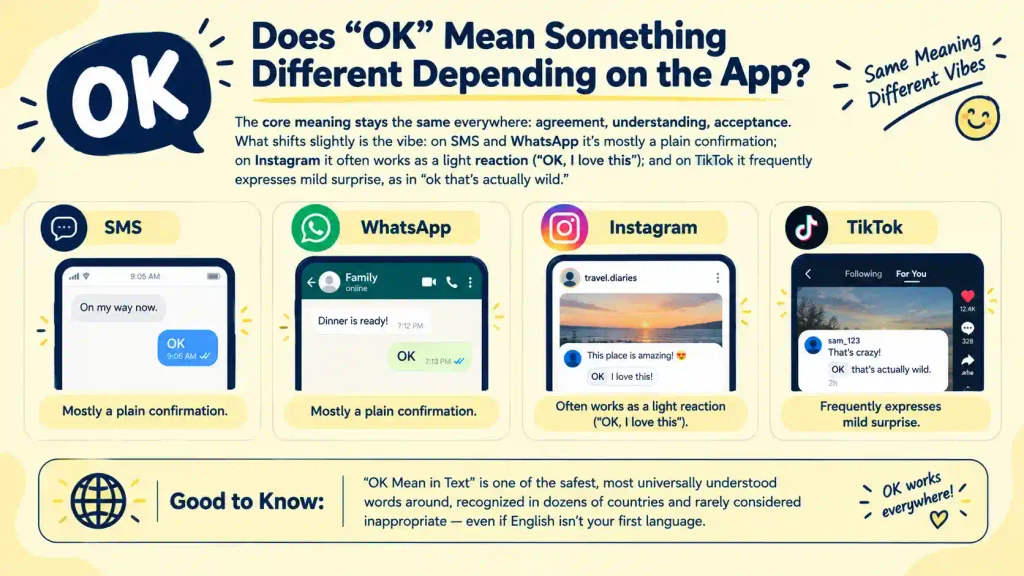
The core meaning stays the same everywhere: agreement, understanding, acceptance. What shifts slightly is the vibe: on SMS and WhatsApp it’s mostly a plain confirmation; on Instagram it often works as a light reaction (“OK, I love this”); and on TikTok it frequently expresses mild surprise, as in “ok that’s actually wild.” Worth knowing if English isn’t your first language: “OK Mean in Text” is one of the safest, most universally understood words around, recognized in dozens of countries and rarely considered inappropriate.
Why Parents Text “Ok.” and Younger Texters Don’t
This generational gap is less about attitude and more about habits formed in different eras. People who learned to write before texting existed often carry over standard sentence-ending punctuation out of habit. A period signals grammar, not mood, and many grew up before tapback reactions existed as an acceptable standalone reply, so typing “Ok.” felt like the complete response. Younger texters tend to skip the period and reach for other words: “bet,” “gotcha,” “yep,” that read as more current. Neither habit is right or wrong; they’re shaped by when someone learned to text, not by how much they care.
How to Reply When Someone Texts You “OK”
The right response depends on tone: casually, try “Cool,” “Sounds good,” or “Got it”; professionally, “Understood” or “Noted, I’ll take care of it” works better. If you suspect tension, skip guessing silently and ask directly but gently, “You seem a little unsure; is everything OK?” gives the other person room to explain without feeling accused.
OK vs. Other Common Text Shorthand
| Term | Meaning | Type |
| OK | All right, understood, agreed | Standard word |
| IDK | I don’t know | Acronym |
| IMO | In my opinion | Acronym |
| BRB | Be right back | Acronym |
| NVM | Never mind | Acronym |
Unlike the others in this list, OK functions as a complete, standalone word in modern English rather than a true acronym.
Frequently Asked Questions
What does OK mean in a text?
Agreement, understanding, or acceptance; the digital version of a nod, usually just confirming a message was received.
What’s the difference between OK and okay?
None in meaning. Okay is a spelled-out version of OK, which is actually the older, original form
Is there actual research on why a period in a text feels cold?
Yes. A Binghamton University study led by Celia Klin found that one-word replies ending in a period were rated less sincere than the same replies without one, an effect that didn’t appear in handwritten notes
Is it rude when someone just texts “OK”?
Usually not; it’s typically neutral. The real signal comes from the surrounding conversation, not the word itself.
Where does the word OK come from?
It began in 1839 as a joking misspelling of “all correct” (“oll korrect”) in the Boston Morning Post, and survived thanks to Martin Van Buren’s 1840 “Old Kinderhook” campaign.
Should I use OK or okay in formal writing?
Most style guides, including the AP Stylebook, favor “OK.” Both spellings are grammatically correct.
The Bottom Line
For a word that started as a throwaway joke in a 19th-century newspaper feud, “OK” has had a remarkable run; nearly two centuries later, it’s arguably the most recognized word on the planet, and it still hasn’t changed its basic meaning. What has changed is everything wrapped around it: the punctuation, the platform, the conversation it’s replying to. So the next time an “OK Mean in Text” shows up and you’re not sure how to take it, don’t overanalyze the two letters themselves; look at the punctuation, notice the pattern, and consider how that person usually texts.
Read More: LOL Meaning in Text 2026: Proven Mistake to Avoid