
HMU is one of the simplest pieces of internet slang once you know how to read it, even though it can feel oddly ambiguous the first time you see it. If you want to understand hmu meaning in text, it doesn’t have one fixed meaning so much as a range of them, shaped by who sent it, which app it showed up on, and the relationship behind the message.
A “hmu” from your best friend means something completely different from a “hmu” on a stranger’s dating profile, even though the letters never change and the real hmu meaning in text depends on context. Once you learn the hmu meaning in text, you will never reply wrong again.
HMU Meaning: The Short Answer
HMU stands for “Hit Me Up.” It’s a casual way of saying “contact me,” “message me,” or “let me know.” People use it constantly in texts, captions, and comments as an easy way to invite someone to get in touch.
Technically, HMU is an initialism rather than an acronym, because people read it letter by letter (H-M-U) instead of pronouncing it as a word. You’ll see it almost everywhere in lowercase “hmu” since capitalization rarely matters in casual texting.
There’s a second, less common meaning worth knowing. HMU Meaning in Text can also stand for “hook me up,” a request to be connected with someone or something the sender wants; for example, “HMU with tickets if you know anyone selling.” You can usually tell the two apart by what follows: “hmu” on its own or before a time reference (“hmu tonight”) almost always means “contact me,” while “hmu with” means “hook me up with.”
You might also see a joke definition claiming HMU means “hold my unicorn.” That’s an internet meme, not a real meaning a running gag about the silly things HMU could theoretically stand for, and nobody actually uses it that way in conversation.
Where HMU Came From
The phrase “hit me up” predates texting by decades, surfacing in American slang long before smartphones as a general request to be contacted. As mobile messaging took hold, it compressed into three letters, the same way “be right back” became “brb.” This is the root of the modern hmu meaning in text.
The abbreviated form gained real traction as internet slang spread in the early 2000s, shifting from a general request into something used specifically for social invitations online. From there, it moved from early forums and instant messengers onto every major platform that followed Facebook, Instagram, Snapchat, TikTok, and group chats of every kind, and has stayed remarkably stable in what we now know as the hmu meaning in text ever since.
The Full Range of What HMU Can Mean
HMU isn’t a fixed request; it’s closer to an open door. Depending on context, it can mean:
- A general invitation to talk again: “Hmu whenever, no rush.” No plan attached, just an open line.
- A request to make plans: “I’m free Saturday, hmu if you want to do something.”
- An offer of availability: “Bored at home, hmu.” The sender has time and would welcome a message.
- A request for information: “Hmu if you hear anything about the concert.” Closer to “let me know” than “start a conversation.”
- A romantic opener covered in more detail below.
- A favor request (“hook me up”) has the secondary meaning above.
Is HMU Flirting? Reading the Tone Correctly
This is probably the most-searched question about hmu meaning in text, and the honest answer is: usually not, but it can be.
Between established friends, HMU is almost always platonic for hmu meaning in text; it functions like “let me know” or “keep in touch,” low-effort and not loaded with subtext.
The tone shifts in specific situations: a one-on-one message from someone you don’t know well, especially after meeting in person or matching on a dating app, often functions as a soft opener without the pressure of a direct ask. Paired with flirty language or emoj is a wink, a heart, a compliment the meaning changes completely, and on dating apps, “hmu” in a bio is often shorthand for “I’m interested, make a move” in hmu meaning in text.
The word itself carries no romantic weight. What changes the meaning is everything around it: the relationship, the platform, and the tone of the rest of the message. If you’re ever unsure, it’s completely normal to just ask what someone means.
HMU Across Different Platforms
The core meaning doesn’t change from app to app, but the expected response often does.
Snapchat. Typically invites a private Snap or chat rather than a public reply common under a story, where “hmu if you’re around” invites direct messages instead of comments.
Instagram and TikTok. Shows up mostly in captions and comments as a call to action, the digital equivalent of “message me about this” placed at the end of a post to drive replies or DMs.
Dating apps. A direct signal of openness. “New in town, hmu if you know good hiking trails” reads as small talk, but attached to something more personal, it usually signals genuine interest.
Discord and group chats. Often means “tag me” for something time-sensitive “hmu when the raid starts.” Social pressure is lower here since the request is tied to an activity, not a relationship.
Workplace messaging. Rarely appropriate, even in casual channels, since it reads as too informal for most workplace norms. “Please reach out” says the same thing without the risk.
HMU vs. Similar Phrases
| Phrase | Meaning | Typical Setting | Formality |
| HMU | Contact me, in any form | Texting, social media | Casual |
| DM me | Send a direct message on that platform | Instagram, X/Twitter | Casual, specific |
| Text me | Send an SMS specifically | Phone texting | Neutral |
| Reach out | Contact me | Email, work chat | Professional |
| Ping me | Send a quick message | Slack, workplace chat | Semi-casual |
| Hook me up | Get or arrange something for me | Texting, in person | Informal, favor-based |
The distinction most people miss: HMU is channel-agnostic; it doesn’t specify how you should get in touch, while “DM me” and “text me” name the exact method. That flexibility is part of why HMU has stuck around so long: it works no matter what app the conversation eventually moves to.
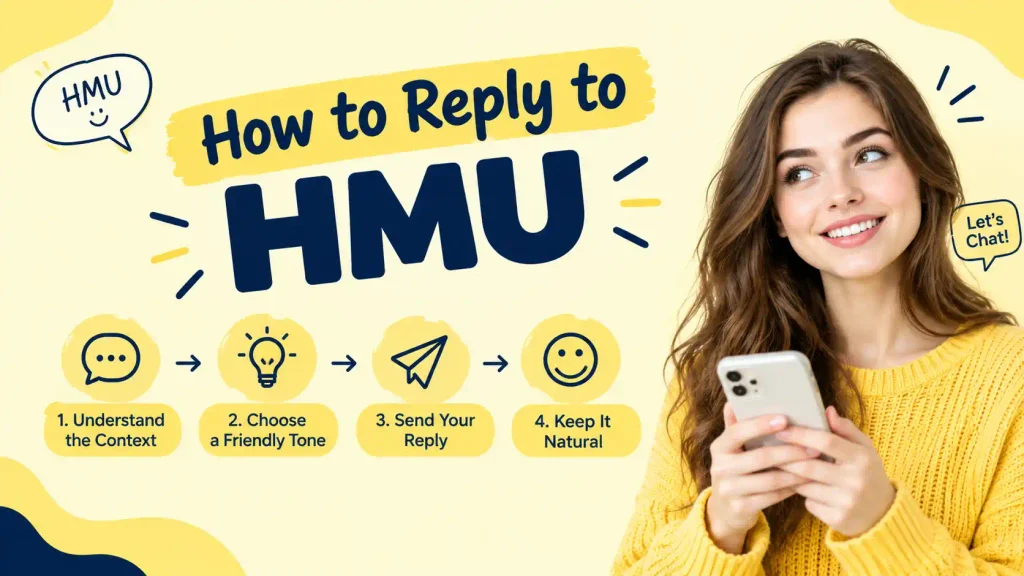
How to Reply to HMU
There’s no single correct response; it depends on your own intent.
If you’re interested: “For sure, I’ll message you later.” or “Sounds good, what time works?”
If you want to keep it low-key: “Will do.” or “Bet, talk soon.”
If the tone feels flirty and you’re into it: “Definitely was hoping you’d say that.”
If you’re not interested, or the message feels off: “Thanks, but I’m good for now.”
If you’re genuinely unsure what someone wants, just ask: “Hmu about what, exactly?” more common than people assume, especially from someone new.
One thing worth being direct about: HMU carries no inherent urgency or obligation. If a message doesn’t sit right with you, especially from someone you don’t know well, you’re never required to respond just because the ask feels casual.
HMU Variations You Might See
| Variation | Meaning |
| HMUL | Hit me up later |
| HMUS | Hit me up sometime |
| HMUT | Hit me up tonight |
| WYHMU | Why you hitting me up |
These are far less common than plain “hmu,” but follow the same logic, extending the phrase to specify timing rather than changing its core meaning.
Who Actually Uses HMU?
HMU skews younger, most common among Gen Z and millennial texters, but it isn’t generation-locked. Plenty of people in their 30s and 40s use it comfortably, particularly in social and gaming contexts. The bigger generational gap shows up in formality preference: older texters who recognize the phrase often still type it out in full (“message me later”), even when they understand the abbreviation perfectly well.
Frequently Asked Questions
Is HMU rude?
No. It’s informal, but not disrespectful. It reads closer to “let me know” than a demand, and most people interpret it as relaxed rather than pushy.
Is HMU the same as “DM me”?
Not quite. “DM me” asks for a direct message on one specific platform. HMU is more general; it could mean a text, a call, a Snap, or a DM, depending on how you’d normally reach that person.
Does HMU always mean flirting?
No. Between friends, it’s almost always platonic. It leans flirty mainly in one-on-one messages with someone new, especially when paired with playful language or emojis.
Can HMU mean something other than “hit me up”?
Occasionally. It can mean “hook me up,” usually when followed by “with,” as in “hmu with the details.” The “hold my unicorn” version you may see online is a joke, not an actual usage.
Should I use HMU at work?
It’s best avoided in professional messages, even casual ones. Phrases like “reach out” or “let me know” say the same thing without sounding too informal for the setting.
Is it still used in 2026?
Yes. HMU remains a widely used piece of everyday texting slang, especially among younger users, even as its overall popularity has settled compared to its earlier peak online.
Conclusion
At the end of the day, HMU is just three letters doing the work of an entire sentence: a small, easy way of saying “the door’s open, come talk to me whenever.” It’s rarely urgent, rarely rude, and only occasionally flirty. The real meaning always lives in the context around it, not the letters themselves: who sent it, where it showed up, and what kind of relationship you already have with that person.
Once you can read that context, HMU stops being a confusing text and becomes exactly what it was always meant to be: a quick, low-pressure invitation to keep talking. So next time it lands in your inbox, you’ll know exactly what to do with it.
Read More: LYR Meaning in Text: The Essential Mistake to Avoid in 2026

Daniel is a former English literature teacher turned digital educator. He believes that grammar rules stick best when tied to real-life stories, which is why his articles focus on practical usage, antonyms, metaphors, and word meanings explained the way you’d actually use them in conversation.