

YFM stands for “you feel me?” It is a casual way of asking whether someone understands, relates to, or agrees with what you just said. It looks like a tiny abbreviation, but it carries more personality than most. The same three letters can sound warm, playful, sarcastic, or impatient, depending on the message around them.
In this guide, you will learn what YFM Meaning in Text means, how it works inside a sentence, and how to read its tone. You will also find out where the phrase comes from, how to tell it apart from the radio station and the band that share its name, and exactly how to reply. Everything here is written in plain language, with clear examples you can use right away. By the end, you will be able to read, answer, and use YFM with confidence.
Quick Answer
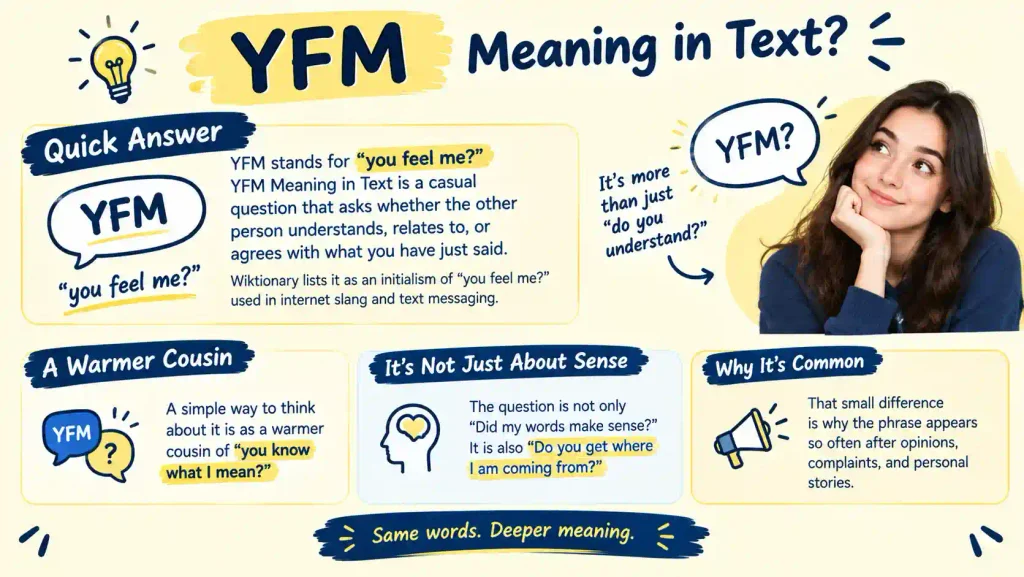
YFM stands for “you feel me?” YFM Meaning in Text is a casual question that asks whether the other person understands, relates to, or agrees with what you have just said. Wiktionary lists it as an initialism of “you feel me?” used in internet slang and text messaging.
A simple way to think about it is as a warmer cousin of “you know what I mean?” The question is not only “Did my words make sense?” It is also “Do you get where I am coming from?” That small difference is why the phrase appears so often after opinions, complaints, and personal stories.
How YFM Works in a Sentence
YFM Meaning in Text almost always sits at the end of a statement, much like a tag question in speech. The message comes first, and YFM invites a reaction. Here are a few examples:
- “I would rather stay home tonight than go out, yfm?”
- “Some days I just need an hour of quiet, yfm.”
- “That ending made no sense at all, yfm??”
A few habits are worth noticing.
Lowercase Is the Norm
Most people type “yfm” in lowercase. Capital letters can make it feel louder or more deliberate.
The Question Mark Is Optional
With a question mark, YFM Meaning in Text usually works as a real or rhetorical question. Without one, it often acts as emphasis, like a friendly nudge that says, “You know how it is.”
Extra Punctuation Adds Intensity
Repeated question marks, as in “yfm???”, usually signal strong feeling. The sender may be impatient, amused, or simply insisting that you agree.
Why “Feel” and Not “Know”?
In this phrase, “feel” means to understand or relate. It has nothing to do with touch. That is the key difference between YFM and similar expressions.
“You know what I mean?” checks whether your point was clear. “You feel me?” checks whether the other person shares the sense of it, whether that is a mood, an opinion, or an experience.
So when someone sends “yfm?” after describing an exhausting week, they are asking for a little empathy as well as comprehension. A reply such as “Yes, I get it” is usually all they need.
Three Jobs YFM Does in a Conversation
1. Checking In
The sender has explained something and wants to know it landed. Example: “I will meet you at the gate, not the cafe, yfm?”
2. Asking for Agreement or Empathy
The sender has shared an opinion or a feeling and hopes you relate. Example: “I love rainy evenings, yfm?”
3. Adding Emphasis
The sender is not waiting for an answer. YFM works as a verbal nudge, similar to “right?” at the end of a joke or a rant. Example: “Mondays should start at noon, yfm.”
How to Read the Tone Behind YFM
The three letters never change, but the mood can. These are practical rules of thumb rather than strict rules.
| Clue in the message | Likely reading |
| Personal topic, single question mark | A sincere request for understanding |
| Complaint with no question mark | Venting, with a shared eye-roll between friends |
| Several question marks | Strong feeling, impatience, or playful insistence |
| Follows a sarcastic remark | A rhetorical question that needs no answer |
| Sent between close friends or partners | Usually friendly, even when it sounds blunt |
When you are unsure, read the previous few messages. Context explains the tone far better than the abbreviation does. A sharp “yfm?” after a sarcastic remark is a very different message from a soft “yfm?” after someone admits they are tired.
YFM in Everyday Situations
Examples make the differences easier to see. Here is how the same three letters can behave in four common settings.
In a Private Chat With a Friend
“I have been so drained lately, yfm?” The sender is opening up. A warm, short reply such as “Yeah, I get it. Want to talk?” fits perfectly.
In a Social Media Comment
“This song has no business being this good, yfm?” Here, YFM invites other readers to agree. A like or a quick “so true” is a natural response.
In a Caption
“Sunday reset, coffee, no plans, yfm.” The tone is relaxed and relatable. Nobody expects a direct answer.
In a Group Chat Disagreement
“We already decided this yesterday, yfm?” The tone here leans toward impatience. A calm clarification, such as “Fair, I must have missed that,” usually keeps things friendly.
Variations You May See
YFM has a few close relatives, and all of them carry the same basic meaning.
- yfm and YFM are the standard written forms.
- ya feel me reflects the way the phrase often sounds in speech.
- u feel me is a looser texting spelling.
- feel me? is the shortest spoken version.
Where Does YFM Come From?
YFM is a shortened form of the spoken phrase “you feel me,” which is widely linked to African American Vernacular English (AAVE) and reached a broad audience through hip-hop. The exact moment the phrase first appeared is hard to pin down, because spoken slang rarely leaves a clear written record.
The texting version is easier to explain. Typing three letters is quicker than typing three words, so “you feel me?” became “yfm?” in chats, comments, and captions.
Because the phrase has cultural roots, it is best used naturally rather than as a costume. If it is not part of how you normally talk, a more neutral alternative may sound more genuine.
Other Things Called YFM
Searching for “YFM” can bring up results that have nothing to do with texting.
YFM (99.2 FM) is a youth-focused radio station in Johannesburg, South Africa. It plays mostly urban music, including kwaito, hip-hop, and R&B, with a smaller share of talk programming. The “Y” stands for “youth.”
Your Favorite Martian is a band. Wikipedia’s article on the radio station includes a note pointing readers to the band’s page, which shows how often the two names are confused.
Use this table to tell them apart.
| If “YFM” appears near… | It probably means… |
| An opinion, a feeling, or a casual sentence | You feel me? |
| DJs, shows, frequencies, or South Africa | The radio station |
| Songs, albums, or fan chatter | Possibly the band |
A few low-quality websites claim that YFM stands for something crude. Dictionary sources such as Wiktionary do not support that claim, and in everyday texting, “you feel me?” is the meaning you will meet.
How to Reply When Someone Sends YFM
Match your answer to what you actually think.
If You Agree
- “Yeah, I feel you.”
- “Totally. Same here.”
If You Want to Offer Support
- “That sounds exhausting. I get it.”
- “Of course. That makes sense.”
If You Are Confused
- “Wait, can you say more? I am not sure I follow.”
If You See It Differently
- “I get your point, but I look at it another way.”
“I feel you” is the natural answer to “you feel me?” It means “I understand and relate.” You do not have to agree with everything to respond kindly. Honesty delivered politely works well in casual chats.
Common Mistakes When Using YFM
A few small slips can change how your message lands.
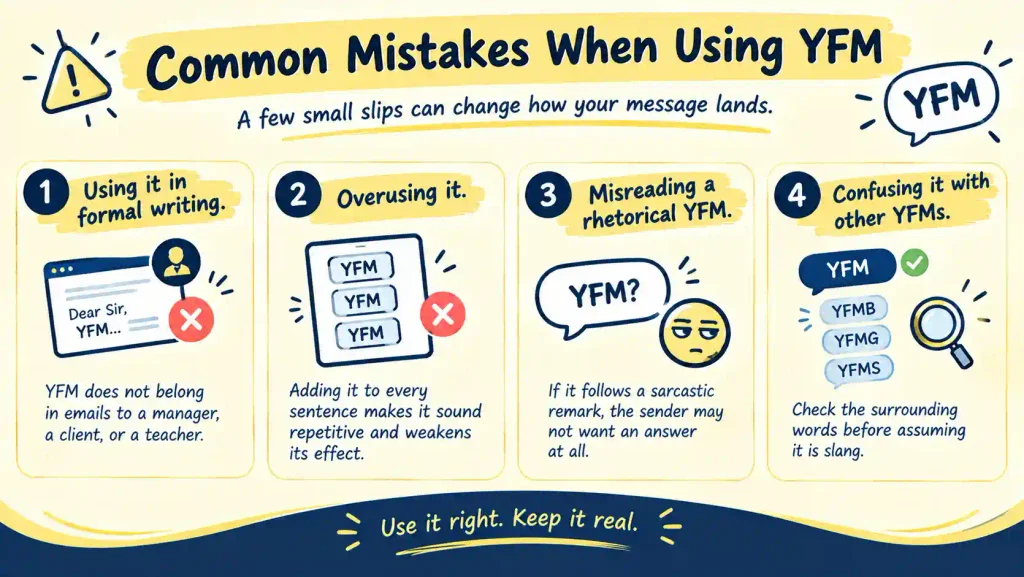
- Using it in formal writing. YFM does not belong in emails to a manager, a client, or a teacher.
- Overusing it. Adding it to every sentence makes it sound repetitive and weakens its effect.
- Misreading a rhetorical YFM. If it follows a sarcastic remark, the sender may not want an answer at all.
- Confusing it with other YFMs. Check the surrounding words before assuming it is slang.
Is YFM Appropriate Everywhere?
YFM is informal. It suits texts, direct messages, comments, and captions among friends. It does not belong in:
- Work emails or messages to managers and clients
- School essays or academic writing
- Messages to people who may not know the slang
In those settings, a plain “Does that make sense?” does the same job without confusion.
YFM Compared With Similar Phrases
Several expressions overlap with YFM, but each has a slightly different job.
| Phrase | What it asks or does | Feel |
| YFM (you feel me?) | Do you relate to this? | Personal, empathetic |
| YKWIM (you know what I mean?) | Was I clear? | Neutral |
| “I feel you” | I understand and relate | A reply, not a question |
| IKR (I know, right?) | You said what I was thinking | Enthusiastic reaction |
If you want a neutral check, choose YKWIM. If you want to invite a personal reaction, YFM fits better.
A Short Note for Parents
If your teenager uses YFM, there is generally nothing to worry about. It is an ordinary conversational tag, and safety resources aimed at parents describe it as low-risk slang. As with any phrase, the message around it matters far more than the three letters.
Frequently Asked Questions
What does YFM mean on Snapchat, Instagram, or TikTok?
It means the same thing everywhere: “you feel me?” The platform changes the setting, such as a quick snap, a caption, or a comment, but it does not change the meaning.
Is YFM the same as “ya feel me”?
Yes. “Ya feel me” is a spoken-style spelling of the same phrase, and YFM is the abbreviated version.
Do I need a question mark with YFM?
No. With a question mark, it usually works as a question, whether real or rhetorical. Without one, it often works as emphasis.
Is YFM rude?
No. It is casual and neutral. Like any phrase, it can sound impatient or sarcastic depending on the message around it.
Can I use YFM at work?
It is best avoided in professional and academic writing. Use a clearer phrase, such as “Does that make sense?”
Does YFM mean anything besides “you feel me”?
Yes, but only in other contexts. It is also the name of a South African radio station and is sometimes used for a band. In texting, it almost always means “you feel me?”
Conclusion
YFM is a small abbreviation with a simple job. It stands for “you feel me?” and it asks whether the other person understands or relates to what you have said. Most of the time, it is friendly, casual, and harmless. The only real challenge is tone, and that is easy to solve once you know what to look for.
Read the whole message before you decide how to respond. Check the punctuation, think about who sent it, and reply honestly. Keep YFM for relaxed chats, and choose clearer wording at work or school. If the letters appear beside DJs or South Africa, you are probably reading about the radio station instead.
Read More: TT Meaning in Text 2026: Clear Answers to This Confusing Abbreviation