
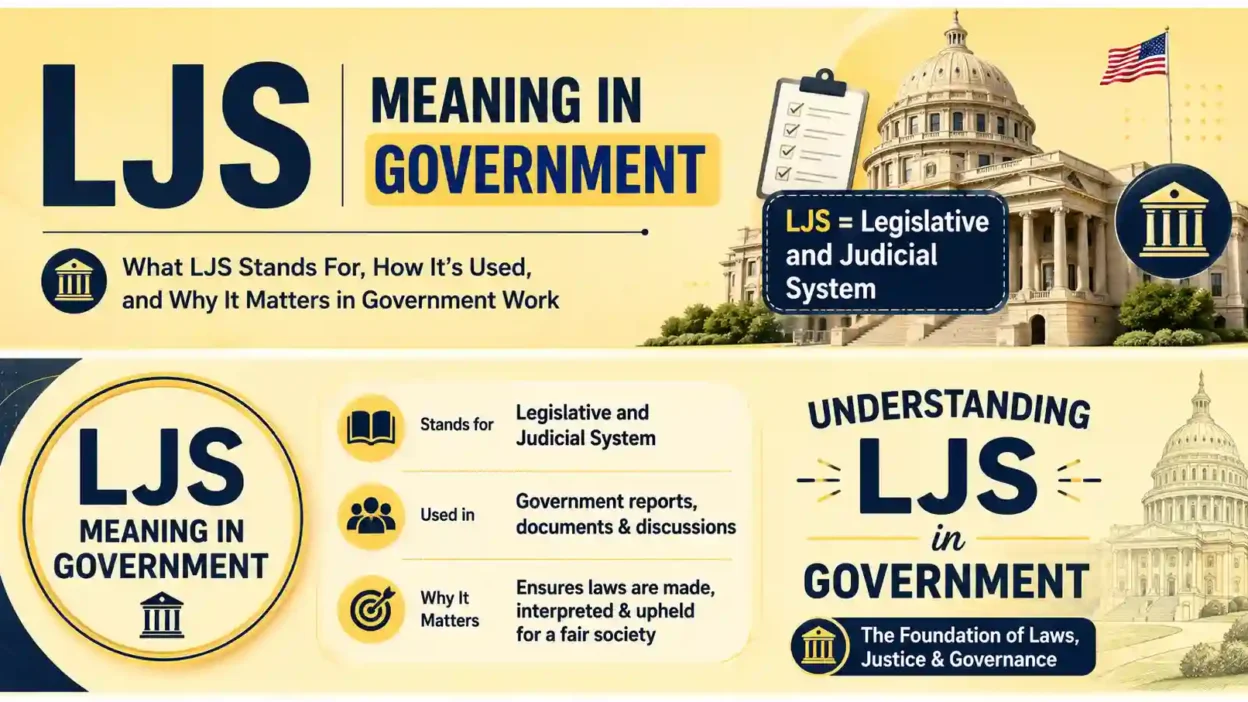
LJS stands for Law and Justice Sector the courts, police, and legal systems that keep a country fair and running smoothly.
LJS Meaning in Government also has other meanings, like “let’s just say” in texting or Long John Silver’s, the restaurant chain. This guide covers the government meaning first, then walks through every other common use of the abbreviation.
🔎 Quick Answer
LJS = Law and Justice Sector (in government and policy contexts)
It refers to the full system of courts, police, and legal institutions that create, enforce, and uphold the rule of law within a country. Governments and international donors including the World Bank, USAID, and UNDP use the term when funding or planning legal reform projects.
Other common meanings: “Let’s Just Say” (texting), Long John Silver’s (restaurant), Liberal Jewish Synagogue, London Judo Society, Literary Journalism Studies.
What Does LJS Mean in Government?
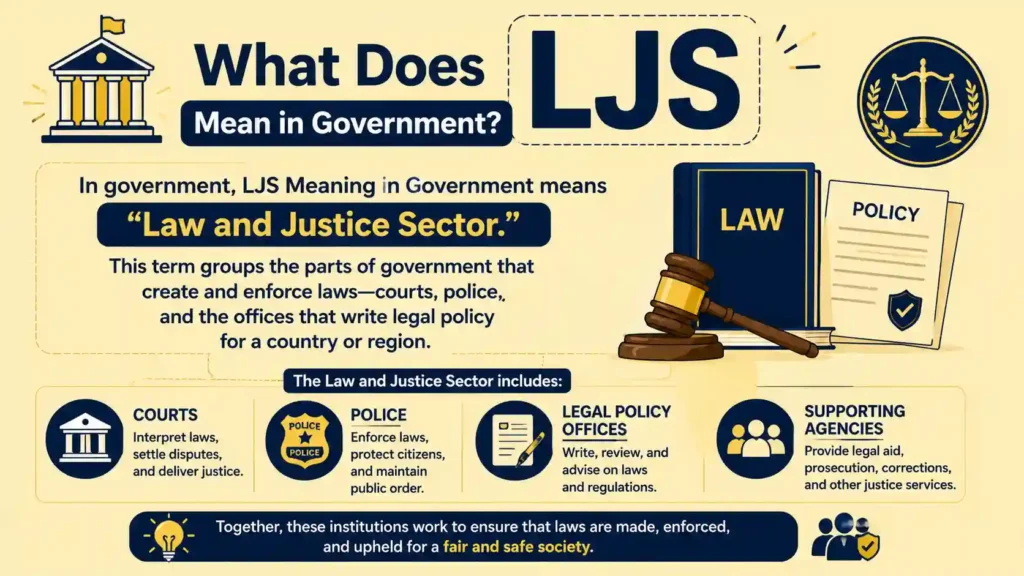
In government,LJS Meaning in Government means “Law and Justice Sector.” This term groups the parts of government that create and enforce laws—courts, police, and the offices that write legal policy for a country or region.
Governments and aid groups use this term often to describe large, multi-year projects that improve how laws work in a country. It’s typically written out in full the first time it appears in a report, then shortened to LJS for the rest of the document.
You’ll often see LJS paired with a country name or region, such as “Kenya’s LJS reform program” or “LJS funding across Southeast Asia.” That pairing signals the writer is talking about a specific, funded initiative rather than the abstract concept of justice in general.
This pattern of shortening long phrases is common in policy writing. It keeps documents easy to read, even when they cover complex topics like legal reform, judicial independence, or police accountability.
The Law and Justice Sector, Defined
A Law and Justice Sector isn’t one single office it’s a whole system made up of several parts working together toward the same goal.
Think of it like a team. Each player has a different job, but everyone works toward fair treatment under the law, and no single part of the system works well without the others. A court cannot deliver a fair verdict without accurate evidence. Police cannot investigate effectively if the laws they’re enforcing are vague or outdated. And even a well-written law is meaningless if ordinary people can’t access legal help when they need it.
This interconnected nature is exactly why the term “sector” is used instead of “office” or “department.” A sector implies a network of institutions, funding streams, and personnel not a single building with one set of employees.
Which Institutions Make Up a Law and Justice Sector
A Law and Justice Sector usually includes:
- Courts and the judiciary judges who hear cases and make legal rulings, including appellate and specialized courts.
- Law enforcement police who keep order, investigate crimes, and gather evidence for prosecution.
- Ministries of justice government offices that create and manage legal policy and oversee how laws are implemented.
- Legal aid services groups that help people who can’t afford a lawyer access representation and legal advice.
- Corrections systems prisons, probation programs, and parole boards that carry out court decisions.
Some broader definitions also include prosecutorial offices and oversight bodies like ombudsman offices or judicial councils, which monitor whether the system is behaving fairly. Each part has its own role and budget, often with its own set of donors. Together, they ensure laws stay fair and are actually followed across an entire country not just written down on paper.
Why Governments and Aid Organizations Use the Term “LJS”
International groups including the World Bank, USAID, and the UNDP (United Nations Development Programme) use the term LJS often.
These groups fund projects in countries that need help building fair legal systems. Some countries have courts that move too slowly, leaving people waiting years for a trial. Others have police forces that need better training, equipment, or accountability structures. LJS gives these organizations a short, clear way to refer to many related goals at once: better courts, safer streets, and fairer laws for everyday people.
A country’s Law and Justice Sector often becomes a major focus after a conflict or a major political change. Rebuilding trust in courts and police takes time, funding, and careful planning which is why so many international reports rely on the LJS abbreviation. Donor countries frequently attach LJS funding to broader development goals, since a functioning legal system tends to support economic growth and reduce corruption.
Reports from these organizations often measure LJS progress using specific indicators, such as how long the average case takes to resolve or how much trust surveys show in the police and courts. These metrics help donors track whether their funding is making a difference.
How “LJS” Is Used in Government and Policy Documents
LJS Meaning in Government shows up often in reports about legal reform. Writers use it as a quick stand-in for the full phrase “Law and Justice Sector,” much like any other professional abbreviation used to keep dense documents readable.
LJS in a sentence (governmental context):
- “The new funding will support LJS reforms, including better training for judges and police.”
- “The government’s LJS strategy focuses on reducing court delays and improving access to legal aid.”
Notice how the abbreviation keeps each sentence short and clear, even though the topic behind it is fairly complex.
Common Related Terms
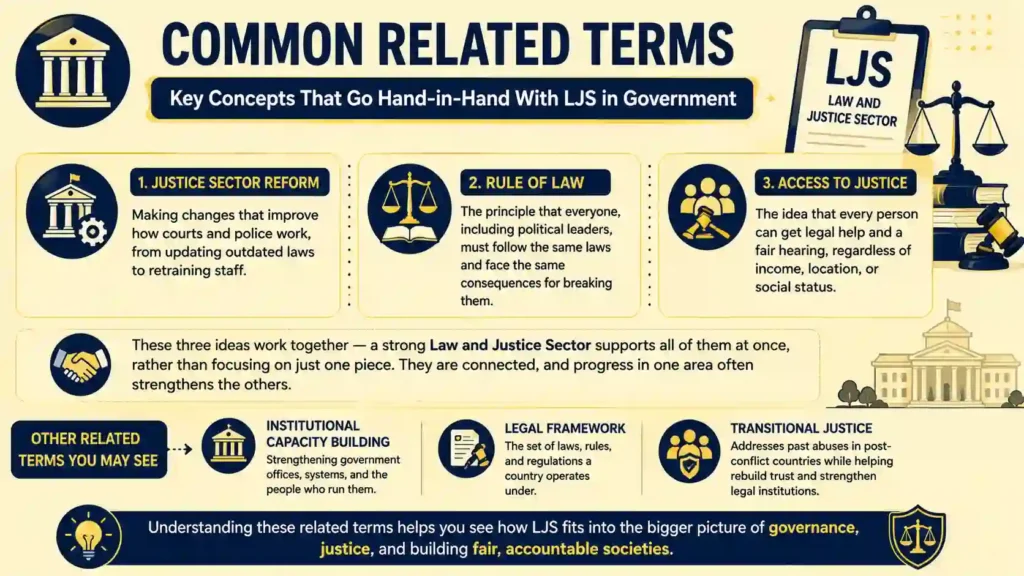
A few terms often appear next to LJS in government writing, and understanding them helps make sense of the bigger picture:
- Justice sector reform making changes that improve how courts and police work, from updating outdated laws to retraining staff.
- Rule of law the principle that everyone, including political leaders, must follow the same laws and face the same consequences for breaking them.
- Access to justice the idea that every person can get legal help and a fair hearing, regardless of income, location, or social status.
These three ideas work together a strong Law and Justice Sector supports all of them at once, rather than focusing on just one piece. You might also see terms like “institutional capacity building” (strengthening government offices) or “legal framework” (the set of laws a country operates under) nearby. “Transitional justice” also appears often inLJS Meaning in Governmentreports about post-conflict countries, referring to how a society addresses past abuses while rebuilding its legal institutions.
Other Meanings of LJS
LJS isn’t only a government term it has several other meanings depending on where you see it and who’s using it.
LJS = Long John Silver’s (Restaurant Chain)
A common short form for Long John Silver’s, a U.S. seafood restaurant chain. People use it casually, like “Let’s grab LJS for lunch.” This meaning has nothing to do with government or law.
LJS = “Let’s Just Say” (Texting/Slang)
In texting, LJS Meaning in Governmentoften means “let’s just say”used before sharing something without fully committing to the details, often to soften a statement or add a bit of mystery. Checking the surrounding conversation is the best way to confirm which meaning applies.
LJS = Liberal Jewish Synagogue
A specific religious institution located in St John’s Wood, London. This meaning is mostly used by people familiar with that community.
LJS = London Judo Society
In sports contexts, LJS can refer to the London Judo Society, a martial arts club based in London unrelated to the government meaning.
LJS = Literary Journalism Studies
In academic settings, LJS may refer to Literary Journalism Studies, a field focused on narrative, story-driven journalism. Most commonly seen in university papers or academic journals.
📊 LJS vs. Similar Abbreviations Comparison Table
| Abbreviation | Stands For | Common Context | Easy Way to Tell Apart |
| LJS | Law and Justice Sector / “Let’s Just Say” | Government reports / texting | Context: policy doc vs. casual chat |
| IJS | “I’m Just Saying” | Texting, social media | Starts with “I’m,” not “Let’s” |
| LSJ | Liddell-Scott-Jones (Greek-English lexicon) or Lansing State Journal | Academic / news | Letters are reordered L-S-J, not L-J-S |
Even though these abbreviations look similar, they rarely show up in the same type of writing. LJS and IJS both appear in casual digital conversation, while LSJ almost always shows up in academic contexts. If you’re reading a government report, LJS is by far the most likely meaning.
Frequently Asked Questions
What doesLJS Meaning in Government?
In a governmental context, LJS stands for Law and Justice Sector the full system of courts, police, and legal institutions that uphold the rule of law within a country. Governments and international aid groups use this term when planning or funding legal reform projects.
What does LJS stand for?
LJS Meaning in Government has several meanings depending on context. In government and policy settings, it most commonly stands for Law and Justice Sector. In casual texting, it usually means “let’s just say.” It can also refer to Long John Silver’s or a few organization names.
What is a Law and Justice Sector program?
A government- or donor-funded project meant to strengthen courts, law enforcement, and legal institutions within a country. These programs aim to improve access to justice, support the rule of law, and help legal systems run more fairly for everyone involved.
Is LJS an abbreviation or an acronym?
LJS is an abbreviation, not an acronym. An abbreviation is spoken letter by letter (“L-J-S”), while an acronym is pronounced as a single word, like NASA. Since LJS is spoken as three separate letters, it counts as an abbreviation.
What is the difference between LJS and IJS?
LJS most often means Law and Justice Sector in government writing, or “let’s just say” in casual texting. IJS is a separate, unrelated abbreviation meaning “I’m just saying” used when sharing an opinion without intending to start an argument. The easiest way to tell them apart is the first letter: L for “let’s,” I for “I’m.
How do you abbreviate Law and Justice Sector?
Law and Justice Sector is commonly abbreviated as LJS. This short form appears often in government reports, policy papers, and documents from international aid organizations funding legal reform work around the world.
What does LJS mean on social media or in texting?
On social media and in texting, LJS usually means “let’s just say” used to hint at something, an opinion, a story, or a feeling, without fully committing to every detail, often with a playful or guarded tone
Key Takeaways
- The LJS Meaning in Government is “Law and Justice Sector” the most common use in government settings.
- A Law and Justice Sector includes courts, police, ministries of justice, legal aid, and corrections systems, and sometimes prosecutorial and oversight bodies.
- Groups like the World Bank, USAID, and UNDP use the term LJS when funding legal reform projects.
- LJS Meaning in Government has several other meanings too, including Long John Silver’s, “let’s just say,” a synagogue, and a judo club.
- Checking the context around LJS who wrote it and what they were talking about is the best way to know which meaning applies.