WB Meaning in Text is one of the oldest, most stable pieces of internet shorthand still going strong today, quietly surviving decades of new slang, new apps, and new platforms without changing meaning.
Once you know WB Meaning in Text, you’ll spot it everywhere: texts, gaming lobbies, Instagram comments, even a work Slack channel welcoming someone back from vacation. This guide breaks down exactly what WB means, the one mix-up that trips almost everyone up at least once, and how to use it so it lands naturally instead of awkwardly.
Quick Answer
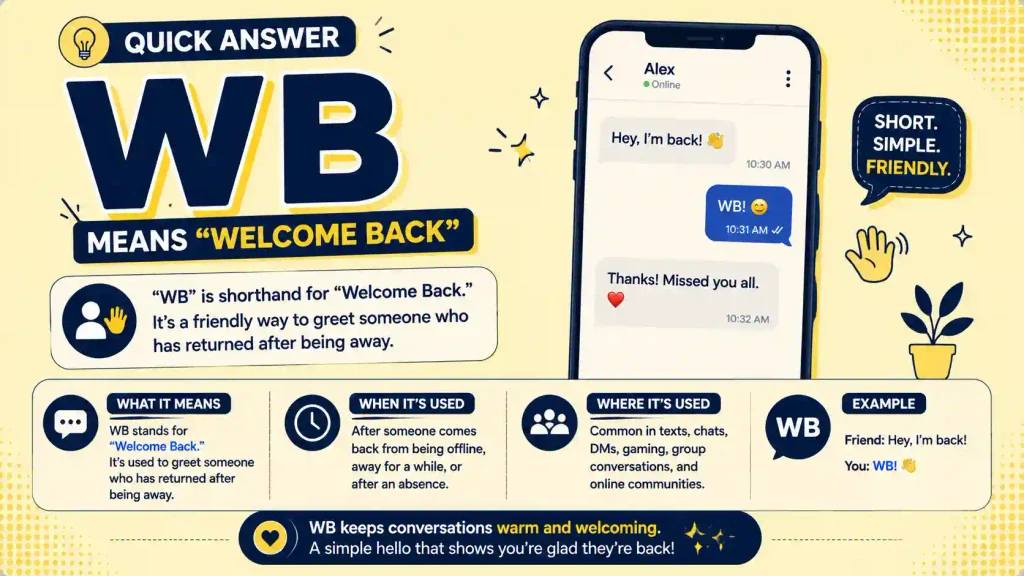
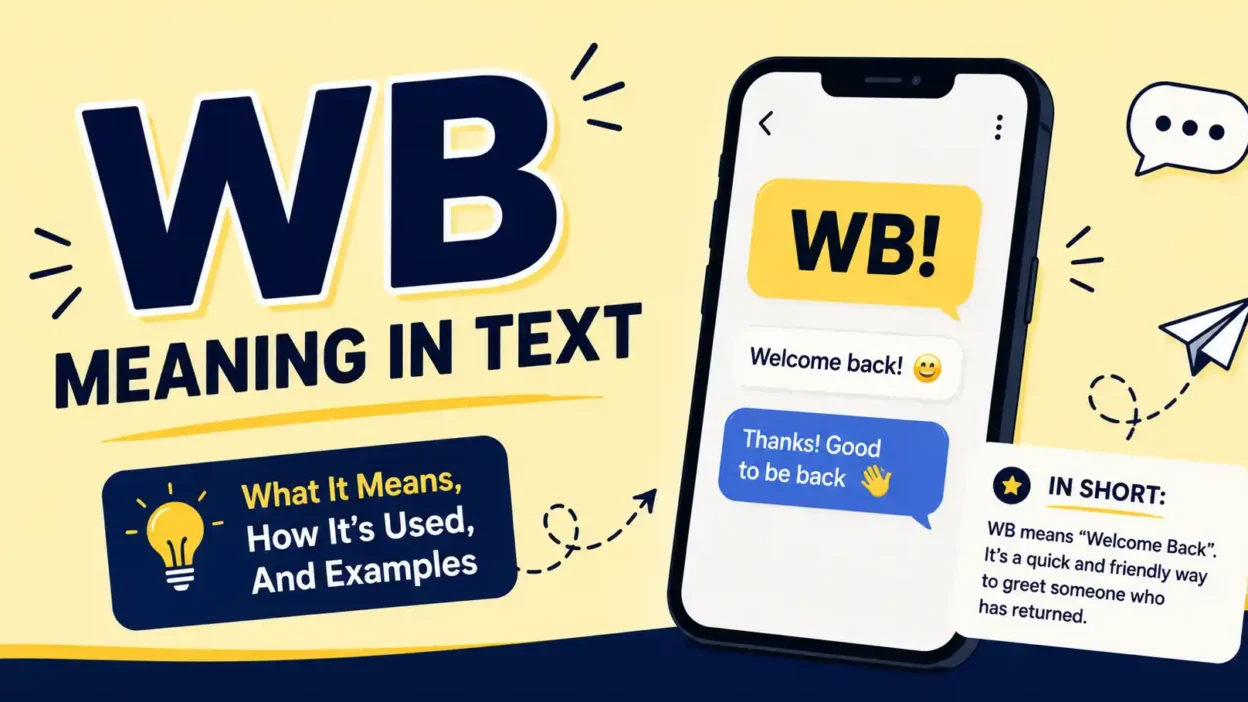
WB stands for “Welcome Back.” It’s a casual greeting sent to someone who has just returned to a conversation, a game, or an online space after stepping away, going offline, disconnecting, or being inactive for a while.
That’s the WB Meaning in Text in roughly 95% of the places you’ll encounter it. A smaller slice of cases points to something else entirely, which is where most of the confusion starts.
Seeing WB in Action
Abbreviations make more sense with real context than with a bare definition, so here’s how “wb” typically shows up across different platforms.
In a text thread:
Friend: sorry, had to run an errand
You: no worries, wb!
In a multiplayer game:
Player 1: my connection dropped, back now
Player 2: wb, ready when you are
In a Discord voice channel:
[User reconnects]
Mod: WB, you missed the first round
In an Instagram comment:
“WB!! We missed these posts”
Notice the pattern: WB rarely starts a conversation on its own. It’s a reaction to someone’s return, which is the biggest visual clue for telling it apart from other two-letter abbreviations.
WB vs. WBU: The Mix-Up Everyone Runs Into
This is the single most common point of confusion when people search for wb meaning in text, and it’s worth slowing down on.
- WB = “Welcome Back,” a greeting, sent to someone who just showed up.
- WBU = “What About You?” a question, sent after you’ve answered something about yourself.
The two look similar at a glance, especially on a small phone screen where a fast typist might drop a letter by accident. But they serve opposite roles in a conversation: one welcomes, the other asks.
A fast way to tell them apart: if the message ends with a question mark, or if it follows a statement like “I’m doing okay,” it’s almost certainly WBU. If it’s a short, standalone line reacting to someone reappearing, it’s WB.
“I’m good, just tired. wbu?” → WBU, asking a question
“hey wb, you good?” → WB, greeting someone’s return
Other Things WB Can Mean
Outside of casual chat, WB carries several unrelated meanings, and the right one depends entirely on the topic being discussed. This is where dictionary sites can be misleading; many list dozens of expansions for “WB” without flagging which one applies to texting.
| Meaning | Typical Context |
| Welcome Back | Texting, chat apps, gaming, social media |
| Write Back | Older email and letter correspondence, requesting a reply |
| Warner Bros. / The WB | Film, television, and entertainment coverage |
| World Bank | News, economics, and international finance |
| White Balance | Photography and video editing settings |
| Weight-Bearing | Physical therapy, fitness, and medical instructions |
| Work Breakdown (Structure) | Project management documentation |
| Wide Ball | Cricket scoring and commentary |
If you land on a definition page for “WB” that talks about magnetic flux, you’ve hit a different term entirely: Wb (capital W, lowercase b) is the symbol for the weber, the SI unit of magnetic flux, named after physicist Wilhelm Weber.
It shares two letters with chat slang and nothing else. Some dictionary sites default to this scientific definition first, which is why a search for “WB Meaning in Text” sometimes returns a physics answer instead of a texting one.
In everyday messaging, though, none of these alternate meanings come up unless the surrounding conversation is clearly about that topic: a photography tutorial, a cricket match, a business article. Absent that context, “Welcome Back” is the safe assumption.
Where WB Came From
WB Meaning in Text isn’t a recent invention. It dates back to the early days of real-time internet chat in the 1990s, on platforms like IRC (Internet Relay Chat), AOL Instant Messenger, and later MSN and Yahoo Messenger. Short greetings like HYY are also commonly used in casual texting
Connections dropped constantly on that era’s dial-up internet, and typing speed mattered because messages were composed in real time rather than drafted and sent. Short acknowledgments like WB Meaning in Text BRB (“be right back”), and AFK (“away from keyboard”) let people keep a conversation moving without breaking its pace every time someone’s connection blinked out.
That same need for fast, low-effort acknowledgment carried straight into texting, gaming voice chat, and social platforms as they emerged. The vocabulary didn’t change much because the underlying situation didn’t either: people still step away and come back, and a two-letter response still does the job faster than typing the full phrase.
Does WB Change Meaning Depending on Tone or Punctuation?
Mostly, no, but small formatting choices shift how it reads, even though the meaning stays the same.
- “wb” (lowercase, no punctuation) the default: casual and neutral.
- “WB!!” or “wbbb” is stretched or emphasized, signaling genuine enthusiasm rather than a flat acknowledgment.
- “wb…” with a trailing ellipsis can read as sarcastic or teasing, often used when someone was gone longer than expected or missed something important.
- “Welcome back” spelled out in full reads as more sincere or slightly more formal, common when someone returns from something significant, like time off after an illness or a long absence, rather than a five-minute break.
None of this changes the core definition. It just tells you something about the sender’s tone, which matters more in close friendships and small group chats than in fast-moving gaming lobbies, where everyone defaults to the shortest version.
Formal vs. Informal: When to Use It
WB is casual internet shorthand, and it behaves like one.
Fits naturally in:
- Texting friends and family
- Group chats
- Gaming voice and text channels
- Social media comments and DMs
- Casual internal workplace chat, like a team Slack channel, if that’s already the tone your team uses
Doesn’t fit in:
- Client-facing or external professional emails
- Formal reports, proposals, or documentation
- First-time messages to someone in a work context you don’t know well.
- Any communication where the reader might not recognize chat abbreviations
If you’re unsure whether an audience will read “wb” as friendly rather than unprofessional, spelling out “welcome back” costs nothing and removes the ambiguity entirely.
How to Reply to WB
A reply to WB in a text doesn’t need to be long; it’s an acknowledgment, not an invitation to explain your whole absence.
Short and simple:
- “Thanks!”
- “Glad to be back”
- “Good to be here”
Slightly warmer:
- “Thanks, missed this chat”
- “Appreciate it, catching up now”
If you were away for a specific reason worth mentioning:
- “Thanks! Internet died mid-match, all good now”
- “Thanks, had a rough week, glad to be back”
There’s no strict rule here. The main thing to avoid is over-explaining a short absence in response to a two-letter greeting; it tends to feel mismatched in tone.
Alternatives to WB
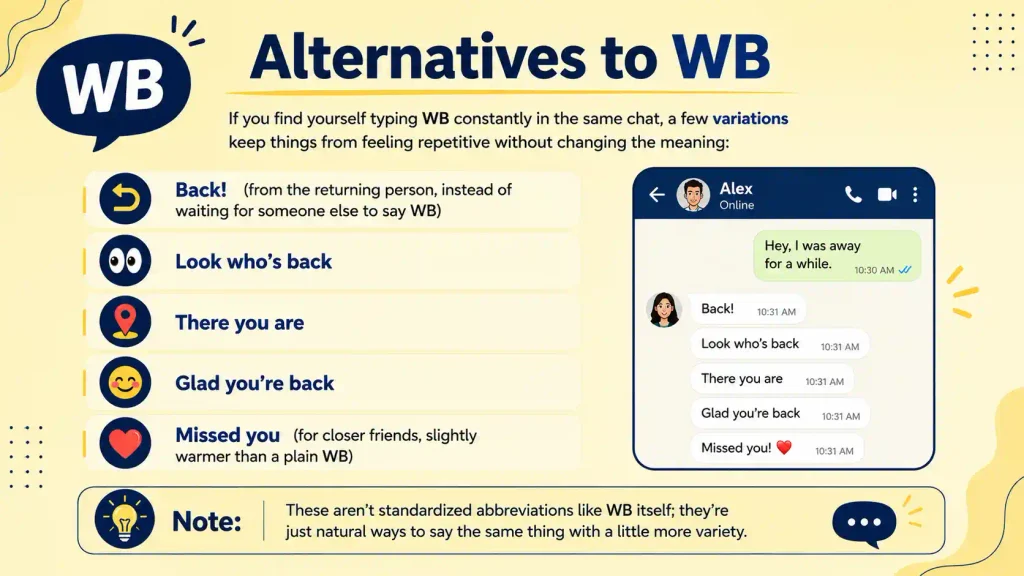
If you find yourself typing WB constantly in the same chat, a few variations keep things from feeling repetitive without changing the meaning:
- “Back!” (from the returning person, instead of waiting for someone else to say WB)
- “Look who’s back”
- “There you are”
- “Glad you’re back”
- “Missed you” (for closer friends, slightly warmer than a plain WB)
These aren’t standardized abbreviations like WB itself; they’re just natural ways to say the same thing without repeating the same three letters every time.
Related Chat Abbreviations Worth Knowing
WB rarely travels alone. It’s part of a small family of shorthand terms that show up in the same fast-paced conversations.
| Term | Meaning | When It’s Used |
| WB | Welcome Back | Greeting someone who returned |
| WBU | What About You? | Turning a question back on the other person |
| BRB | Be Right Back | Announcing a short break before leaving |
| AFK | Away From Keyboard | Common in gaming, signals temporary inactivity |
| TTYL | Talk To You Later | Signing off from a conversation |
| GTG | Got To Go | Leaving, usually more abruptly than TTYL |
| HRU | How Are You? | Opening or continuing small talk |
Knowing this small set covers the majority of shorthand you’ll run into in everyday texting and gaming chat.
Frequently Asked Questions
What does WB Meaning in Text?
WB means “Welcome Back.” It’s a short, informal greeting sent to someone who has returned to a conversation after being away, going offline, or staying inactive for a while.
Is WB the same as WBU?
No. WB is a greeting meaning “Welcome Back.” WBU is a question meaning “What About You?” typically sent right after answering a question about yourself. They’re easy to mix up visually but serve different purposes.
Does WB always mean “Welcome Back”?
In texting and chat, almost always, yes. Outside that context, WB can also refer to Warner Bros., the World Bank, white balance in photography, weight-bearing in medical contexts, work breakdown structure in project management, or wide ball in cricket. The surrounding topic makes the right meaning obvious.
What’s the difference between WB and Wb?
“WB” (both letters capitalized) is internet slang for “Welcome Back.” “Wb” (capital W, lowercase b) is the scientific symbol for the weber, a unit of magnetic flux used in physics. They look nearly identical but come from completely unrelated fields.
Is it rude to not reply to WB?
Not inherently; it’s a low-effort greeting, and in fast-moving group chats or gaming lobbies, plenty of people don’t respond to every one they receive. In a one-on-one conversation or a smaller, closer group, a quick reply is generally considered polite, but there’s no strict social rule attached to it.
Where did WB Meaning in Text originate?
WB traces back to 1990s and early 2000s internet chat culture, on platforms like IRC, AOL Instant Messenger, and MSN Messenger, where slow connections and frequent disconnections made short acknowledgments like WB, BRB, and AFK useful for keeping conversations moving.
The Bottom Line
In almost every text, chat, or comment you’ll ever see it in, WB means “Welcome Back.” The only trap worth remembering is WBU, and the fix takes half a second: check for a question mark. The Warner Bros., World Bank, and photography meanings only surface when the conversation is obviously about one of those topics, so outside of that, there’s nothing left to second-guess. Next time “wb” lands in your chat, whether you’re the one sending it or the one seeing it after stepping away, you’ll know exactly what’s being said: simply, someone’s glad you’re back. That’s the whole meaning, and now you’ll never have to wonder again.

Rachel is a passionate linguist and content writer with a love for the English language’s hidden nuances. With years of experience in teaching ESL students, she specializes in breaking down idioms and similes into simple, everyday examples. Her mission is to make English learning fun, not intimidating.