

Seeing “STD” in STD Meaning in Text can make you stop and reread the conversation. Most of the time, the answer is simple: STD stands for sexually transmitted disease, a health condition passed on through sexual contact. That’s what STD Meaning in Text refers to in most texts, DMs, and posts you’ll come across.
But “most of the time” isn’t “always,” and the rare exceptions are exactly why this phrase gets searched so often. This guide covers the real meaning, the rare alternate meanings, how to read context when you’re unsure, and the health information most explainer articles skip entirely.
Quick Answer
In nearly every modern text, STD means sexually transmitted disease an infection spread mainly through vaginal, anal, or oral sex, and sometimes through close skin-to-skin contact.
There are two legitimate exceptions worth knowing for STD Meaning in Text:
- Subscriber Trunk Dialing an older telecom term, mostly used in the UK and India, for direct long-distance dialing without an operator. You’ll see STD Meaning in Text in technical documents, rarely in a personal text.
- “Sign the Deal” a piece of dated office slang that appeared briefly in old workplace-abbreviation lists years ago. It never became common usage and is essentially extinct in everyday texting today.
Outside niche technical writing, if a real person texts you “STD Meaning in Text,” they mean the health term. There’s no meaningful ambiguity left in casual conversation, even though the word can look unfamiliar the first time you see it typed out rather than spoken.
Why This Word Causes a Double-Take
Most texting abbreviations are low-stakes; nobody pauses over “BRB” or “IDK.” STD is different because it sits at the intersection of a serious health topic and a subject many people feel awkward discussing directly. That combination is exactly why a second of confusion over the word can feel bigger than it is.
It doesn’t help that the “correct” medical term has quietly been shifting for years, so even people who know roughly what STD Meaning in Text means sometimes wonder if they’re using outdated language. That shift is worth understanding on its own, which is what the next section covers.
STD vs. STI: The Distinction Most Articles Get Wrong
STI stands for sexually transmitted infection. STD stands for sexually transmitted disease. They’re related, not interchangeable, and the difference comes down to one thing: whether the condition is causing noticeable effects in the body.
- An infection means a virus, bacterium, or parasite is present in the body.
- A disease means that infection has progressed enough to cause symptoms or complications.
Every STD starts as an STI, but not every STI becomes an STD. Someone can carry chlamydia and feel completely fine at that stage; it’s an infection, not yet a disease. Left untreated, it can eventually cause pain or fertility problems, at which point it fits the clinical definition of a disease rather than a silent infection.
This explains something that might otherwise seem strange: even though “STI” is now the term doctors and public health bodies prefer, “STD” hasn’t disappeared from texting or everyday speech. Most people learned “STD” first, in health class or casual conversation, long before “STI” became the standard clinical term. Because of that, “STD” stays the default word people reach for, even when “STI” is technically more accurate.
At a Glance
| STD | An infection that has caused symptoms or a diagnosable disease | Everyday conversation, older health materials |
| STI | Presence of an infection, symptomatic or not | Modern clinical language, CDC and WHO materials |
| Asymptomatic | Causing no noticeable symptoms | Common description for many STIs |
| Screening | Testing for infection regardless of symptoms | Recommended on a routine basis |
How to Tell What “STD” Means in Your Specific Text
Rather than just saying “context matters,” here’s an actual way to work it out when you’re unsure about STD Meaning in Text:
- Check who’s texting you. A partner, a clinic, a friend from health class, or a public health account are all near-certain signals of the medical meaning. A telecom engineer or an old technical manual would be the rare exception.
- Check the surrounding words. Terms like “test,” “results,” “clinic,” “symptoms,” or “protection” nearby confirm the health meaning of STD Meaning in Text instantly. Words like “dial” or “line” nearby, which would suggest the telecom meaning, are extremely rare to see in personal texting.
- Check the tone. Genuine conversations about STDs are almost always neutral or caring, not jokey. If the word is being used as an insult or a punchline, that’s a sign of a tone problem, not proof of some hidden alternate meaning.
- When in doubt, just ask. A simple “what do you mean by that?” clears things up faster than guessing, and it keeps a sensitive topic honest, which matters more here than with almost any other kind of text abbreviation.
Where the Term Actually Came From
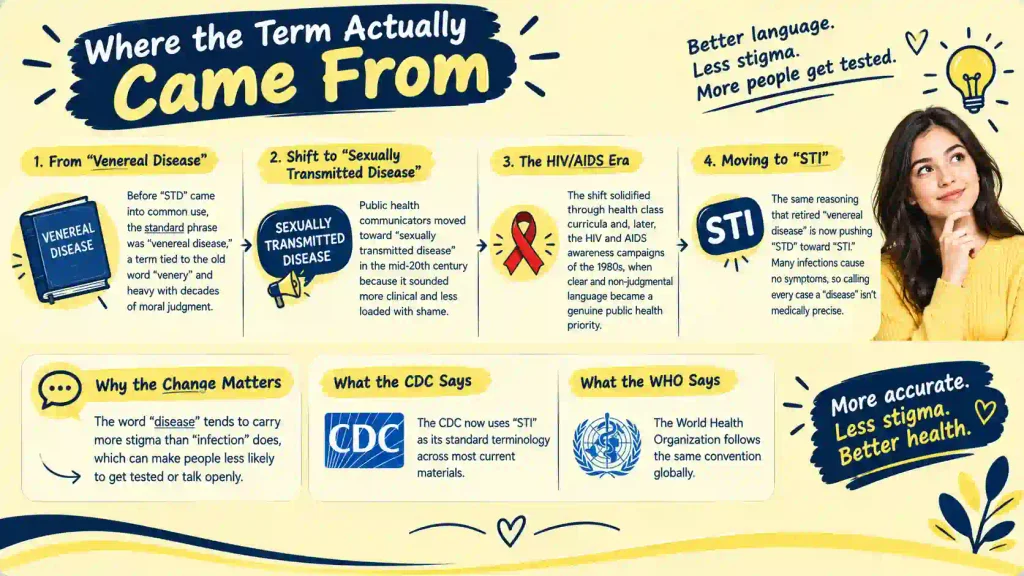
Before “STD” came into common use, the standard phrase was “venereal disease,” a term tied to the old word “venery” and heavy with decades of moral judgment. Public health communicators moved toward “sexually transmitted disease” in the mid-20th century largely because it sounded more clinical and less loaded with shame. The shift solidified through health class curricula and, later, the HIV and AIDS awareness campaigns of the 1980s, when clear and non-judgmental language became a genuine public health priority.
The same reasoning that retired “venereal disease” is now pushing “STD” toward “STI.” Many infections cause no symptoms at all, so calling every case a “disease” isn’t medically precise. On top of that, the word “disease” tends to carry more stigma than “infection” does, which can make people less likely to get tested or talk openly. The CDC now uses “STI” as its standard terminology across most current materials, and the World Health Organization follows the same convention globally.
The Numbers Behind the Word
This is the part most articles on STD Meaning in Text skip, and it genuinely helps explain why the word comes up so often. The CDC’s most recent provisional surveillance data, from 2024, shows more than 2.2 million reported cases of chlamydia, gonorrhea, and syphilis combined in the United States. That number has actually been declining for three consecutive years, down 9% from 2023, but it’s still 13% higher than it was a decade ago. One especially troubling trend inside that data is congenital syphilis, passed from mother to newborn, which has climbed nearly 700% since 2015.
Globally, the picture is larger still. The World Health Organization estimates that more than 1 million curable STIs are acquired every day among people aged 15 to 49, with roughly 374 million new infections occurring each year across just four curable types: chlamydia, gonorrhea, syphilis, and trichomoniasis. Beyond those, an estimated 520 million people in that same age range are living with genital herpes, and hundreds of millions more carry HPV at some point in their lives.
These figures matter for a simple reason: they explain why STIs are one of the most common categories of infection in the world, not a rare or niche health topic. A large share of cases cause no symptoms at all, which is exactly why routine testing, rather than waiting to feel unwell, is the standard medical recommendation.
The Most Talked-About STIs, Briefly Explained
- Chlamydia the most frequently reported bacterial STI in the U.S., often symptomless, and easily treated with antibiotics once caught.
- Gonorrhea another common bacterial infection, increasingly monitored for antibiotic resistance in some regions.
- Syphilis has distinct stages, and cases, including in newborns, have been rising in recent years, which is why public health agencies are tracking it closely.
- HPV extremely widespread; most sexually active people will encounter some strain in their lifetime, and vaccination prevents the highest-risk types.
- Herpes (HSV-1 and HSV-2) a lifelong viral infection that’s manageable with treatment and very common worldwide.
- HIV: modern treatment can lower viral load to undetectable, at which point transmission risk drops to effectively zero, the basis of the CDC-endorsed “Undetectable equals Untransmittable” message.
- Trichomoniasis is caused by a parasite rather than a virus or bacterium, and is fully curable with medication.
Talking About It Without Making It Weird
If someone mentions STD or STI testing in a text, the most useful response is usually the simplest one: treat it as ordinary health information, not a confession. A reply like “good idea, let me know how it goes” keeps the conversation calm and normal, which is exactly the tone health professionals encourage.
Where this becomes genuinely unhelpful is when the word gets used to tease or shame someone. That’s less a language problem than a respect problem. The term itself is neutral; how it’s used in a given conversation is what determines whether it feels supportive or hostile.
Why Testing Matters More Than Symptoms
Because so many STIs are asymptomatic, waiting to feel something before getting tested misses the entire point of screening. The CDC’s general guidance calls for at least annual testing for sexually active adults under 25, and for older adults with new or multiple partners, with more frequent testing depending on individual risk factors. A healthcare provider can tailor this to a specific situation far better than a general guideline can on its own.
Most testing today is quick, confidential, and far less complicated than people expect. For many clinics, it’s a routine part of preventive healthcare rather than an exceptional or uncomfortable event, and results are often available faster than most people assume.
Frequently Asked Questions
What does STD Meaning in Text message?
It almost always means sexually transmitted disease, an infection spread through sexual contact. This holds whether it shows up in a personal text, a health class group chat, or a social media caption.
Is STD the same as STI?
Not exactly. STI means an infection is present, whether or not it causes symptoms. STD means that infection has progressed into a diagnosable disease. Every STD begins as an STI, but not every STI becomes one.
Why do health organizations now say STI instead of STD?
Because many infections cause no symptoms, calling every case a “disease” isn’t medically accurate. The CDC and WHO now use “STI” as standard terminology, partly for precision and partly because “infection” carries less stigma than “disease.”
Does STD ever mean something unrelated to health?
Rarely. In telecom contexts, it can stand for Subscriber Trunk Dialing, an older term used mostly outside the U.S. In personal texting today, this meaning is essentially never intended.
Can someone have an STI without any symptoms?
Yes, very commonly. Chlamydia, HPV, and herpes often cause no noticeable symptoms at all, which is exactly why routine testing, not waiting until something feels wrong, is the recommended approach
How often should I get tested?
The CDC recommends at least annual testing for sexually active adults under 25, and more frequent testing for older adults with new or multiple partners. A healthcare provider can personalize this schedule based on individual risk.
Is it inappropriate to bring up STD testing in a text?
No. Discussing testing or results over text is a normal, responsible way to communicate about health, especially between partners. It only becomes a problem when the term is used to mock or shame rather than inform.
The Bottom Line
When “STD” shows up in a text, the health meaning is almost always the right read, and a glance at the surrounding words will confirm it in nearly every case. The wider story behind that three-letter abbreviation is worth knowing too: a decades-long shift in medical language, millions of documented cases every year, and a growing public health push toward routine testing rather than waiting for symptoms that, for many infections, simply never show up at all.
Read More: Awe Meaning in Text: Avoid This Simple Mistake in 2026

Daniel is a former English literature teacher turned digital educator. He believes that grammar rules stick best when tied to real-life stories, which is why his articles focus on practical usage, antonyms, metaphors, and word meanings explained the way you’d actually use them in conversation.