

“bae” isn’t nearly as simple as most people assume. If you’ve ever searched *bae mean in text*, you know it’s more than just “babe”. It has a genuine linguistic history, a wildly popular origin story that turns out to be false, and its own set of unwritten social rules for when it feels charming and when it falls flat. Most explanations online stop at “it means babe” and move on, which leaves out the more interesting and more accurate story behind the word.
This guide goes further. You’ll learn exactly what “ If you’ve ever searched *bae mean in text*, you know it’s more than just “babe”” is today, the real linguistic roots behind it (not just the popular myth), how to use it naturally as both a noun and an adjective, where it doesn’t belong, and whether it still holds up in 2026. By the end, you’ll understand “bae” better than most people who use it every day, and you’ll know exactly why the “before anyone else” story keeps getting passed around even though it isn’t true.
QUICK Answer:
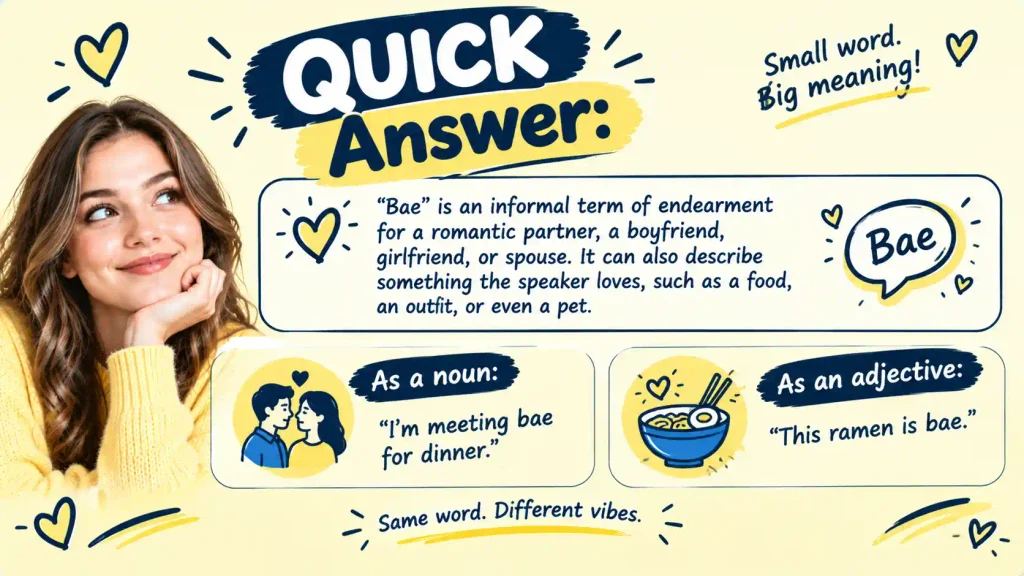
“Bae” is an informal term of endearment for a romantic partner, a boyfriend, girlfriend, or spouse. It can also describe something the speaker loves, such as a food, an outfit, or even a pet.
- As a noun: “I’m meeting bae for dinner.”
- As an adjective: “This ramen is bae.”
It functions much like “babe” or “baby,” just with a more casual, internet-native feel.
Where “Bae” Actually Came From
Most articles repeat the same two-sentence origin story: it started on Urban Dictionary, then blew up because of a Pharrell song. That’s part of the picture, but it skips the more interesting and better-documented part of the story of what ” bae ” means in text.
It’s a Sound Change, Not an Invention
“Bae” didn’t appear out of nowhere as a made-up internet word. Linguists who study African American Vernacular English (AAVE) point to a well-known pattern in the dialect: dropping consonant sounds at the ends of words. This is the same process that turns “and” into “an” or softens consonant clusters at the end of a syllable.
Applied to “baby,” this kind of sound-dropping naturally produces something closer to “bae.” So rather than being a random abbreviation someone typed up for fun, bae in text reflects a genuine, longstanding pattern of spoken English that later got written down and spread through text and social media. This is also why bae in text feels so natural to say out loud; it was a spoken form before it was ever a typed one.
The Documented Timeline
Piecing together dictionary records, meme archives, and linguistic write-ups gives a clearer timeline than most slang explainers offer:
- Mid-2000s: The Oxford English Dictionary’s earliest recorded evidence of “bae” as a noun dates to 2006. By then bae mean in text had already been circulating informally before that, including entries on Urban Dictionary and use in some early rap and R&B lyrics.
- Early 2010s: The word spread gradually through Black American communities and hip-hop culture before crossing into wider youth slang, following a pattern common to many words that start in AAVE and later become mainstream.
- 2013–2014: “Bae” exploded on Twitter, Vine, and Instagram. Pharrell Williams’s single “Come Get It Bae” (2014) put bae mean in text in front of a mass audience, and outlets like TIME named it one of the year’s defining slang terms.
- 2014–2015: Meme culture cemented bae mean in text. Formats like “bae caught me slippin’” (posed candid-looking photos), “cooking for bae” (jokingly bad homemade meals), and the Vine catchphrase “you got a bae, or nah?” kept the word circulating long after its initial spike.
Understanding this timeline matters because it explains why “bae” feels both dated and oddly persistent; it’s not a fleeting internet fad, it’s a decade-plus-old word with roots that go back even further.
Does “Bae” Stand for “Before Anyone Else”?
Almost certainly not, even though this is the explanation most people have heard.
“Before anyone else” is what linguists call a backronym: a phrase invented after the fact to explain a word’s letters, rather than the actual source of the word. The giveaway is timing: written and spoken examples of “bae” as a shortened form of “baby” or “babe” predate the “before anyone else” explanation by years. If the acronym were the true origin, you’d expect to see that meaning attached to the word from the start. Instead, it shows up later, layered on top of a word that was already in use.
Language researchers who have studied the word’s spread, including linguist Neal Whitman’s analysis for Visual Thesaurus, reached the same conclusion: “bae” is a phonetic shortening of “babe” and “baby,” not an acronym. The “before anyone else” version is a fun, memorable story and a genuinely nice sentiment, but it’s a reverse-engineered meaning, not a history.
How to Use “Bae” the Right Way
As a Noun (Talking About a Person)
Used this way, “bae” simply substitutes for “boyfriend,” “girlfriend,” “partner,” or occasionally a very close friend.
- “Bae’s picking me up at eight.”
- “I told bae about the new restaurant.”
- “Can’t hang out tonight; it’s date night with bae.”
As an Adjective (Describing Something You Love)
Here, “bae” works like “amazing” or “the best.”
- “This coffee is bae.”
- “My dog is basically bae at this point.”
- “That jacket is so bae.”
A Note on Tone
“Bae” is casual and affectionate by default, but it can also be used sarcastically or ironically calling a difficult coworker “bae” as a joke, for instance. Read the relationship and the context before assuming it’s meant romantically. Between friends, it’s frequently used platonically and doesn’t necessarily signal attraction.
Bae vs. Babe vs. Boo vs. Bestie
These words overlap, but each carries a slightly different weight.
| Term | Typical Meaning | Tone |
| Bae | Partner, or something loved (noun or adjective) | Casual, internet-native, sometimes ironic |
| Babe | Romantic partner | Warm, classic, sincere |
| Boo | Romantic partner, also rooted in AAVE | Sweet, informal |
| Bestie | Very close friend (rarely romantic) | Playful, platonic |
| Honey / Darling | Affectionate partner nickname | Traditional, gentler |
The practical difference: “babe” tends to read as more sincere and timeless, while “bae” reads as more modern, playful, and occasionally tongue-in-cheek. “Boo,” like “bae,” has roots in African American English and carries a similar sweet, informal tone.
The Memes That Turned “Bae” Into a Cultural Moment
Slang rarely spreads on definition alone; it spreads through repetition in jokes and formats people can copy. “Bae” is a good example:
- “Bae caught me slippin’” Posts featuring an artfully “candid” photo, implying a partner snapped it while the subject wasn’t paying attention.
- “Cooking for bae”: Photos of deliberately messy or failed homemade dishes, poking fun at the idea of impressing a partner with a home-cooked meal.
- “You got a bae, or nah?” A catchphrase that originated on Vine and got repeated across the platform until it became shorthand for the word itself.
These formats did more to cement “bae” in everyday language than any dictionary definition could, which is part of why the word still feels tied to a specific mid-2010s internet aesthetic.
When “Bae” Doesn’t Belong
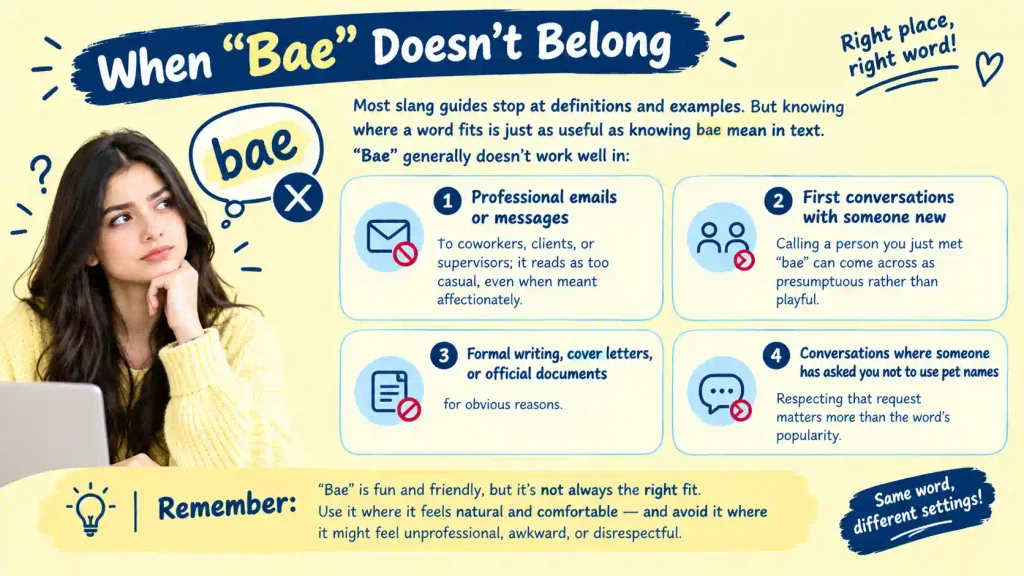
Most slang guides stop at definitions and examples. But knowing where a word fits is just as useful as knowing bae mean in text. “Bae” generally doesn’t work well in:
- Professional emails or messages to coworkers, clients, or supervisors; it reads as too casual, even when meant affectionately.
- First conversations with someone new: calling a person you just met “bae” can come across as presumptuous rather than playful.
- Formal writing, cover letters, or official documents for obvious reasons.
- In conversations where someone has asked you not to use pet names, respecting that request matters more than the word’s popularity.
Outside of texting, social captions, and casual conversation with people you’re close to, it’s safest to reach for a more neutral word.
Does “Bae” Mean Something Else Elsewhere?
Word coincidences are common across languages, and “bae” has a couple of amusing ones:
- Danish: “bæ” is an informal, childlike word for poop unrelated to the English slang, but a fun fact worth knowing before using the word around Danish speakers.
- Icelandic: “bæ” is a casual way to say “bye,” similar to how English speakers say “see ya.” Using it with someone much older can come across as a little too familiar, since it skips a more formal goodbye.
These overlaps are purely coincidental; none of them influenced how the English slang term or bae mean in text developed.
Is “Bae” Still Used in 2026?
Yes, though its role has shifted. “Bae” is no longer the go-to word it was during its 2013–2014 peak, and plenty of people now consider it a somewhat dated 2010s term. But “dated” doesn’t mean “gone.” bae mean in text shows up regularly in three specific ways:
- Ironically or jokingly, as a nod to internet culture from a decade ago.
- Affectionately but casually, especially among people who grew up during its original rise.
- In captions and memes, where the retro feel is often part of the appeal rather than something to avoid.
In short, “bae” has moved from a trend to a fixture, less common as a person’s default word for “boyfriend” or “girlfriend,” but far from forgotten.
Frequently Asked Questions
What does bae mean in text?
It’s an informal term of endearment for a romantic partner, and sometimes for a very close friend or something the sender likes a lot. Tone and context usually make the intended meaning clear.
Does “bae” really stand for “before anyone else”?
Probably not. That explanation appeared after the word was already in use, which points to it being a backronym rather than the word’s true origin. Most linguistic evidence supports “bae” as a shortened form of “baby” or “babe.”
Where did “bae” come from?
It developed from a consonant-dropping pattern common in African American Vernacular English, applied to “baby.” Written evidence dates back to the mid-2000s, with mainstream popularity arriving around 2013–2014 through social media and music.
Is it okay to call someone “bae” if you just met them?
It’s generally better to wait. Because “bae” implies closeness, using it too early can feel presumptuous rather than charming.
What’s the difference between “bae” and “babe”?
“Babe” is the older, more traditional word. “Bae” is a shortened, more casual version that became closely tied to text messaging and social media culture starting in the 2010s. Both carry a similar affectionate meaning.
The Bottom Line
“Bae” isn’t a secret acronym, and it definitely didn’t spring out of nowhere on the internet. It’s a natural sound-shortening of “baby,” rooted in African American Vernacular English, that traveled through hip-hop, Twitter, Vine, and a wave of unforgettable memes on its way to becoming one of the defining slang words of the 2010s. The “before anyone else” story is catchy, but the real bae mean in text is more interesting: a spoken pattern that quietly became one of the internet’s most recognizable terms of endearment.
The word is less dominant today, but it hasn’t disappeared; it’s simply settled into a more casual, often nostalgic role in everyday texting and social captions. So the next time “bae” pops up in your messages, you won’t just recognize it. You’ll know exactly where it came from, and you’ll know how to use it well.
Read More:OK Mean in Text 2026: Is “OK.” Secretly Making People Hate You?

Rachel is a passionate linguist and content writer with a love for the English language’s hidden nuances. With years of experience in teaching ESL students, she specializes in breaking down idioms and similes into simple, everyday examples. Her mission is to make English learning fun, not intimidating.


