
TTYL, short for “talk to you later,” is one of the internet’s oldest and most widely used sign-offs, a casual way to pause a chat without ending it or setting a deadline for when you’ll reply.
Despite decades of use across Usenet, AOL Instant Messenger, texting, and modern DMs, its origins are often misreported, and its etiquette isn’t always obvious. This guide breaks down what TTYL Meaning in Text actually means, where it really came from, how it compares to similar abbreviations like BRB and GTG, and when it’s appropriate to use so you never have to guess again.
The Short Answer
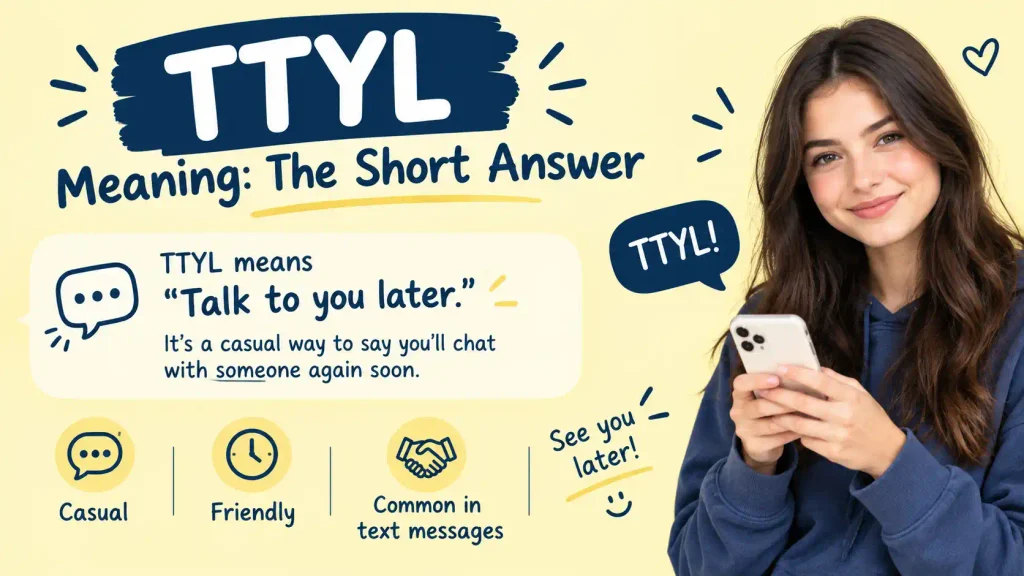
TTYL Meaning in Text means the sender has to step away from the conversation but isn’t ending the relationship or the topic just this particular exchange, for now. It works as a stand-alone reply or tacked onto the end of a longer message:
- “Running late, ttyl!”
- “In a meeting, TTYL”
- “This was a good chat, ttyl 🙂”
Case doesn’t change the meaning. Some people type it in caps for emphasis and lowercase for a quieter, throwaway tone, but there’s no rule attached to either.
It’s an Initialism, Not an Acronym, and Here’s Why That Distinction Actually Matters
Most slang guides use “acronym” for anything made of letters, but TTYL Meaning in Text is technically an initialism: you say each letter (T-T-Y-L), unlike a true acronym like NASA, which is pronounced as a word.
This isn’t pedantry for its own sake; it explains why TTYL never picked up a spoken pronunciation the way “lol” eventually did (some people now say “lol” out loud as a word; almost nobody says “ttyl” as anything but four letters). The initialism structure is part of why it’s stayed purely a written form for nearly forty years.
Where TTYL Actually Came From (And a Myth to Retire)
Many pages explaining TTYL repeat a tidy but wrong origin story: that it comes from TTY, the teletypewriter machines used for text-based telecommunication. It’s an understandable guess: TTY and TTYL Meaning in Text share three letters, but there’s no documented link between the hardware abbreviation and the internet sign-off. They’re different things that happen to look similar.
The real paper trail is more interesting. According to linguist Ben Zimmer’s research for the American Dialect Society, the earliest confirmed citation for “TTYL” is a 1988 Usenet post, cited by the Oxford English Dictionary when it added the term. That places TTYL’s origin squarely in late-1980s Usenet and BBS culture years before AOL Instant Messenger existed, and well before most homes had internet access at all.
The AIM-era story that most articles tell isn’t false, exactly; it’s just the term’s second act, not its first. TTYL Meaning in Text migrated from Usenet threads into IRC channels and then into AIM, ICQ, and MSN Messenger through the 1990s, where dial-up connections billed by the minute gave people a real incentive to type four characters instead of eighteen.
When SMS texting took over in the early-to-mid 2000s, character limits and per-message charges gave TTYL Meaning in Text a second reason to spread, and it carried straight through the smartphone era into DMs on Instagram and Snapchat without needing to change at all.
Two dictionary milestones mark its move from slang to recognized vocabulary: the Oxford English Dictionary added it in its June 2016 update, and Merriam-Webster followed in its September 2023 batch of roughly 690 new entries, alongside “rizz” and “jorts.” Urban Dictionary’s crowd-sourced entry actually came earlier, in June 2002, worth noting because it shows TTYL was already considered “established slang” by users nearly 15 years before either major dictionary caught up.
TTYL vs. BRB vs. GTG vs. TTYS: The Difference Is About Expectation, Not Just Duration
Every guide to these sign-offs lists the same expansions and calls it a day. The part that actually resolves confusion is what each one implies the other person should do.
| BRB | Be right back | The conversation stays open the other person may sit and wait, mid-topic |
| TTYS | Talk to you soon | Reconnecting within a short, fairly predictable window |
| TTYL | Talk to you later | The conversation is paused, not the topic dropped no waiting expected, no timeline implied |
| GTG | Got to go | An abrupt, immediate exit, often mid-sentence |
| AFK | Away from keyboard | A short-to-medium step away, common in gaming and voice chat |
| TTFN | Ta-ta for now | A playful, retro-flavored version of TTYL |
Here’s the test that actually separates BRB from TTYL: if someone types BRB and then goes quiet for three hours, that reads as a broken promise; you were left hanging mid-conversation. If someone types TTYL and goes quiet for three hours, nothing feels off, because TTYL never promised a return time in the first place. BRB keeps a seat open at the table. TTYL Meaning in Text clears the table and says you’ll grab another one later.
Why “Later” Is Deliberately Vague and Why That’s a Feature
Most explanations of TTYL treat the vagueness of “later” as a flaw to explain away. It isn’t. Linguists categorize expressions like TTYL as phatic communication language whose job is to manage a social relationship rather than transmit new information, in the same family as “how’s it going” or “take care.” Nobody actually expects a detailed answer to “how’s it going,” and nobody expects a specific return time attached to TTYL Meaning in Text.
That vagueness does real work for both people in the exchange. For the sender, it lets you leave a conversation gracefully without committing; you might not be able to keep you don’t know if it’ll be twenty minutes or two days, so you don’t say. For the receiver, it removes any pressure to be available at a set moment. Compare that to “I’ll text you at 7,” which does create an obligation. TTYL specifically avoids creating one.
Does TTYL Mean Someone’s Losing Interest?
On its own, no. If the conversation felt normal right up until the TTYL landed, it almost always just means the person has somewhere else to be class started, dinner’s ready, their boss walked by. The abbreviation itself carries zero emotional information in either direction.
Where people get tripped up is reading emotional weight into the letters that actually belongs to the context around them. A TTYL sent right after a joke lands completely differently from a TTYL sent the second after you brought up something you were nervous to say, but in both cases, the four letters are doing exactly the same job. If a TTYL Meaning in Text feels like a brush-off, it’s the abruptness or the timing that’s sending that signal, not the phrase.
Who Texts First Afterward?
Nobody “owes” the next message. TTYL Meaning in Text isn’t a turn-taking rule; it’s an exit, and either person is free to restart the thread whenever they think of something to say. Treating it as your cue to wait can accidentally stall a conversation you both would’ve been happy to keep going. If you think of something two hours after receiving a TTYL, there’s no social rule against texting first, even though you were the one who got the sign-off.
How to Reply to TTYL (Or Not Reply at All)
TTYL rarely needs a reply to “work”; that’s part of its design. A short “ok ttyl!” or “talk soon” closes the loop if you want to. Adding a rough timeframe works too (“ttyl, calling you after work”). But silence afterward isn’t a snub, either: TTYL is often meant to be the last line in a thread, so the conversation ending there is the phrase doing its job, not a sign anything’s wrong.
Formal Situations: Where TTYL Doesn’t Belong
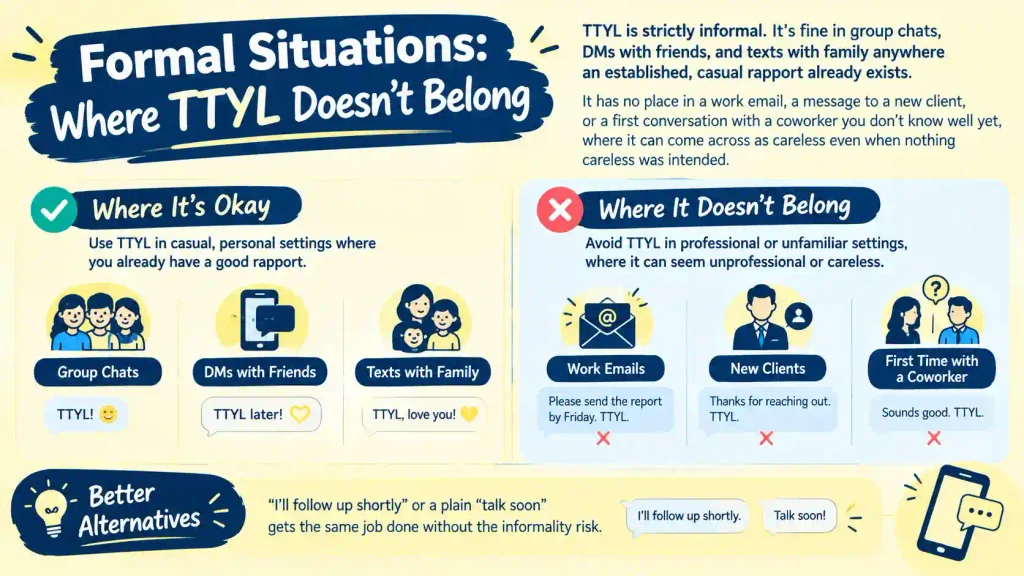
TTYL is strictly informal. It’s fine in group chats, DMs with friends, and texts with family anywhere an established, casual rapport already exists. It has no place in a work email, a message to a new client, or a first conversation with a coworker you don’t know well yet, where it can come across as careless even when nothing careless was intended. “I’ll follow up shortly” or a plain “talk soon” gets the same job done without the informality risk.
Stylized Versions: TTYLLL, TTYL8R, TTYT
A handful of variations show up without changing the underlying meaning:
- TTYLLL: extra letters purely for emphasis, the same instinct behind writing “sooooo” instead of “so.”
- TTYL8R is a leetspeak-style substitution of “8r” for “later,” especially common in 2000s AIM culture.
- TTYT is a more specific relative meaning “talk to you tomorrow,” used when the timeframe actually is known, unlike standard TTYL.
None of these are separate slang terms with their own definitions they’re stylistic texture on the same four-letter core.
Quick Reference: Which Sign-Off Fits Your Situation
- Stepping away for a few minutes, conversation still open → BRB.
- Expect to reconnect within the hour → TTYS.
- Leaving right now, no time to explain → GTG
- No clear sense of when you’ll continue → TTYL
- You know exactly when you’re picking it back up tomorrow → TTYT, or just say the time.
Frequently Asked Questions
Is TTYL rude? No. It’s a standard, low-pressure way to pause a conversation, roughly equivalent to “bye” or “talk soon.” It only reads as abrupt when it cuts off something that was clearly emotional or important without any acknowledgment.
Is TTYL actually a “real” word, or just slang? Both, depending on how you define it. It’s been slang since the late 1980s, but it’s now also a formally recognized dictionary entry; the Oxford English Dictionary added it in 2016, and Merriam-Webster followed in 2023.
Can I use TTYL with a new coworker or someone I’ve just met? It’s safer to hold off. TTYL signals an existing casual rapport. With someone new, especially in a semi-professional context, “talk soon” or “I’ll follow up” is the lower-risk choice until you know how they text.
Is TTYL only for teenagers? No, and this is one of the more overlooked facts about it. Because it dates back to the late 1980s, plenty of people now in their 40s and 50s grew up typing it on Usenet, IRC, or AOL and still use it in family group chats today. It’s one of the few pieces of internet slang that reads as generationally neutral rather than dating whoever sends it.
The Bottom Line
TTYL isn’t a promise to reply by a certain time, and it isn’t a signal that someone’s pulling away; it’s simply a low-pressure way of saying a conversation is paused, not finished. That open-endedness is exactly why a phrase first spotted in a 1988 Usenet post has survived Usenet, IRC, AIM, texting, and now DMs without ever needing to change. Understanding the difference between TTYL and terms like BRB or GTG can help you read texts more accurately and reply (or not reply) with more confidence. Casual, familiar, and generationally neutral, TTYL remains one of the simplest tools in everyday digital communication.
Read More:“HYY Meaning in Text: The Essential Mistake to Avoid” 2026