
Most of the time, WTM means “What’s the move?” a casual way of asking about plans. But if you Google wtm meaning in text, you’ll see the same three letters can also mean “What’s the matter?” when someone’s checking in on you, or “Whatever that means” as a sarcastic reply. The wtm meaning in text completely depends on context, and getting it wrong can make a reply land oddly.
This guide breaks down every meaning of WTM, shows real examples, and gives you a simple way to know exactly which wtm meaning in text fits, every single time. By the end, understanding wtm meaning in text will be so easy you’ll never reply wrong again.
What Does WTM Mean? The Short Answer
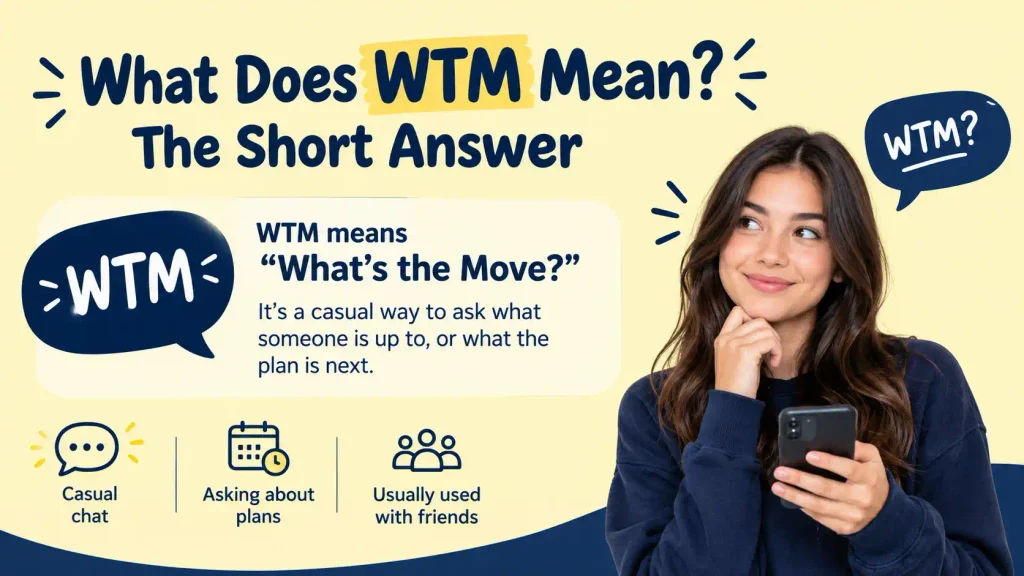
WTM most commonly stands for “What’s the move?” a casual way of asking what someone is doing or planning, usually for tonight, the weekend, or some other upcoming block of time.
Depending on the conversation, though, it can also mean:
- “What’s the matter?” a check-in when someone seems off, quiet, or upset
- “Whatever that means” a sarcastic or skeptical reaction to something confusing
There’s no universal rule that locks WTM into one definition. The meaning shifts based on what’s being discussed and the tone of the exchange, which is exactly why so many people get tripped up by it.
The Three Everyday Meanings of WTM
1. “What’s the Move?” Asking About Plans
This is the version you’ll see most often, especially in group chats and on Snapchat or Instagram. It’s the slang equivalent of asking “What are we doing?” or “What’s the plan?”
Example:
“WTM tonight? I’m bored out of my mind.”
Here, the sender is fishing for ideas or checking if anything’s already been planned. It works just as well solo (“WTM this weekend?”) as it does in a group setting where everyone’s expected to chime in with suggestions.
2. “What’s the Matter?” Checking In on Someone
When the surrounding conversation involves emotion rather than logistics, WTM Meaning in Text shifts into a concern-based question. It’s a shorthand way of asking if someone is okay.
Example:
“You’ve barely said anything all day. WTM?”
This version tends to show up in one-on-one messages rather than group chats, since it’s a more personal, caring question than a logistical one.
3. “Whatever That Means” A Sarcastic Reaction
This is the only version that isn’t a question at all. It’s a dismissive or skeptical comment, often used after quoting someone else’s confusing, vague, or unconvincing statement.
Example:
“He said it’s ‘not that deep.’ WTM.”
The tone here leans doubtful or mocking. If you see WTM Meaning in Text tacked onto the end of a quoted statement rather than standing on its own as a question, this is almost always the meaning in play.
How to Tell Which Meaning Is Being Used
Most guides list the three meanings and leave you to figure out the rest. The real skill is reading the sentence around WTM, and there’s a fast way to do it.
Ask yourself three things, in order:
- Is WTM reacting to a quote or a claim someone just made? If yes, it’s almost certainly “whatever that means.”
- Is the conversation about someone’s mood, silence, or behavior? If yes, it’s “what’s the matter?”
- Is neither of those true? Then it’s “what’s the move?” by default, since that’s the most common use by a wide margin.
Here’s a quick reference for the signal words that tend to cluster around each meaning:
| If the message mentions… | WTM likely means |
| Tonight, this weekend, plans, “I’m free,” “I’m bored” | What’s the move? |
| Quiet, upset, sad, “you seem off,” “you good?” | What’s the matter? |
| A quoted statement, “he said,” “she claims,” air quotes | Whatever that means |
In practice, you’ll rarely need to think this hard; the context usually makes the meaning obvious within a sentence or two. One small note: the question mark is optional. “WTM” and “WTM?” are used interchangeably, since dropping punctuation is common in fast, informal texting.
Less Common Meanings You Might Run Into
Outside the three main definitions, WTM Meaning in Text shows up with a few niche meanings depending on where the conversation is happening. These are far less frequent, but worth knowing.
- “Want to meet?” Occasionally used on dating apps or in early scheduling chats to suggest meeting up in person.
- “Win the match” Shows up in gaming and esports chats, referring to the objective of a session rather than anything social.
You’re unlikely to run into either unless you’re already deep in that specific context, like a gaming Discord server or a dating app conversation.
Where WTM Came From
There’s no single documented moment when WTM was coined, which is typical for internet slang that spreads organically. “What’s the matter?” is a much older, fully spoken phrase that simply got abbreviated once texting made short-form communication the norm. “What’s the move?” is the newer addition, gaining traction among teens and young adults sometime in the early 2010s as a fast way to ask about plans without typing a full sentence.
WTM Across Different Platforms
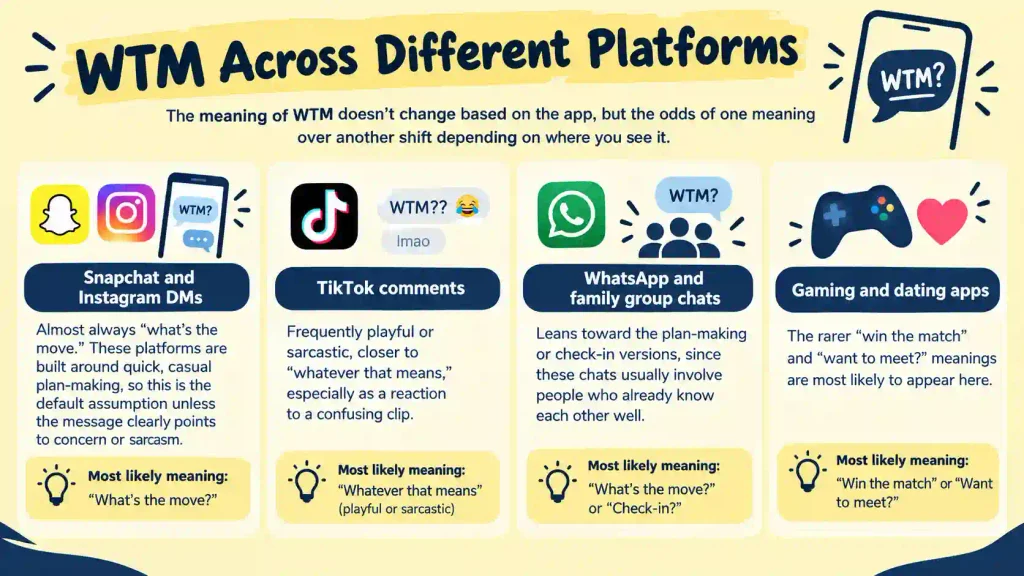
The meaning of WTM doesn’t change based on the app, but the odds of one meaning over another shift depending on where you see it.
Snapchat and Instagram DMs: Almost always “what’s the move.” These platforms are built around quick, casual plan-making, so this is the default assumption unless the message clearly points to concern or sarcasm.
TikTok comments: Frequently playful or sarcastic, closer to “whatever that means,” especially as a reaction to a confusing clip.
WhatsApp and family group chats: Leans toward the plan-making or check-in versions, since these chats usually involve people who already know each other well.
Gaming and dating apps: The rarer “win the match” and “want to meet?” meanings are most likely to appear here.
How to Reply to WTM
Once you’ve identified which meaning fits, replying is straightforward.
Plans, and you have some: Share the details directly: “We’re grabbing food around 7, come through.”
Plans, and you don’t have any yet: Turn it back around: “Nothing yet, what are you thinking?”
Checking on your mood: Be honest, even briefly: “I’m okay, just tired” or “Can we talk later?”
Sarcastic: A short, matching reaction works best: “Right, exactly” or a laughing emoji.
WTM vs. Similar Texting Slang
WTM often gets confused with a few other short, plan-related abbreviations. Here’s how they differ:
| Abbreviation | Full Meaning | What It’s Really Asking |
| WTM | What’s the move? | Future plans or intentions |
| WYD | What you doing? | Current, in-the-moment activity |
| WYA | Where you at? | Location, not activity |
| HMU | Hit me up | A request for someone to reach out |
| LMK | Let me know | A request for a decision or update |
The cleanest way to separate WTM from WYD specifically: WTM looks forward (“what are we going to do?”), while WYD looks at right now (“what are you doing at this exact moment?”).
Common Mistakes People Make With WTM
Assuming it only has one meaning. Treating WTM as always meaning “what’s the move” can lead to a tone-deaf reply if someone was actually checking on your well-being.
Using it in professional or formal writing. WTM Meaning in Text is casual slang through and through. In a work email or a message to someone you don’t know well, spell out the full question instead; “What’s the plan for tomorrow?” reads as far more appropriate.
Confusing it with WTF. They look similar at a glance but carry completely different tones, so a quick misread can come across the wrong way entirely.
Is WTM Still Used in 2026?
Yes. WTM remains active in everyday texting and on platforms like Snapchat, Instagram, and group messaging apps, with particularly strong use among Gen Z and younger millennials. Short, flexible abbreviations that serve multiple purposes tend to have staying power, and WTM’s overlapping meanings have kept it relevant rather than making it obsolete.
WTM Outside of Texting
Away from slang, WTM stands for a handful of unrelated terms that show up in entirely different settings:
- World Travel Market: a major London-based travel and tourism trade show held annually.
- World’s Toughest Mudder: a 24-hour obstacle course event for endurance athletes.
- Windows Task Manager: the earlier name for the Windows tool now simply called Task Manager.
- Winner Takes Most: a business and economics term describing markets where a small number of companies capture most of the profit, rather than a single company taking all of it.
These definitions depend entirely on context. In a casual text from a friend, none of them are likely to be what’s meant.
Frequently Asked Questions
What does WTM Meaning in Text message?
Most often, “What’s the move?,”, a casual way of asking about plans. It can also mean “What’s the matter?” when checking on someone, or “Whatever that means” as a sarcastic remark, depending on context.
Is WTM the same as WYD?
No. WTM asks about future or upcoming plans, while WYD asks what someone is doing right now.
Does WTM mean something different on dating apps?
Occasionally. It can stand for “want to meet?” as a way of suggesting an in-person meetup, though “what’s the move” still shows up there too.
Is it okay to use WTM at work?
No. It’s informal slang and doesn’t fit professional communication. Write out the full question instead, such as “What’s the plan for the meeting?”
How do I know which meaning someone intends?
Check what’s being discussed nearby. Plans and free time point to “what’s the move,” concern about someone’s mood points to “what’s the matter,” and a quoted or confusing statement points to “whatever that means.”
Can WTM come across as rude?
Rarely on its own, but tone and relationship matter. Using it with someone you don’t know well, or in a serious conversation, can read as dismissive even when that’s not the intent.
Final Takeaway
WTM might be just three letters, but it carries an entire conversation’s worth of meaning once you know how to read it. Whether a friend is hunting for weekend plans, quietly checking that you’re okay, or tossing a little sarcasm your way, the words surrounding “WTM” always leave a trail you just have to glance at instead of guessing blindly.
So the next time that message lands in your chat with zero explanation attached, skip the second-guessing entirely. Check the tone, look at what was said right before it, trust the pattern you’ve just learned, and reply with real confidence. You’ve officially gone from wondering what WTM means to being the person who explains it to everyone else in the group chat.
Read More:DDTM Meaning in Text: The Essential Mistake to Avoid in 2026

Daniel is a former English literature teacher turned digital educator. He believes that grammar rules stick best when tied to real-life stories, which is why his articles focus on practical usage, antonyms, metaphors, and word meanings explained the way you’d actually use them in conversation.