

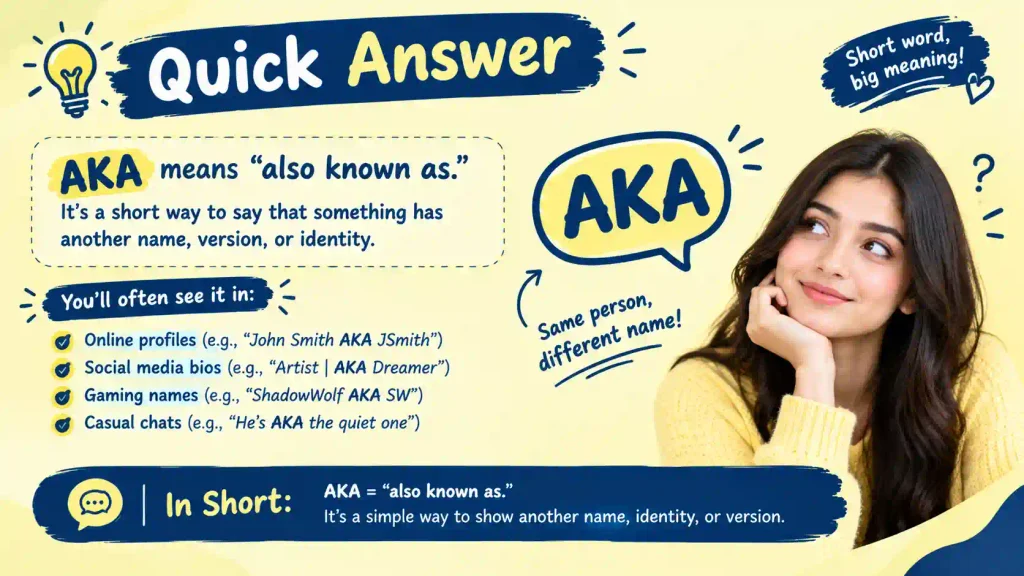
AKA stands for “also known as.” It’s a quick way to attach a second name, nickname, or label to whatever you’re talking about, without breaking the sentence to explain yourself. That’s the short answer, and for most texts and captions, it’s all you need.
But AKA Mean in Text carries more nuance than a one-line definition suggests. How you spell it changes depending on which style guide you’re following. Its tone shifts completely between a court document and an Instagram caption. And it’s frequently confused with lookalike terms like alias, FKA, and i.e., that don’t actually mean the same thing.
This guide covers all of it: the correct spelling for your context, where AKA came from, how to punctuate it, and exactly when to use AKA Mean in Text and when to leave it out.
Quick Answer
AKA introduces an alternate name for a person, place, thing, or idea. It links two labels for the same subject in one sentence:
“Bruce Wayne, aka Batman, funds the city’s best hospital wing.”
Whatever comes right after “aka” is almost always the second name. Context does the rest of the work; you rarely need to look it up mid-conversation, which is exactly why AKA Mean in Text has survived in casual writing for nearly a century.
How to Pronounce AKA
Say each letter individually: “ay-kay-ay.” It’s pronounced the same way as FBI or ATM, not as a blended word like “NASA.” That makes AKA an initialism, not an acronym a distinction worth knowing even though most people use the two words interchangeably in casual conversation.
- Acronym: pronounced as one word (NASA, scuba)
- Initialism: pronounced letter by letter (AKA, FBI, ATM)
AKA, A.K.A., or Aka: Which Spelling Should You Use?
This is where most guides give you a shrug and move on. Here’s a more precise answer: it depends on which style guide you’re following, and the guides genuinely disagree.
| Style Guide | Preferred Form | Notes |
| AP Stylebook | aka | No periods, lowercase |
| Merriam-Webster | aka | Lists “aka” as the primary entry |
| Oxford English Dictionary | aka | No periods |
| Chicago Manual of Style | a.k.a. | Explicitly prefers periods (CMOS 10.4) |
| APA (academic papers) | a.k.a. | Periods retained in formal citations |
If you’re writing for the web, social media, journalism, or general business use, “aka” without periods is the safer, more modern choice. If you’re working within an academic paper that follows Chicago or APA formatting, keep the periods as a.k.a.
Capitalization is more flexible: AKA, Aka, and aka are all accepted. The only real rule is consistency: pick one style and use it throughout the same piece of writing.
Where AKA Comes From
AKA Mean in Text didn’t start as internet slang. Etymological records trace it to legal and law-enforcement documentation, with attestations dating to 1935. Police reports and court records used it as shorthand to list a suspect’s known aliases a practical tool for keeping identity records accurate when someone had more than one name on file.
From there, it moved steadily outward: into journalism and crime writing by mid-century, then into general nonfiction, and eventually into the casual, ironic register it’s known for today. That journey from courtroom paperwork to Instagram captions is part of why AKA Mean in Text works comfortably in both a legal filing and a text message. Few abbreviations manage that range.
Using AKA in Texts and on Social Media
This is where AKA gets its personality. In texting and captions, it rarely just states a fact; it usually adds a wink.
In a text message:
“Running 20 minutes late, aka my default setting.”
In an Instagram or TikTok caption:
“Home alone tonight, aka the best kind of Friday.”
In a group chat, matching a username to a person:
“That’s ChaosGremlin92, aka Priya from accounting.”
The tone shift matters. When AKA sits between two plain facts, it’s informational. When it sets up a gap between what you’d expect and what’s actually true, it’s doing comedic work; that gap is the joke.
The Sarcastic AKA
A large share of AKA Mean in Text online is this ironic flavor, where the “second name” undercuts the first:
“Deep cleaned the kitchen, aka wiped one counter and called it done.”
This construction is so common that it’s arguablyAKA Mean in Text’s dominant use in casual writing today, more common than its original, literal identity-linking function. That’s a real shift worth naming: AKA has partly evolved from a naming tool into a punchline delivery mechanism.
AKA in Formal and Professional Writing
AKA isn’t confined to casual contexts. It shows up in legal documents and court records (linking a legal name to any known alias), business filings (though here its cousin DBA is more common), journalism and biographies (introducing a stage name or pen name), and background checks, where accuracy across name variations matters most.
Should you use it in a resume or professional email? Generally, keep it out with one exception. If you’ve legally changed your name and need to connect your former name to your current one for verification purposes, AKA is the standard way to do it: “Jane Doe (aka Jane Smith).” Outside that case, spelling out “also known as,” or simply choosing one name, reads as more polished.
AKA vs. Similar Terms: How to Tell Them Apart
AKA gets confused with several near-synonyms. Here’s how they actually differ:
| Term | Meaning | Best Used For | Timing |
| AKA | Also known as | Any alternate name, casual or formal | Current name |
| Alias | An assumed identity | Legal and criminal contexts | Current name |
| Nickname | A friendly, informal name | Friends, family | Current name |
| Pseudonym | A name for public creative work | Authors, artists, performers | Current name |
| FKA | Formerly known as | Rebrands, name changes | Past name, now dropped |
| NKA | Now known as | Legal name updates | New legal name |
| DBA | Doing business as | Business and company names only | Current name |
| i.e. | “That is,” restates a point | Clarifying an idea, not naming it | N/A |
| e.g. | “For example” | Giving one sample from a group | N/A |
Two mix-ups are worth flagging specifically. AKA vs. FKA: AKA is a name someone still uses; FKA is a name they’ve dropped. “The artist formerly known as Prince” is FKA territory; that name is retired. AKA vs. i.e./e.g.: AKA swaps in a new name for the same subject, while i.e. restates an idea and e.g. gives one example. None of the three does the other’s job.
Punctuation: How to Write It in a Sentence
AKA Mean in Text almost always interrupts a sentence to insert extra information, which means it needs commas on both sides, the same rule that governs any parenthetical phrase.
Correct: “My upstairs neighbor, aka the world’s loudest sneezer, is home again.”
Missing commas (harder to read): “My upstairs neighbor aka the world’s loudest sneezer is home again.”
The only time you drop the second comma is when AKA falls at the very end of the sentence: “Everyone calls him Doc, aka the guy who fixes everything.”
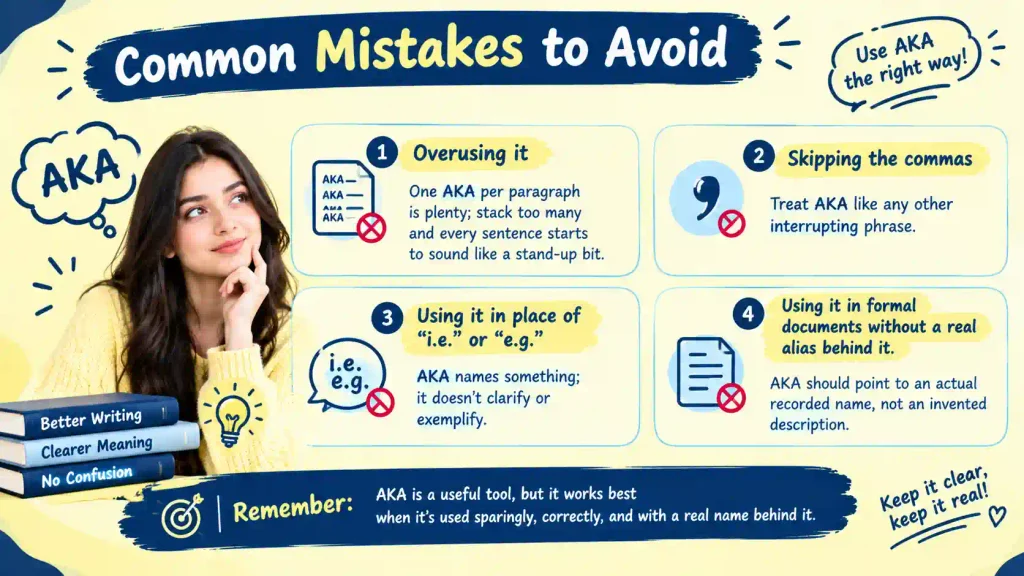
Common Mistakes to Avoid
- Overusing it. One AKA per paragraph is plenty; stack too many and every sentence starts to sound like a stand-up bit.
- Skipping the commas. Treat AKA like any other interrupting phrase.
- Using it in place of “i.e.” or “e.g.” AKA names something; it doesn’t clarify or exemplify.
- Using it in formal documents without a real alias behind it. AKA should point to an actual recorded name, not an invented description.
Other Meanings of AKA (Beyond “Also Known As”)
Outside its usual job, “AKA” occasionally refers to something entirely unrelated. Context always makes clear which one applies:
- Alpha Kappa Alpha (AKA), a historically Black sorority founded in 1908, often called “AKA” by members
- AKA: stage name of South African recording artist Kiernan Forbes
- Aka an ethnic and linguistic group associated with parts of Central Africa
- American Kennel Association, sometimes shortened to AKA in dog-breeding and registration contexts.
- Above-knee amputation: a clinical abbreviation used in medical documentation
If you’re reading a caption, a text, or a general-interest article, the “also known as” meaning applies the overwhelming majority of the time. The alternate meanings above surface almost exclusively within their specific fields, where surrounding context makes the intended meaning obvious.
Quick Reference: AKA at a Glance
- Means: “Also known as”
- Type: Initialism (say each letter)
- Spelling: “aka” for AP/web/general use, “a.k.a.” for Chicago/APA-formatted academic work
- Origin: Legal and law-enforcement records, documented from 1935
- Punctuation: Set off with commas on both sides when mid-sentence
- Tone range: Fully casual (texting, captions) to fully formal (court records)
- Not the same as: alias (more legal), nickname (more casual), FKA (a name no longer used), i.e./e.g. (clarify, don’t rename)
Frequently Asked Questions
What does AKA Mean in Text?
It means “also known as.” In texting, it introduces a nickname, alternate label, or very often a joking description that contrasts with what was just said.
Is it “aka” or “a.k.a.”?
Both are correct, but not interchangeable across every style guide. AP, Merriam-Webster, and the Oxford English Dictionary prefer “aka” with no periods. Chicago prefers “a.k.a.” with periods. For everyday and web writing, “aka” is the more common choice.
Does AKA have a hidden or romantic meaning when someone texts it?
No. AKA is neutral; it just links two names or descriptions. Any romantic or teasing tone comes from the words around it, not the abbreviation itself.
What’s the difference between AKA and FKA?
AKA connects to a name someone currently uses. FKA connects a name someone used in the past but no longer goes by, typically after a rebrand or legal name change.
Can I use AKA in a resume or professional email?
Generally, no, unless you’re formally connecting a legal name change for verification purposes, such as during a background check. Outside that case, formal writing reads cleaner without it.
Is AKA formal or informal?
Both. It’s one of the few abbreviations that functions naturally in a legal filing and a text message. Register and punctuation should shift with the context, but the abbreviation itself works in either one.
The Bottom Line
AKA has quietly done two jobs at once for nearly a century: a precise legal tool for tracking someone’s known names, and a casual, often sarcastic way to add a punchline to an ordinary sentence. Knowing which job you need it for is really the whole trick.
For everyday writing, stick with lowercase “aka” and no periods, wrap it in commas when it interrupts a sentence, and save “a.k.a.” for Chicago- or APA-style academic work. Skip it in resumes and formal emails unless you’re documenting an actual legal name change.
Read More:OK Mean in Text 2026: Is “OK.” Secretly Making People Hate You?


