“you” is a pronoun, and it does a special job. It points to the person you are talking to. That is why no single word can replace it in every sentence. A word that works in a text to a friend may sound strange in an essay or a business email.
This guide makes the choice easy. You will learn the meaning of “Synonyms for You,” 20 useful alternatives, and the tone of each one. Each Synonyms for You includes a clear note on when to use it and when to avoid it. Each example is short, natural, and easy to copy. You will also see a comparison table, common mistakes, a short quiz, and answers to popular questions.
Whether you are preparing for IELTS or TOEFL, writing an email, or learning English, this guide will help you choose the right word with confidence. Let’s begin.
What Does “Synonyms for You” Mean?
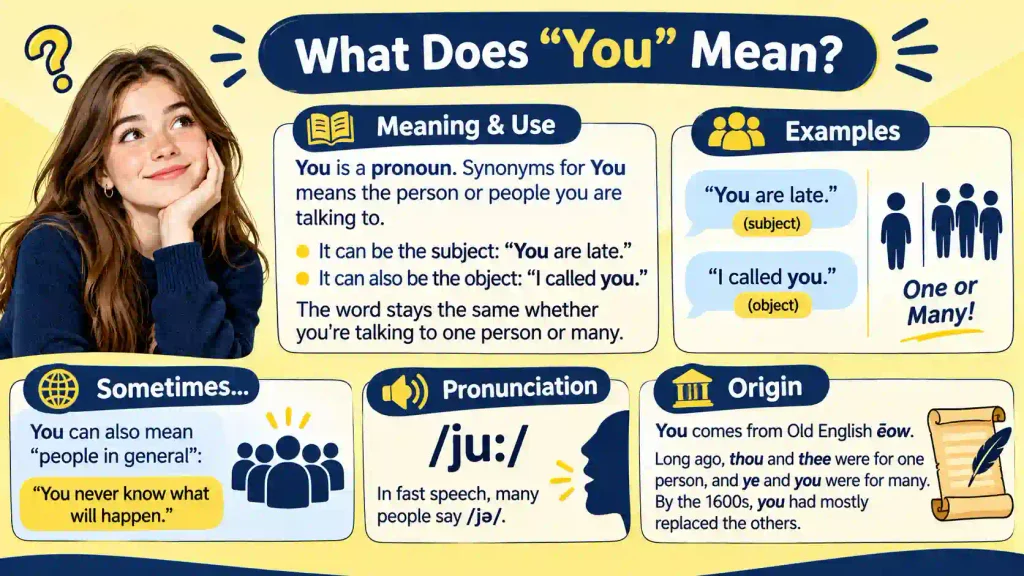
You is a pronoun. Synonyms for You means the person or people you are talking to. It can be the subject: “You are late.” It can also be the object: “I called you.” The word stays the same whether you’re talking to one person or many.
Sometimes, you means “people in general”: “You never know what will happen.”
Pronunciation: /juː/. In fast speech, many people say /jə/.
Origin: you comes from Old English ēow. Long ago, thou and thee were for one person, and ye and you were for many. By the 1600s, you had mostly replaced the others.
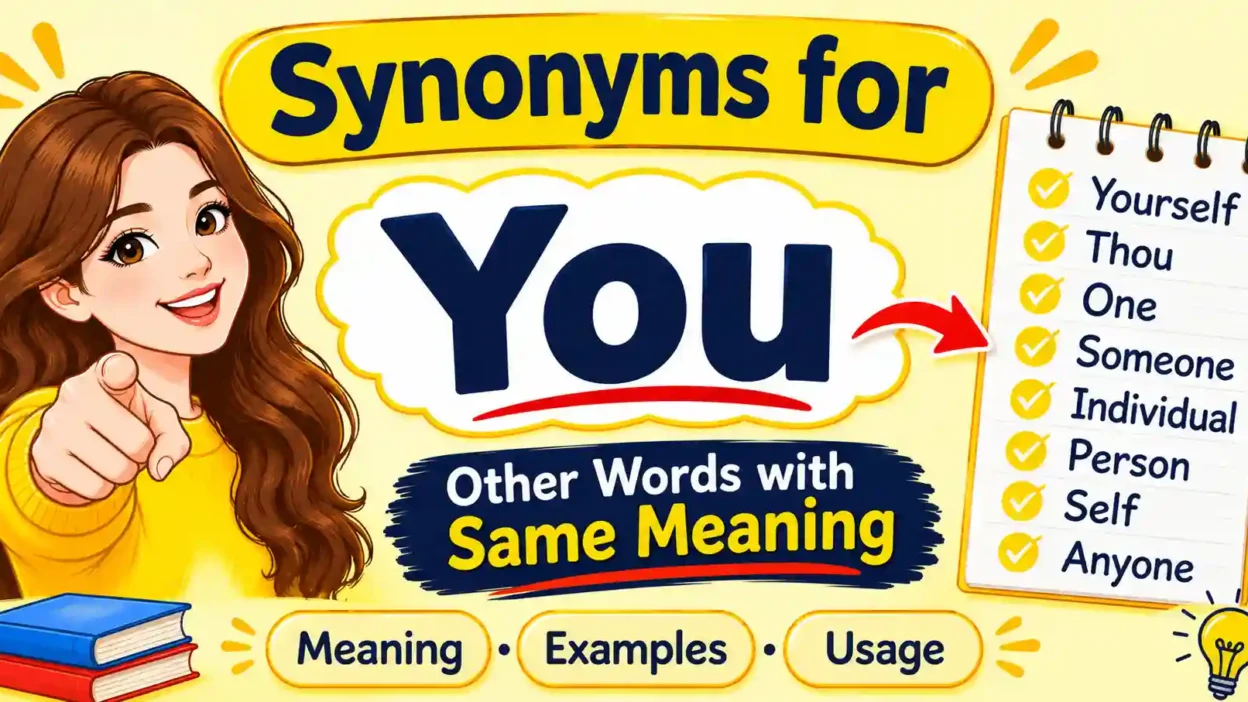
Quick List: Another Word for You
- For a group: all of you, you all, y’all, you guys, you lot
- Old English: thou, thee
- For people in general: one, anyone, people
- For formal writing: the reader, the user, the customer, the client
- For talking to someone: sir, ma’am, mate, buddy, folks, everyone
Synonyms for You by Sense and Context
Each group below has a different job.
When You Mean a Group
all of you (neutral): Clear and polite. It works anywhere.
- “I want all of you to check the answers.”
- “The principal thanked all of you for waiting.”
you all (casual): Mostly spoken. It sounds softer than “all of you.”
- “Are you all ready to begin?”
- “I’ll send you all a reminder tonight.”
y’all (casual, Southern US): Short for “you all.” It sounds friendly. Avoid it in essays.
- “Y’all want some more tea?”
- “We’re glad y’all could come.”
you guys (casual, mostly US): Warm and relaxed. Some people prefer “everyone” for mixed groups.
- “Do you guys need anything else?”
- “I owe you guys a big thank-you.”
you lot (casual, UK): It can sound playful or angry. The tone of voice decides.
- “Are you lot coming to the quiz tonight?”
- “You lot made a big mess in here.”
When You Mean Old-Style English
Use these only in old texts and poems.
thou (very old): It means “you” for one person, as the subject.
- “Thou art my oldest friend.”
- “What dost thou want from me?”
thee (very old): It means “you” for one person, as the object.
- “I bring thee good news.”
- “The king will reward thee.”
When You Mean People in General
one (formal): Careful and a little stiff in American English.
- “One should always read the rules first.”
- “One cannot learn a language without practice.”
anyone (neutral): Relaxed and open to everybody.
- “Anyone can improve with daily practice.”
- “Anyone who reads this guide will avoid common mistakes.”
people (neutral): Simple and clear for general facts.
- “People often forget names in the first week.”
- “People learn faster when they speak aloud.”
When You Write for a Reader
These nouns talk about the reader, not to the reader. They suit essays and manuals.
The reader (formal to neutral): The person reading the text.
- “The reader will find the dates below.”
- “A strong opening pulls the reader in.”
The user (technical): The person using a product or system.
- “The user must create a password first.”
- “The app gives the user a short tour.”
The customer (business): A person who buys goods or services.
- “The customer gets a receipt by email.”
- “Every complaint helps the company understand the customer.”
The client (business): A person who receives a professional service, often over time.
- “The client signs the contract on Friday.”
- “Our designer shows the client three logo ideas.”
When You Speak to Someone
These words add respect or warmth. They usually stand next to “you.” We say “Thank you, sir,” not “Thank sir.”
sir (polite, formal): A respectful word for a man.
- “Your table is ready, sir.”
- “Excuse me, sir, you dropped your wallet.”
ma’am (polite, mostly US): Short for “madam,” which is more formal.
- “May I see your ticket, ma’am?”
- “Good morning, ma’am. How can I help?”
mate (casual, British and Australian): Friendly and relaxed.
- “Thanks, mate. You saved me.”
- “Are you all right, mate?”
buddy (casual, US): Friendly, but it can sound sharp when the speaker is annoyed.
- “Thanks, buddy. You really helped.”
- “Listen, buddy, you can’t park here.”
folks (casual): A warm way to greet a group.
- “Folks, you can get coffee now.”
- “Thanks for coming, folks.”
everyone (neutral): Speaks to the whole group calmly.
- “Everyone, please open your books.”
- “Good morning, everyone. Welcome back.”
Comparison Table: Which Word Fits Best?
| Word | Meaning | Tone | Best used when | Example |
| all of you | Every person in a group | Neutral | Clear rules or thanks | “All of you did well.” |
| y’all / you all | You (many people) | Casual | Friendly talk in the US South | “Y’all ready?” |
| you guys / you lot | You (many people) | Casual | Chat with friends (US / UK) | “Do you guys need help?” |
| thou / thee | You in old English | Old-fashioned | Poems and old texts | “I bring thee news.” |
| one / anyone | Any person in general | Formal / neutral | General facts | “Anyone can apply.” |
| the reader / the user | The person who reads or uses | Formal / technical | Essays and manuals | “The user taps Save.” |
| sir / ma’am | Polite way to address someone | Respectful | Shops and customer service | “May I help, ma’am?” |
You vs Confusable Words
you’re means “you are.” Example: “You’re right.”
your shows ownership. Example: “Your bag is here.”
yourself points back to the person you address. Example: “Did you hurt yourself?” It cannot be the subject, so “Yourself should apply” is wrong.
Teacher tip: swap “you” for the new word. If you must change other words, it is only a related word, not a synonym.
How to Choose the Right Alternative
Ask three questions. Who am I talking to? Is it formal? Does the sentence still work?
Formal Writing
Use the reader, the user, or one. Or rewrite the sentence: “The data are shown below.”
Casual Speech
Use you guys, y’all, mate, or buddy. Choose the word that matches your region.
Academic Writing (IELTS, TOEFL, Essays)
Many teachers advise against using “you” for people in general in formal essays. Write “People should exercise daily.”
Business Writing
Use the customer or the client in policies. In a direct email, “you” is clearer.
Creative Writing
Use thou and thee for historical voices. Use y’all, or you lot to show where a character comes from.
Antonyms of You
The word “you” has no true opposite. The closest contrasts are words for the speaker or other people.
- I/me (the speaker): “I will call you tomorrow.”
- we/us (the speaker and others): “We will meet you there.”
- they/them (other people): “They told you the truth.”
Related Words, Idioms and Collocations
Common phrases: thank you, see you, bless you, after you.
Idiom:
- between you and me (privately): “Between you and me, the test was hard.”
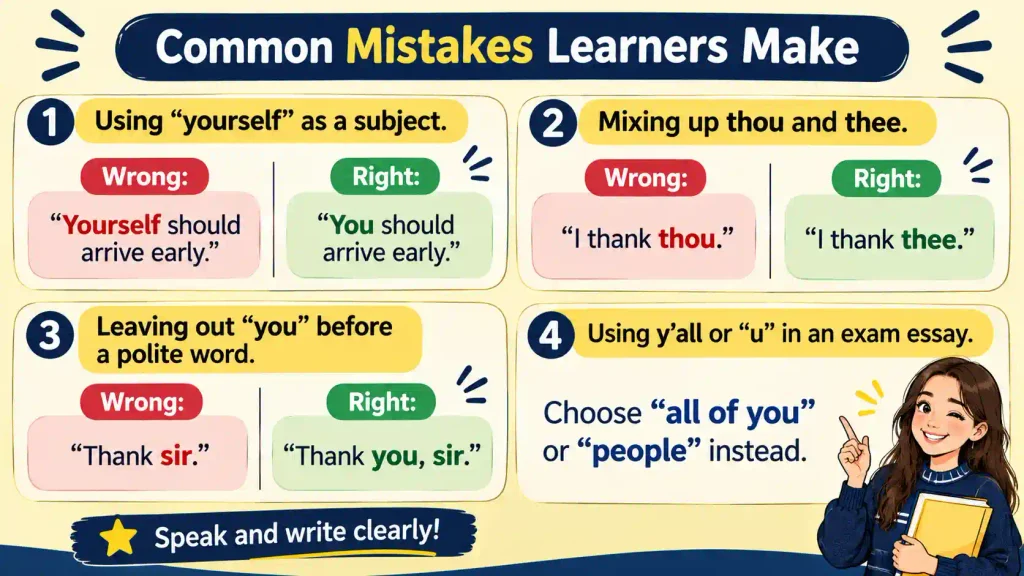
Common Mistakes Learners Make
- Using “yourself” as a subject. Wrong: “Yourself should arrive early.” Right: “You should arrive early.”
- Mixing up thou and thee. Wrong: “I thank thou.” Right: “I thank thee.”
- Leaving out “you” before a polite word. Wrong: “Thank sir.” Right: “Thank you, sir.”
- Using y’all or “u” in an exam essay. Choose “all of you” or “people” instead.
Mini Quiz: Test Yourself
- “I bring good news.” (thou/thee / thy)
- Best word for a software manual: “ must enter a password.” (Buddy / The user / Y’all)
- A friendly British thank-you: “Cheers, !” (mate / sir / one)
- Fix the mistake: “Yourself should arrive by nine.”
- Which one is NOT a synonym of you: y’all, anyone, or your?
Answers: 1) thee. 2) The user. 3) mate. 4) “You should arrive by nine.” 5) your.
Frequently Asked Questions
What is another word for Synonyms for You?
There is no perfect one-word replacement, because you is a pronoun. For groups, use y’all, you all, or you guys. For people in general, use one or anyone. In formal writing, use the reader or the user.
What is a formal word for Synonyms for You?
One: the reader and the user are formal choices. In business writing, use the customer or the client. However, you is fine in most emails, because it is clear and friendly.
What is the plural of you?
The plural of you is you. English uses one word for one person or many. To show a group, say you all, all of you, y’all or you guys in the US, and you lot in the UK.
Is yourself a synonym for you?
No. Yourself is a reflexive pronoun that points back to the person you address, as in “Did you hurt yourself?” It cannot be the subject, so “Yourself should apply” is wrong.
What is the difference between thou and thee?
Thou is the old word for you as the subject. Thee is the old word for you as the object. Say “Thou art kind,” but “I thank thee.” Today, use both words only for effect.
Can I use Synonyms for You in academic writing?
Sometimes, but check your task rules first. Many teachers advise against using “you” for people in general in formal essays. Writers often use people, one, or the reader instead.
Conclusion
The right Synonyms for You depend on your situation. Use y’all or you guys when you talk to a group. Use one or anyone for people in general. Choose the reader or the user in formal writing. Keep thou and thee for old books and poems.
Remember this simple rule: if a new word forces you to change the rest of the sentence, keep “you.” Clear writing is better than fancy writing.
Now it is your turn. Pick three words from this guide and use them in sentences today. Bookmark this page, share it with a friend who is learning English, and come back whenever you need another word for you. Your English will grow one word at a time.

Rachel is a passionate linguist and content writer with a love for the English language’s hidden nuances. With years of experience in teaching ESL students, she specializes in breaking down idioms and similes into simple, everyday examples. Her mission is to make English learning fun, not intimidating.