“Overall” is useful, but it appears everywhere. Students open every paragraph with it, and writers lean on it in every report. Soon the text sounds repetitive and flat. A better word makes your writing clear, confident, and natural.
This guide is made for English learners, students, writers, and IELTS or TOEFL candidates. Instead of one long list, it sorts every word by its job: a final verdict, a “mostly” statement, or an adjective like “overall cost”. You will also find original examples, a comparison table, antonyms, common mistakes, a short quiz and clear answers to popular questions.
Read on to find the exact word for your essay, email or conversation. Pick one, try it in a sentence, and notice the difference straight away. Every word below comes with its tone, its limits, and two natural examples, so you never have to guess.
What Does “Synonyms for Overall” Mean?
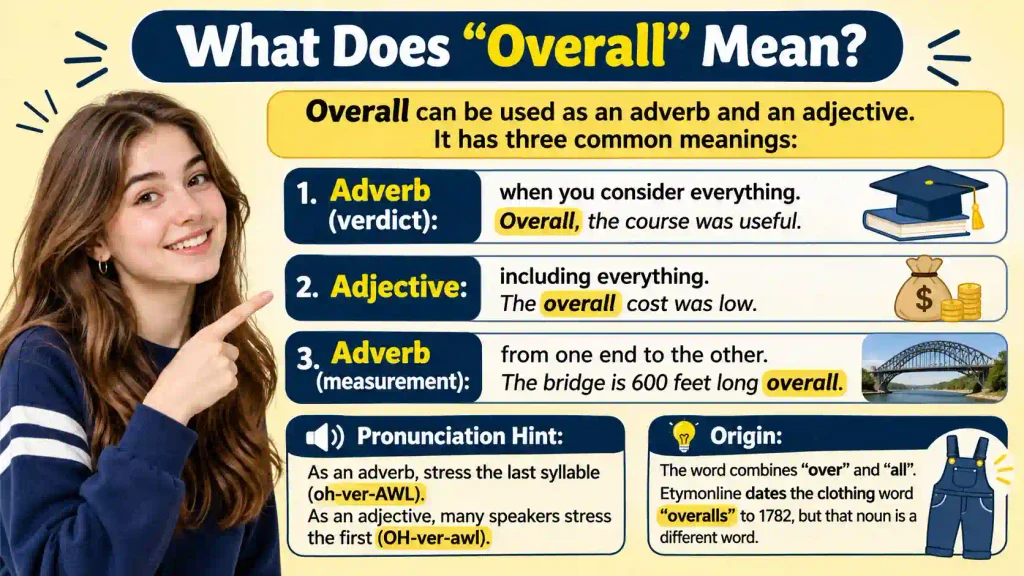
Overall can be used as an adverb and an adjective. It has three common meanings:
- Adverb (verdict): when you consider everything. Overall, the course was useful.
- Adjective: including everything. The overall cost was low.
- Adverb (measurement): from one end to the other. The bridge is 600 feet long overall.
Pronunciation hint: as an adverb, stress the last syllable (oh-ver-AWL). As an adjective, many speakers stress the first (OH-ver-awl).
Origin: the word combines “over” and “all”. Etymonline dates the clothing word “overalls” to 1782, but that noun is a different word.
Quick List: Another Word for Overall
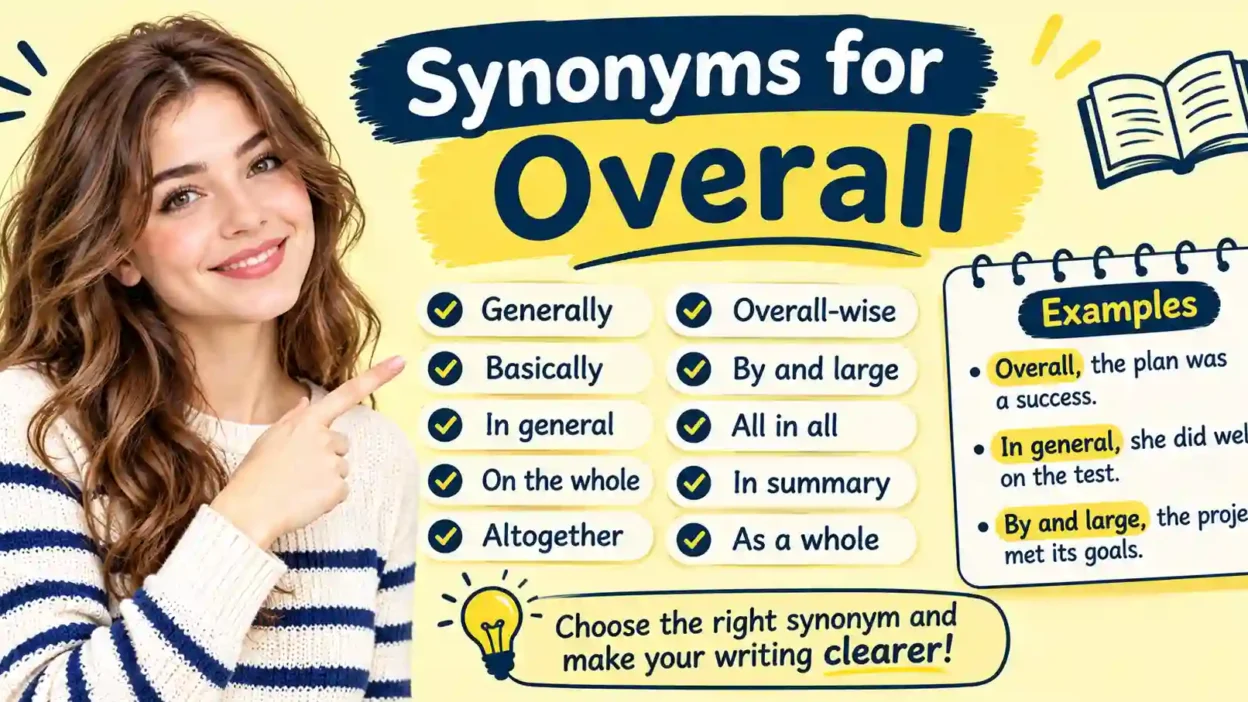
Verdict: all in all, on the whole, in general, by and large, all things considered, on balance, in sum, as a whole.
Meaning “mostly”: largely, mainly, mostly, predominantly.
Adjectives: total, comprehensive, general, all-inclusive, sweeping, gross, aggregate, overarching.
How we chose these synonyms: each word was checked against its dictionary sense and tested in real sentences. Words that fit only one context carry a warning.
Classroom tip: students often begin every paragraph with “Overall.” Use one verdict word per text.
Synonyms for Overall by Sense and Context
1. Verdict phrases
Use these at the start or end of a sentence. Add a comma after an opening phrase.
All in all gives a friendly final judgment (informal to neutral).
- All in all, the trip cost less than we expected.
- The café is noisy, but all in all, I would return.
On the whole accepts small flaws and still gives a verdict (neutral to formal).
- On the whole, the students handled the new software well.
- The film has slow scenes, but on the whole it is worth seeing.
In general describes a usual pattern, not one event, so avoid it for a single trip.
- In general, buses here run late on Fridays.
- My sister prefers tea to coffee, in general.
By and large means “despite a few exceptions” (informal to neutral).
- By and large, our neighbors were kind to us.
- The town has changed very little, by and large.
All things considered shows that you weighed every factor.
- All things considered, we chose the cheaper flight.
- The surgery went well, all things considered.
On balance compares good points with bad ones (formal).
- On balance, remote work brings more benefits than costs.
- On balance, I would hire the second candidate.
In sum introduces a summary of points already made (formal).
- In sum, the three experiments point to the same result.
- In sum, the plan is cheap, fast and safe.
As a whole treats a group or thing as one unit. It often follows the noun.
- The team as a whole improved this season.
- As a whole, the book is more thoughtful than funny.
2. Words that mean “mostly” (not interchangeable)
These words show proportion, not a final verdict. “Overall, the trip was great” sounds natural, but “Largely, the trip was great” does not.
Largely means “to a great extent” and often explains a cause.
- The delay was largely due to bad weather.
- The report is largely accurate, though two figures are wrong.
Mainly points to the chief reason or the biggest part.
- She reads mainly crime novels.
- Our visitors come mainly from Spain and Italy.
Mostly is informal and means “in most cases”.
- The room was mostly empty by nine.
- I mostly walk to work.
Predominantly is formal and means the largest share.
- The audience was predominantly female.
- The region is predominantly rural.
3. Adjective synonyms
Use these in phrases such as “the overall cost”.
Total means everything added together.
- The total cost was $480.
- Total sales rose in May.
Comprehensive means it covers everything needed (neutral to formal).
- She wrote a comprehensive guide to local hiking trails.
- The plan offers comprehensive coverage.
General means broad, not detailed.
- My general impression of the school is positive.
- He has a general idea of the plan.
All-inclusive refers to prices and packages that cover everything, not opinions.
- The all-inclusive price covers meals and tours.
- We booked an all-inclusive week by the sea.
Sweeping means wide-reaching, and it can sound critical when used for statements.
- The city announced sweeping changes to its parking rules.
- It is unfair to make a sweeping statement about teenagers.
Gross is technical and means “before deductions”, so use it only for money or weight.
- Her gross pay is $3,000 a month, before tax.
- The truck’s gross weight, with cargo, is twelve tons.
Aggregate means combined from separate parts (formal and technical). British football uses “on aggregate” for a two-match total.
- The aggregate score decides who goes through.
- Aggregate demand fell during the winter.
Overarching names the highest-level goal or theme (formal), not costs or impressions.
- The company’s overarching goal is to cut waste.
- One overarching theme runs through the poems.
Comparison Table: Which Overall Synonym Fits Best?
| all in all | final judgment | informal-neutral | reviews, chats | All in all, the day went smoothly. |
| on the whole | verdict despite flaws | neutral-formal | reports, feedback | On the whole, the training helped. |
| in general | usual pattern | neutral | habits, trends | In general, winters here are mild. |
| on balance | pros against cons | formal | business, essays | On balance, the merger makes sense. |
| total | everything added up | neutral | costs, scores | Our total bill was $62. |
| largely | to a great extent | neutral-formal | causes | The problem is largely financial. |
Overall vs. Confusable Words
Overall vs. overalls: “overalls” is a noun for loose work clothing. In US English, it often means bib trousers, and in British English, a one-piece work suit. It is not a synonym.
Overall vs. in conclusion: “overall” can appear anywhere, but “in conclusion” belongs only in your final paragraph.
Overall vs. mostly: “mostly” shows proportion, while “overall” gives the big picture. “The staff is mostly young” is a fact, but “Overall, the staff is happy” is a judgment.
How to Choose the Right Synonym
- Formal or academic: on balance, in sum, as a whole, comprehensive.
- Business emails: on the whole, on balance, all things considered, total.
- Casual speech: all in all, by and large, mostly.
- Creative writing: skip the vague opener and show the scene. Instead of “Overall, the house was shabby,” write “Peeling paint, a sagging porch, one working light.”
- IELTS and TOEFL: “overall” suits a Task 1 overview. In Task 2, vary it with “on balance” or “in sum”.
Quick-pick rule: one verdict? Use all in all or on the whole. A habit? Use in general. A total? Use total. A weighed choice? Use on balance.
Antonyms of Overall With Examples
Specifically and in particular: “Specifically, the second chapter needs more evidence.” “I enjoyed the music in particular.”
Specific: “Give me a specific example.” “She had no particular reason to leave.”
Partial and partially: “The road is only partially open.” “We received a partial refund.”
Related Words, Idioms and Collocations
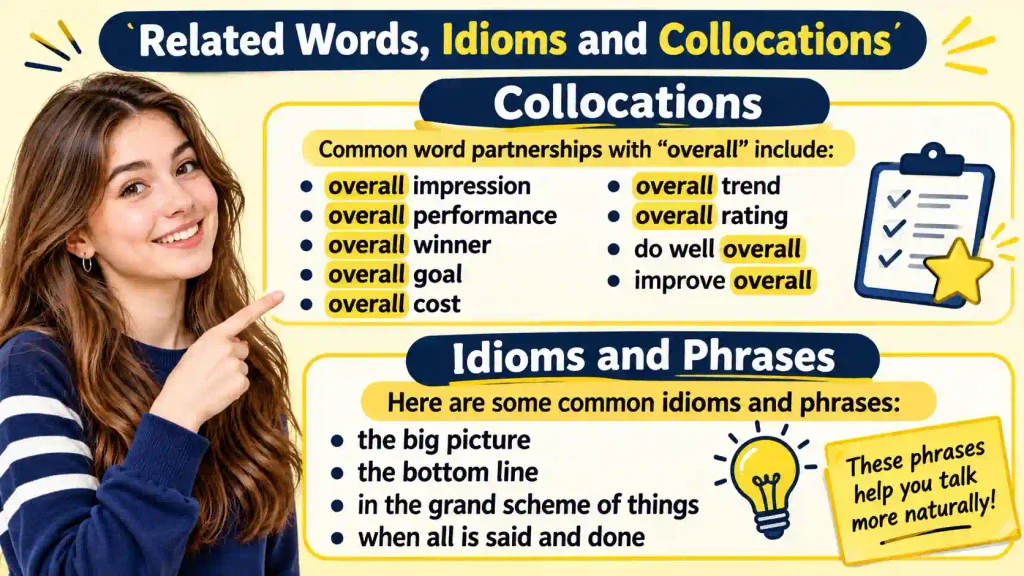
Collocations: overall impression, overall performance, overall winner, overall goal, overall cost, overall trend, overall rating, do well overall, improve overall.
Idioms and phrases: the big picture, the bottom line, in the grand scheme of things, when all is said and done.
Common Mistakes Learners Make
- Missing the comma: write “Overall, the plan worked,” not “Overall the plan worked.”
- Using “the overall” as an adverb: write “Overall, the team played well,” not “The overall, the team played well.”
- Using “mostly” or “largely” as a verdict. They show proportion, not judgment.
- Using “in general” for one event. Choose “all in all” or “on the whole” instead.
- Starting every paragraph with “overall”. Use it once, then vary your sentences.
- Confusing “overall” with “overalls”. One is a general word, and the other is clothing.
- Writing “overall total”. The two words repeat the same idea.
Mini Quiz: Test Your Choice
- Which phrase gives a friendly final verdict? (a) mostly (b) all in all (c) gross
- The price covers meals and tours. (a) all-inclusive (b) sweeping (c) general
- True or false: “Largely” can replace “overall” at the start of a verdict.
- Which is punctuated correctly? (a) Overall the plan worked. (b) Overall, the plan worked.
- Which word is an opposite of “overall”? (a) total (b) specific (c) comprehensive
Answers: 1-b. 2-a. 3-False; “largely” shows proportion. 4-b. 5-b.
Frequently Asked Questions
What is another word for overall?
Another word for overall is “on the whole” when you give a final verdict. Other good choices include all in all, in general, by and large, and all things considered. For adjectives, use total, comprehensive, or general. Choose the word that matches your sentence, not only the meaning.
What can I say instead of “overall” in an essay?
Use “on balance”, “on the whole” or “in sum” in an essay. “On balance” fits arguments that weigh pros and cons, while “in sum” fits a summary of points already made. Keep “all in all” and “mostly” for less formal writing.
What is the difference between “overall” and “in general”?
“Overall” gives a verdict after considering everything, often about one situation. “In general” describes a usual pattern across many cases. “Overall, the trip was great” is natural, while “In general, trips here are cheap” describes a pattern.
What is the opposite of overall?
The opposite of overall is “specifically” or “in particular” for adverbs, and “specific”, “particular” or “partial” for adjectives. “Overall” looks at the whole picture, while these words focus on one detail or part
Do I need a comma after “overall”?
Yes, put a comma after “overall” when it begins a sentence: “Overall, the plan worked.” The comma separates the opener from the main clause. You do not need one when “overall” is an adjective inside the sentence, as in “The overall plan worked.”
Can I use “overall” in an IELTS essay?
Yes. “Overall” is common in IELTS Writing Task 1 overviews. In Task 2, vary it with “on balance” or “in sum,” so your vocabulary looks wider. Do not replace it with “mostly” or “largely”.
Conclusion
The best synonyms for overall depend on the job the word is doing. Use on the whole, all in all, or on balance for a final verdict. Choose in general for a usual pattern, and pick total or comprehensive when you need an adjective. Avoid mostly and largely when you want a verdict, because they show proportion, not judgment.
Now try it yourself. Open your last essay or email, find the word “overall”, and replace it with the best fit from this guide. Small word choices make your writing sound more precise and more professional.
Read More:Synonyms for Focus: 20 Other Words With Meanings, Examples and Tips