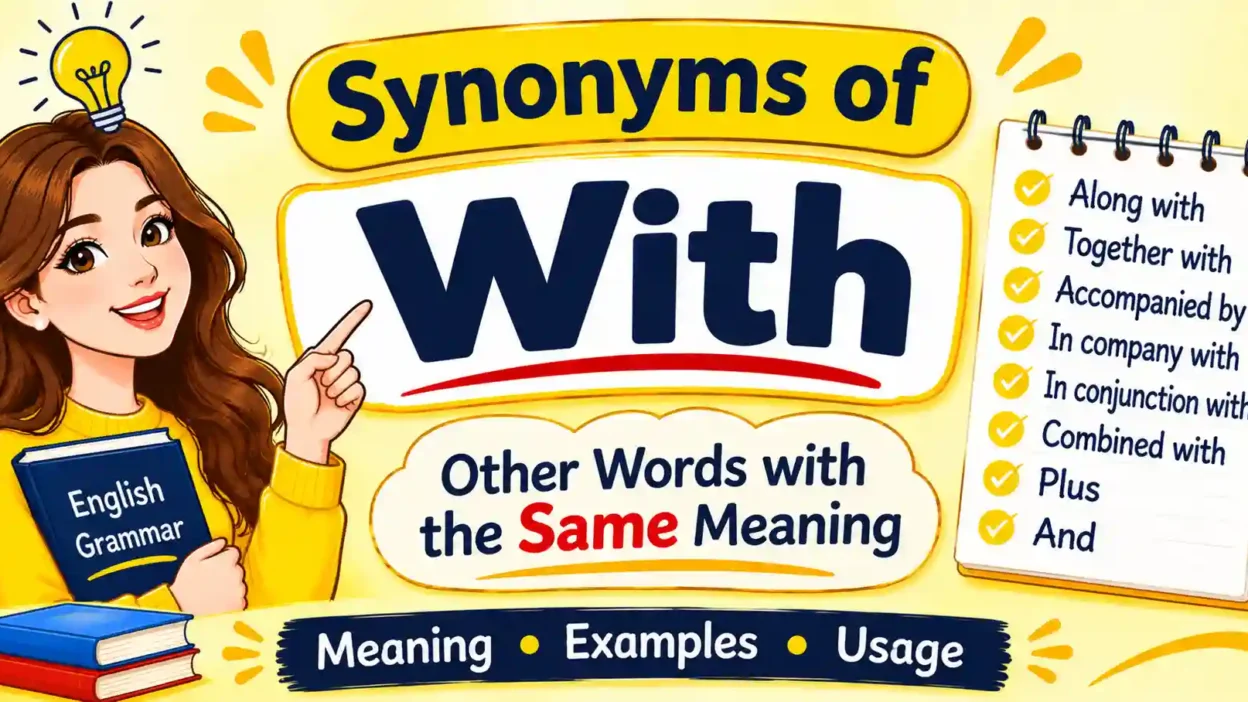
The best synonyms for “with” are alongside, together with, accompanied by, using, by means of, including, plus, and featuring. However, there is a catch: “with” does seven different jobs, so no single replacement fits every sentence.
Have you ever noticed “Synonyms of With” in almost every line of your essay? Or swapped it for a fancier word and watched the sentence turn awkward? You are not alone. Learners, students, and writers all face this problem, and a thesaurus rarely explains which word fits which meaning.
This guide solves it with one simple idea: choose the synonym by the job “with” is doing. You will find 20 alternatives sorted by meaning, each with a tone label, a short note, and fresh examples. You will also learn which look-alike words to avoid, which mistakes to watch for, and which words suit IELTS, TOEFL, business emails, and creative writing.
What Does “Synonyms of With” Mean?
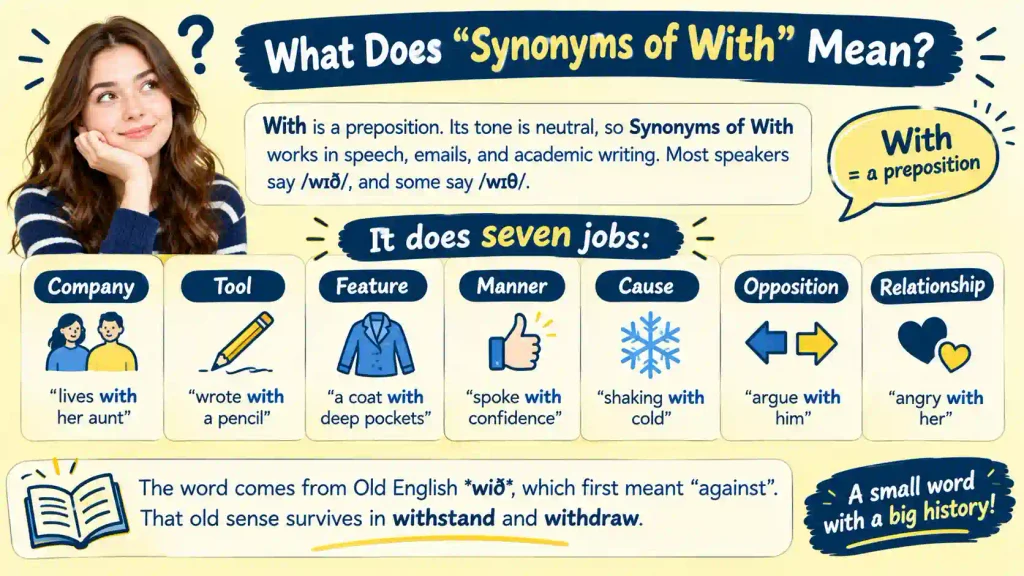
With is a preposition. Its tone is neutral, so Synonyms of With works in speech, emails, and academic writing. Most speakers say /wɪð/, and some say /wɪθ/.
It does seven jobs: company (“lives with her aunt”), tool (“wrote with a pencil”), feature (“a coat with deep pockets”), manner (“spoke with confidence”), cause (“shaking with cold”), opposition (“argue with him”) and relationship (“angry with her”).
The word comes from Old English wið, which first meant “against”. That old sense survives in withstand and withdraw.
Quick List: 20 Alternatives to With
- Company: alongside, together with, accompanied by, in the company of, in collaboration with
- Tool or method: using, by means of, via, through
- Addition: including, plus, in addition to, as well as
- Feature: featuring, having, boasting, wearing
- Cause: thanks to, because of
- Contrast: despite
How we chose these synonyms: we tested each word in real sentences and kept only those that replace “with” in one clear meaning. Stiff or narrow words are labeled.
Synonyms of With by Meaning and Context
Each word below replaces “with” in one sense only. In casual speech, plain “with” is often best.
1. Company
alongside (neutral): shared effort between equals.
- Younger players trained alongside the national squad.
- Volunteers worked alongside firefighters all night.
together with (neutral-formal): stresses a group. The verb follows the first noun. “Along with” works the same way.
- The captain, together with two cadets, was waiting.
- Return the form together with a copy of your passport.
accompanied by (formal): common in news, events, music and food.
- The minister arrived accompanied by two advisers.
- A slide show accompanied the speech.
in the company of (formal, literary): enjoying people’s presence.
- Grandpa is happiest in the company of old friends.
- She grew up in the company of three brothers.
in collaboration with (formal, still contains “with”): joint projects.
- The study ran in collaboration with three universities.
- Students built the app in collaboration with a museum.
2. Tool or method
using (neutral): the default swap for a tool.
- Lena fixed the zipper using a needle and thread.
- Check your answer using a calculator.
by means of (formal, stiff in speech): technical methods.
- Water reaches the village by means of a pipeline.
- The ships communicated by means of signal flags.
via (neutral): a route or channel.
- Tickets are sold via a mobile app.
- Our flight to Tokyo goes via Doha.
through (neutral): process, effort or person.
- Imran improved his accent through daily practice.
- She found the flat through a colleague.
3. Addition
including (neutral): names part of a set.
- The tour costs $50, including lunch.
- All flights, including those to Dubai, were delayed.
plus (informal): extras and prices.
- Rent is $900, plus utilities.
- I packed two sandwiches, plus an apple.
in addition to (formal): an extra on top.
- In addition to her salary, she gets a travel allowance.
- He teaches biology in addition to chemistry.
as well as (neutral): balanced addition. The verb follows the first subject.
- The hotel has a gym as well as a rooftop pool.
- Ravi, as well as his sisters, was invited.
4. Feature
featuring (neutral, promotional): highlights a notable feature.
- We booked a cabin featuring a wood stove.
- Local artists held a show featuring old-town paintings.
having (formal, stiff in speech): rules and definitions.
- Choose a laptop having at least 16 GB of memory.
- Anyone having a valid pass may enter.
boasting (informal, promotional): proud and positive.
- The town, boasting two castles, draws many visitors.
- The new stadium, boasting 60,000 seats, opens in May.
wearing (neutral): clothes and accessories.
- The woman wearing a lab coat greeted us.
- A boy wearing red boots splashed through puddles.
5. Cause
thanks to (neutral): a good cause that deserves credit.
- Thanks to the new bridge, the commute is shorter.
- We won thanks to a late goal.
because of (neutral): any cause.
- Several flights were canceled because of fog.
- She missed the call because of a dead battery.
6. Contrast
despite (neutral-formal, narrow): replaces “with” in “With all her training, she froze.”
- Despite his injury, Omar finished the race.
- Despite the early start, nobody looked tired.
Comparison Table: Which Word Fits Best?
| alongside | as an equal partner | Neutral | describing teamwork | The interns trained alongside senior engineers. |
| accompanied by | having someone along | Formal | writing reports | The film was accompanied by live music. |
| using | by means of a tool | Neutral | giving instructions | Slice the bread using a serrated knife. |
| by means of | through a device | Formal | technical writing | Heat is stored by means of molten salt. |
| via | through a channel | Neutral | naming apps or routes | Send your CV via the job portal. |
| featuring | having a notable part | Promotional | writing ads | She rents a loft featuring tall windows. |
| despite | although there was | Neutral-formal | showing contrast | Despite heavy rain, the match went ahead. |
With vs. Confusable Words
With vs. and: “And” joins equal items and takes a plural verb. Compare “Sana and Omar are cooking” with “Sana is cooking with Omar.”
With vs. beside or near: these show position only. “She sat with him” means together. “She sat beside him” tells you where.
With vs. among: “among” needs a group of three or more. “She felt calm among the crowd” cannot take “with” without changing the meaning.
With vs. within: “within” means inside a limit, as in “within an hour”. It is not a synonym.
How to Choose the Right Synonym
Use this three-step swap test:
- Name the job “with” is doing.
- Pick a word from that group and check the grammar.
- Read the sentence aloud. If it sounds stiff, keep “with”.
- Casual: keep with, or use plus, using, or because of.
- Academic (IELTS, TOEFL): through, in addition to, accompanied by and despite.
- Business: in collaboration with, via, including and thanks to.
- Creative: alongside, in the company of and wearing.
American writers often prefer “because of”, while “owing to” can sound more British.
Antonyms of With
- without: “Zara left home without her keys.”
- excluding: “The price is $40, excluding tax.”
- against: “Half the town stood with the mayor, and half stood against her.”
Related Words, Idioms and Collocations
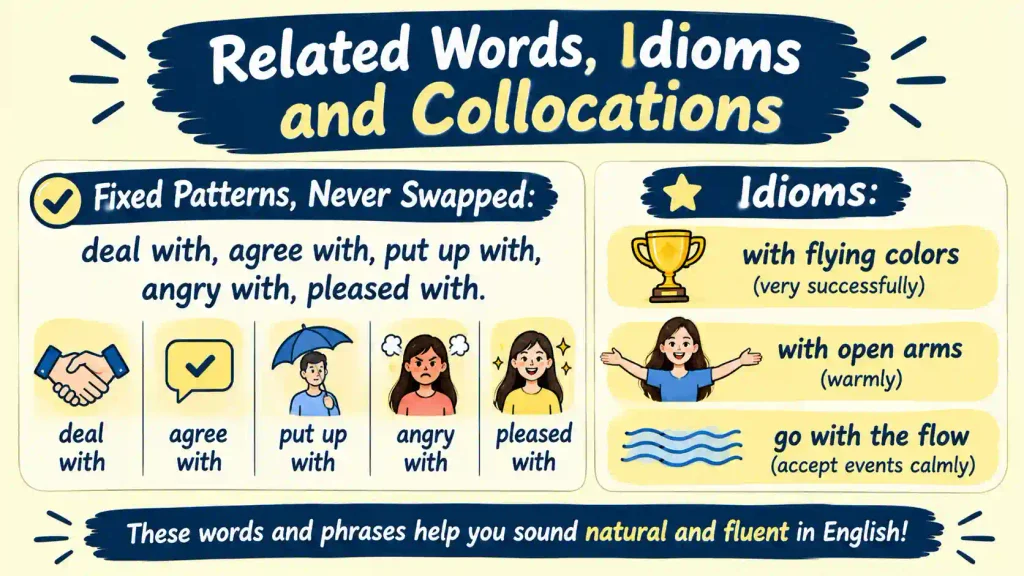
- Fixed patterns, never swapped: deal with, agree with, put up with, angry with, pleased with.
- Idioms: with flying colors (very successfully), with open arms (warmly), go with the flow (accept events calmly).
Common Mistakes Learners Make
- Wrong: “She cut the bread by a knife.” Right: “with a knife” or “using a knife”.
- Wrong: “I sat near my sister” (when you mean together). Right: “I sat with my sister.”
- Wrong: “The coach, together with his players, are late.” Right: “is late.”
- Wrong: “She is married with a doctor.” Right: “married to a doctor.”
- Wrong: “Despite of the rain.” Right: “Despite the rain.”
Mini Quiz
- Choose the best swap: “Lena fixed the lamp a small screwdriver.” (a) by (b) using (c) near
- Choose the correct verb: “The coach, together with two players, (is/are) waiting.”
- Which word can replace “with” in “a hotel with a rooftop pool”? (a) featuring (b) among (c) via
- Replace “With” in “With all her training, she froze.” (a) Despite (b) Plus (c) Via
- True or false: “near” is a good synonym for “with” for company.
Answers: 1. (b) using. 2. is. 3. (a) featuring. 4. (a) Despite. 5. False, because “near” shows location only.
FAQs
What is another word for Synonyms of With?
Common alternatives include alongside, together with, using, including, and featuring. No single word fits every sentence because “with” has several jobs. Use alongside for company, using for a tool, including for an extra item, and featuring for a feature. Check your sentence’s meaning first
What is a formal synonym for with?
Accompanied by, in addition to, by means of, and in collaboration with are all useful formal options. Each fits one meaning: company, extras, method, and joint projects. Formal does not mean better, so choose the word that matches your meaning.
Can I use “using” instead of “with”?
Yes, but only when “with” means a tool or method. “She cut the cloth with scissors” becomes “She cut the cloth using scissors.” It does not work for company or features, so “I went using my sister” is simply wrong.
Is “together with” the same as “with”?
They are close, but not identical. “Together with” stresses a group and sounds more formal. The verb still agrees with the first noun: “The teacher, together with her students, is here.” In everyday speech, plain “with” is usually more natural.
What is the opposite of with?
The most common opposite is “without”, which shows a lack. Other opposites depend on the meaning: “excluding” opposes “including”, and “against” opposes “with” when it means support. Example: “He left without his phone.” Choose the opposite that matches the sense you need.
What can I use instead of with in an essay?
Use through, in addition to, accompanied by, or despite, depending on the meaning. For IELTS and TOEFL, accuracy matters more than fancy words. Example: “The results improved through regular testing.” Keep “with” in fixed patterns such as “deal with” and “agree with.”
Can I replace with in every sentence?
No. “With” has seven main jobs, and each synonym covers only one or two. Fixed patterns such as “agree with” and “deal with” cannot change. If a swap sounds stiff or changes the meaning, keep “with”. Clear writing beats avoiding one common word.
Conclusion
Choosing among the synonyms of with is easy once you know the secret: match the word to the job. Use alongside for company, using for tools, including for extras, featuring for features, and despite for contrast. Always read your new sentence aloud, because your ear catches awkward wording quickly.
Remember, the goal is not to remove “with” from your writing. The goal is to write clearly, naturally, and in the right tone for your reader. Sometimes the plain word is still the best, so trust your judgment.
Short, clear sentences win every time. Key takeaway: name the job first, swap second. Bookmark this guide, practice one group of words each day, and soon the right choice will feel automatic.
Read More:20 Synonyms for You: Better Words for Every Tone & Situation [2026]