

Orgo Meaning in Text means organic chemistry. In a text message, it is a casual nickname college students use for the class, exam, lab, or homework. So when a friend writes, “Can’t hang out tonight, orgo exam tomorrow,” they are simply saying they must study for an organic chemistry test.
This guide answers all of that in plain language. You will learn how to read the meaning from context, how orgo differs from o-chem and organic chemistry, and where the word came from. You will also discover why “organic” means something very different in a science class than on a food label, why the course has such a tough reputation, and how it connects to the MCAT.
The Quick Answer
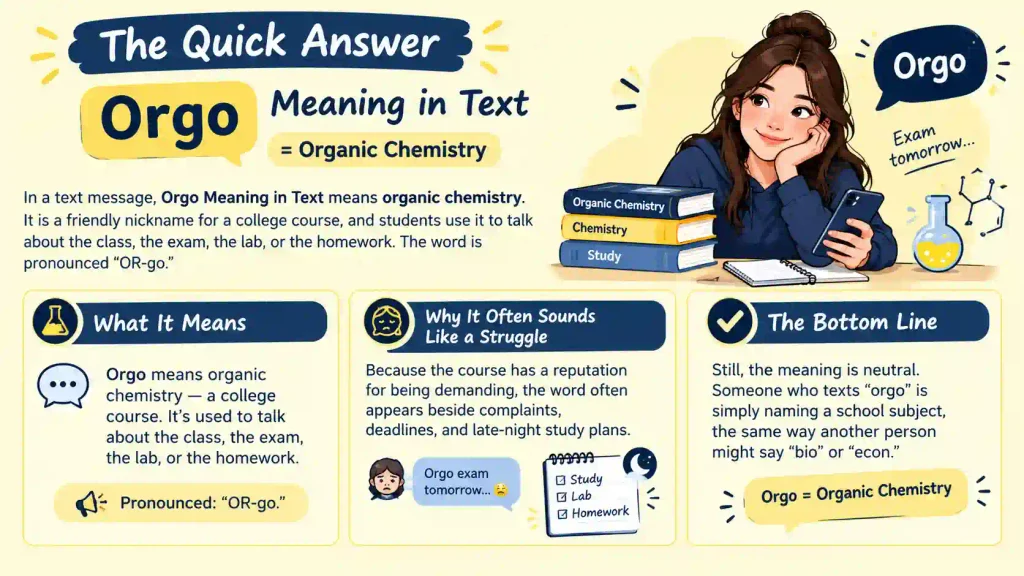
In a text message, Orgo Meaning in Text means organic chemistry. It is a friendly nickname for a college course, and students use it to talk about the class, the exam, the lab, or the homework. The word is pronounced “OR-go.”
Because the course has a reputation for being demanding, the word often appears beside complaints, deadlines, and late-night study plans. Still, the meaning is neutral. Someone who texts “orgo” is simply naming a school subject, the same way another person might say “bio” or “econ.”
How to Tell What Someone Means
Most of the time, the surrounding words settle the question. Read the whole message before you decide, and use the table below as a shortcut.
| If the message mentions… | It most likely means… | Example |
| Exam, midterm, lab, professor, pre-med | Organic chemistry | “Orgo midterm is Monday.” |
| Study group, office hours, flashcards | Organic chemistry | “Orgo study group at 7?” |
| Groceries, dinner, skincare, produce | Organic (food or lifestyle) | “Bought orgo strawberries.” |
| Teams, reporting, departments | Possibly “org” (organization) | “Send it to the orgo lead.” |
The food and workplace readings are uncommon. Wiktionary does record an informal use of “orgo” as an adjective meaning organic, but in a chat between students, the chemistry meaning is the safest bet.
If nothing in the message helps, ask: “Do you mean organic chemistry?” It is short, polite, and far better than a wrong guess.
Common Texts With Orgo, Translated
Here are typical messages and what they usually mean.
- “Orgo exam Friday. Pray for me.” They have an organic chemistry test and feel nervous.
- “Lab ran three hours over. Orgo is a lot.” Their lab session lasted much longer than planned.
- “Can’t go out. Orgo lab report due at midnight.” They need to finish a written report tonight.
- “Just finished Orgo II!” They completed the second course in the sequence.
- “Orgo is killing me.” This is an exaggeration. It means the course feels very hard right now.
- “Orgo homework at the library?” This is an invitation to study together.
Notice that tone changes the message slightly. A cheerful text with an exclamation mark usually signals excitement or relief, while short, flat sentences often signal tiredness. In other words, the same word can carry very different feelings, and reading the mood is just as useful as knowing the word.
Many colleges teach the subject in two parts, called Orgo I and Orgo II. In every example, the word points to a school subject, not to a hidden code or an insult.
Orgo, O-Chem, and Organic Chemistry: Is There a Difference?
No. Orgo, o-chem, ochem, and org chem all refer to the same subject. Which one people choose usually depends on habit and campus culture. “Organic chemistry” is the formal name, and it belongs in papers, official documents, and emails to professors or employers. A simple rule works well: if a teacher, boss, or stranger will read your message, write the full name.
Where Did the Word Come From?
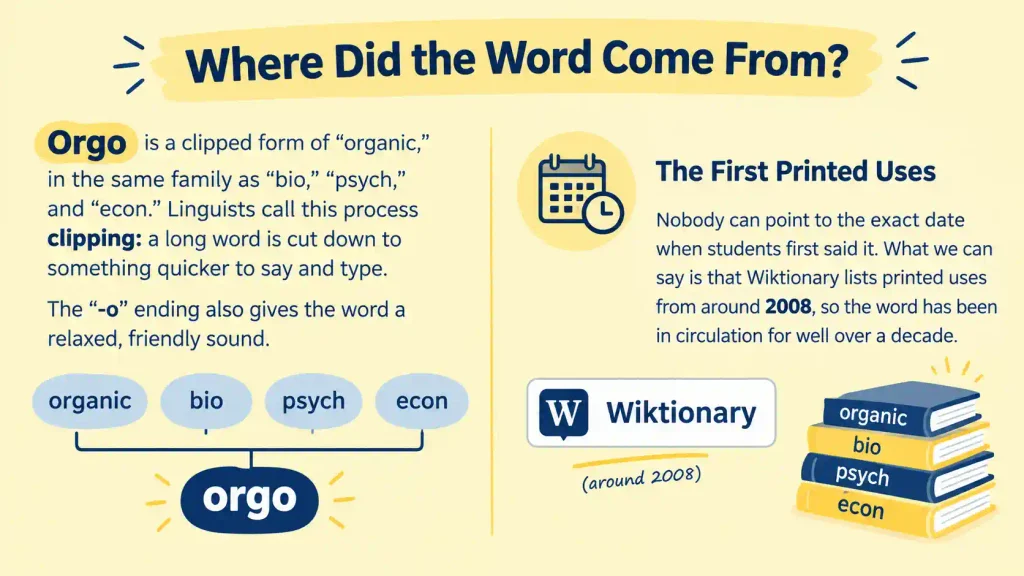
Orgo is a clipped form of “organic,” in the same family as “bio,” “psych,” and “econ.” Linguists call this process clipping: a long word is cut down to something quicker to say and type. The “-o” ending also gives the word a relaxed, friendly sound.
Nobody can point to the exact date when students first said it. What we can say is that Wiktionary lists printed uses from around 2008, so the word has been in circulation for well over a decade.
Why “Organic” Means Something Different in Chemistry
This is the biggest source of confusion for people outside science. On a food label, “organic” describes how something was grown. In chemistry, it refers to compounds built around carbon. That is why chemists smile at the idea of “chemical-free” food: everything you eat is made of chemicals, and much of it is organic in the chemistry sense.
The history explains the odd overlap. The Swedish chemist Jöns Jacob Berzelius introduced the term “organic chemistry” in 1807. The idea behind it was that compounds from living things carried a special “vital force,” so nobody could make them in a laboratory. In 1828, Friedrich Wöhler described making urea from ammonium cyanate, a reaction often cited as the starting point of modern organic chemistry.
A popular story says this single experiment destroyed the vital-force idea overnight. Historians disagree. Vitalism only began losing support around 1845, when Kolbe reported another conversion from inorganic to organic material, and a 2000 survey found that about 90 percent of chemistry textbooks repeat some version of the myth.
Today, “organic” in a chemistry class simply describes carbon-based chemistry. That includes medicines, plastics, fuels, and many of the molecules in your own body.
Why Students Find Orgo So Difficult
The course has a fearsome reputation, and part of it comes from the way the subject works. Knowing why helps you respond with more empathy when someone says it is wearing them down.
- It rewards understanding over memorizing. There are too many reactions to memorize one by one. The real skill is following how electrons move, so that new problems start to make sense.
- It builds on itself. Missing one week’s ideas makes the following week harder.
- It is visual. Students must picture three-dimensional molecules from flat drawings.
- It is problem-heavy. Reading the textbook is rarely enough. Comfort comes from working through many problems.
- It is time-hungry. Lectures, labs, and problem sets often overlap, so the workload can feel relentless during busy weeks.
You will often hear orgo called a “weed-out” course. That phrase is student opinion, not an official label, and difficulty varies widely between schools and instructors.
Why Pre-Med Students Talk About It So Much
Many medical schools expect applicants to have completed organic chemistry, so pre-med students often spend a year on it. There is a second reason as well: the MCAT.
Organic chemistry is not a separate MCAT section. It appears inside two of them. About 15 percent of the 59 Chemical and Physical Foundations questions relate to it, and about 5 percent of the 59 Biological and Biochemical Foundations questions do too. Altogether, that comes to roughly 12 of the 230 questions. The exact numbers vary from one test to another, so treat them as approximate guides rather than fixed rules.
One MCAT prep company also notes that the exam does not ask you to draw or complete reaction mechanisms. As a result, some students find that the exam covers a narrower slice than the course did.
How to Reply When Someone Texts You About Orgo
You do not need any chemistry knowledge to reply well. What helps most is matching the other person’s mood.
| Their message | A good reply |
| “Orgo exam tomorrow. I’m nervous.” | “You have put in the work. You’ve got this. Text me afterward!” |
| “Orgo is killing me.” | “That sounds exhausting. Do you want to vent or take a break?” |
| “Anyone up for orgo studying?” | “I’m in. Where should we meet?” |
| “I passed orgo!” | “Congratulations! That course is no joke. I’m so proud of you.” |
| “I can’t do this anymore. Orgo is ruining everything.” | “You sound really stressed. Do you want to talk about it?” |
Timing matters too. A quick reply before an exam is kind, but a long message can add pressure. Save the deeper conversation for after the test. Warm, brief, and specific messages usually land best.
A few habits to avoid:
- Saying “It can’t be that bad,” which dismisses how they feel.
- Offering study advice nobody asked for.
- Turning the conversation toward your own hard class.
If a friend’s messages go beyond ordinary exam stress, such as constant hopelessness or talk of not coping, check in more directly. Encourage them to reach out to a school counselor or someone they trust.
Practical Tips If You Are Taking Orgo
If you are about to start the course yourself, here are five habits that tend to help:
- Practice problems, not just rereading. Solve, check, and note why each mistake happened.
- Learn the reason behind each reaction. Ask where the electrons are going and why.
- Use a molecular model kit. Holding a physical model makes three-dimensional ideas easier to grasp.
- Go to office hours early. Small questions are easier to fix before they pile up.
- Study in short, regular sessions. Cramming works poorly for material that builds week after week.
None of these tricks is magic, but together they turn a scary subject into a manageable routine.
Frequently Asked Questions
What does Orgo Meaning in Text?
It is slang for organic chemistry, usually referring to a class, exam, lab, or homework.
Is orgo a bad word or an insult?
No. It is a harmless school nickname. If a message uses it with no school context and feels strange, ask the sender what they mean
Can orgo mean organic food?
Sometimes, informally. Context such as groceries or skincare makes that clear, but the chemistry meaning is far more common.
Is it okay to write orgo in an email to a professor?
It is better to write “organic chemistry” in formal emails, papers, and applications. Keep “orgo” for texts and chats with classmates.
What is the difference between Orgo I and Orgo II?
They are the first and second courses in a two-part organic chemistry sequence at many colleges.
Is orgo used outside the United States?
The word is most familiar from U.S. campus slang, although online videos and social media have spread it further. Elsewhere, “organic chem” or “o-chem” may be more common.
Should I worry if a friend says orgo is killing them?
Usually not. It is a common way to say the course feels overwhelming. Still, if the stress seems constant or serious, check in gently.
Final Thoughts
So, what does orgo mean in a text? It means organic chemistry, and the words around it will almost always confirm that. When they do not, a quick “Do you mean organic chemistry?” clears things up in seconds.
Still, the definition is only half of the whole story. Someone who mentions orgo is usually tired, nervous, or quietly proud, and a short, warm reply often means more than a clever one. Listen first, offer your company, and save the advice until they ask for it.
Now you can read the word with confidence and answer with real kindness. Bookmark this guide for the next mystery message you receive, and share it with anyone who is still wondering what orgo means.
Read More: CSL Meaning in Text: Avoid This Common Mistake 2026

Daniel is a former English literature teacher turned digital educator. He believes that grammar rules stick best when tied to real-life stories, which is why his articles focus on practical usage, antonyms, metaphors, and word meanings explained the way you’d actually use them in conversation.