
OFNG usually means “on foenem grave,” an intensified way of swearing that something is true, similar to saying “I swear” or “on God.” It is the louder, more dramatic cousin of the shorter term OFN, and people use it when a plain promise does not feel strong enough to convince someone.
What most articles on this topic will not tell you is that OFNG Meaning in Text is a genuinely niche term. It has not been documented by major slang dictionaries the way “no cap” or “ong” have, and the few informal sources that do define it do not fully agree on its roots. Rather than repeat a tidy but shaky origin story, this guide walks through what is actually verifiable, what is disputed, and how to use the term with confidence anyway, without pretending to know more than what the evidence actually supports.
The Short Answer
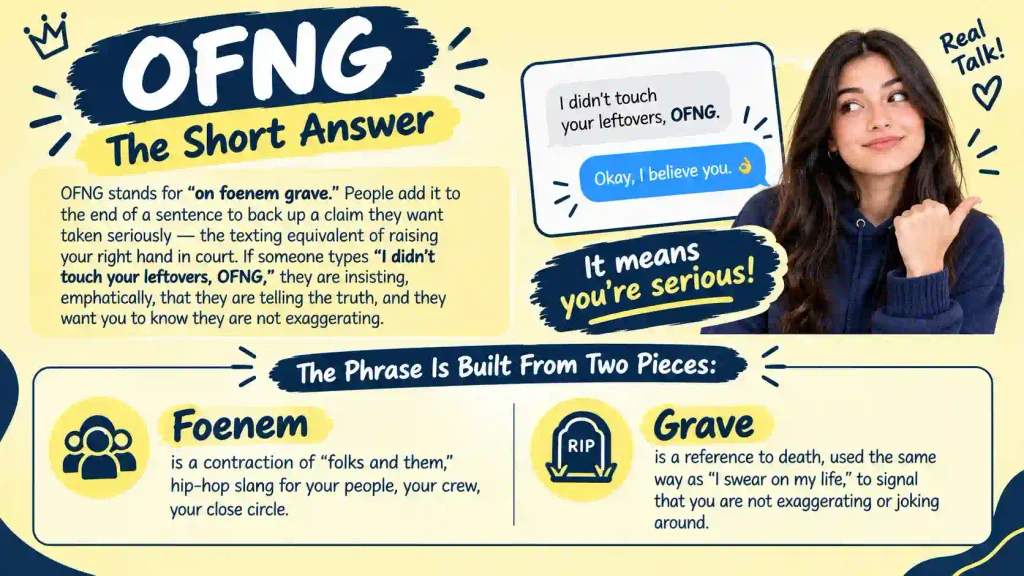
OFNG stands for “on foenem grave.” People add it to the end of a sentence to back up a claim they want taken seriously the texting equivalent of raising your right hand in court. If someone types “I didn’t touch your leftovers, OFNG,” they are insisting, emphatically, that they are telling the truth, and they want you to know they are not exaggerating.
The phrase is built from two pieces:
- “Foenem” is a contraction of “folks and them,” hip-hop slang for your people, your crew, your close circle.
- “Grave” is a reference to death, used the same way as “I swear on my life,” to signal that you are not exaggerating or joking around.
Together, “on foenem grave” reads roughly as “I swear on my people’s lives,” language built for moments when a plain “I promise” does not carry enough weight, and someone wants to remove all doubt from what they are saying.
Where OFNG Actually Comes From
This is the section where most competing guides get overconfident, so it is worth slowing down and separating what is documented from what is assumed. A lot of slang explainers online will state an origin story with total certainty, when the reality is that internet slang rarely has one clean, traceable birthplace.
The Root: AAVE and Hip-Hop Slang
“Foenem” has real, traceable roots in African American Vernacular English and in Chicago drill music, where artists such as Polo G, Chief Keef, and Trippie Redd have used the word in lyrics to refer to their crew or close associates. That gives the “friends” reading of “foenem” solid grounding. It is not a term invented for internet points; it grew out of a specific regional hip-hop scene and then spread the way slang typically does, through song lyrics, social media comments, video captions, and eventually into group chats and DMs far removed from where it started.
This pattern is common with modern slang. A word gains traction within a specific music scene or community, gets repeated in viral clips or popular songs, and then gets picked up by a much wider audience who may have no connection to where it originally came from. That does not make the word less legitimate; it just means its meaning can shift slightly as it travels.
The Catch: Sources Do Not Fully Agree
Here is the nuance that gets flattened in most write-ups. Some informal slang references define the related, shorter term OFN not as “on folks and them” but as “on foe and ‘nem,” meaning “on my enemies.” Under that version, the phrase shifts from “I swear on my crew” to something closer to “I swear on the people who hate me,” which is a genuinely different meaning, not just a spelling variation or a minor detail.
In practice, this does not change how you would read a text message. Both interpretations function as an intensified oath, and the emotional job of the phrase is identical either way someone wants you to believe them. But if accuracy matters more to you than a tidy story, the honest answer is that this detail is not settled, and any source stating it with total certainty is simply guessing and presenting that guess as fact.
Why “Grave” Gets Added
Tacking “grave” onto an oath is not unique to OFNG. It follows a familiar slang pattern, alongside phrases such as “on my mama’s grave,” “on everything I love,” or “I swear to God.” OFNG Meaning in Text borrows that same emotional structure and compresses it into an acronym for faster typing, and the shortened version has simply become the default over time. Almost nobody types out the full phrase anymore, which is normal for how internet slang evolves: full expressions get shortened, and the shortcut eventually replaces the original in everyday use.
OFNG vs. OFN vs. ONG: How They Are Actually Different
These three acronyms look alike and get confused constantly, so here is a direct comparison to keep them straight.
| OFN | “On folks and ‘nem” (or, per some sources, “on foe and ‘nem”) | Moderate | The shorter, more common form. Also used by some people to mean “oh f*** no” context matters a great deal here. |
| OFNG | “On foenem grave” | High | The added “grave” makes it feel more serious and dramatic than plain OFN. |
| ONG | “On God” | High | A completely different root phrase, but it does the same job of swearing something is true. Far more widely recognized than OFNG. |
It is worth flagging that because OFN carries at least two unrelated meanings, a bare “OFN” with no surrounding context can genuinely go either way: it might be someone swearing something is true, or it might be a blunt expression of disbelief. OFNG Meaning in Text does not have that problem. The “grave” locks in the swearing-an-oath meaning, which makes it clearer, not just more intense, than its shorter cousin.
How to Tell What Someone Means When They Use OFNG
Since OFNG Meaning in Text does not have one universally agreed-upon dictionary entry, reading the context around it matters more than it would with mainstream, well-documented slang.
- Check what comes right before it. If it follows a claim someone might doubt, such as “I really did see him there, OFNG,” it is functioning as an emphatic “I swear.”
- Read the overall tone of the conversation.OFNG Meaning in Text shows up almost exclusively in casual, low-stakes exchanges such as texts, comments, and captions. It does not shift meaning based on formality, because it simply does not appear in formal contexts to begin with.
- Look at who is using it. Slang tied to specific online or regional communities can carry slightly different connotations depending on who is typing it, so the same word from different people is not always doing identical work.
- When in doubt, just ask. This slang is niche enough that nobody should expect you to already know it. A quick “wait, what does OFNG Meaning in Text mean lol” will get you a faster, more accurate answer than guessing and risking a misread.
How to Use OFNG (and When Not To)
OFNG works as a sentence-ending intensifier, almost always paired with a claim you want to reinforce. A few natural examples:
- “That shot was clean, OFNG.”
- “I didn’t even edit this photo, OFNG.”
- “He really said that to my face, OFNG.”
- “I studied all night for that exam, OFNG.”
A few practical guidelines are worth keeping in mind before you start using it yourself:
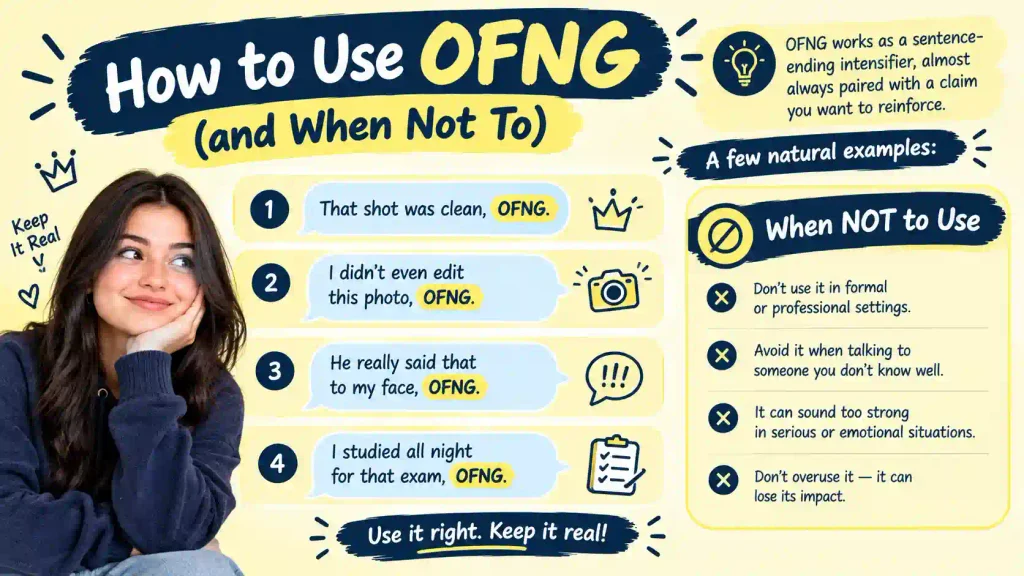
- Keep it strictly casual. This is not a term for email, schoolwork, customer service messages, or anything professional. It will read as out of place, not just informal, in those settings.
- Do not overuse it. Like any intensifier, it loses impact fast if it shows up in every other message. Save it for moments where you actually want to add real weight to a statement.
- Prefer it over bare OFN when clarity matters. Since OFNG Meaning in Text cannot be mistaken for “oh f*** no,” it is the safer, less ambiguous choice of the two when you want your meaning to land without confusion.
- Match the energy of the conversation. Dropping a heavy, dramatic-sounding oath into a lighthearted exchange can come across as odd, so read the room before using it.
Similar Slang Worth Knowing
OFNG Meaning in Text belongs to a broader family of “I am serious” internet slang. If you are trying to keep up with this corner of texting shorthand, these are the closest relatives, along with how they differ in tone:
- No cap “no lie,” marking a statement as genuinely true without necessarily invoking anything as dramatic as an oath.
- Fr / fr fr, short for “for real,” a lighter-weight version of the same idea, often used to agree with someone rather than to swear a claim.
- Deadass “seriously,” often used mid-sentence rather than at the end, and slightly more blunt in tone.
- Ong “on God,” the most widely recognized term in this family, and arguably the closest in intensity to OFNG Meaning in Text.
- OFN is the shorter, more ambiguous relative of OFNG, carrying the same swearing function but without the added clarity.
These terms are not interchangeable in tone. OFNG and “on God” read as more emphatic than a casual “fr,” so matching the right term to the right moment matters if you want to sound natural rather than like you are plugging in a random synonym for effect.
Frequently Asked Questions
What does OFNG Meaning in Text?
It most commonly means “on foenem grave,” an intensified way of swearing that a statement is true, similar in function to “I swear” or “on God.”
Is OFNG the same as OFN?
They are related but not identical. OFN is the shorter form and carries more ambiguity, since some people also use it to mean “oh f*** no.” OFNG’s added “grave” makes the swearing-an-oath meaning unambiguous, regardless of who is using it.
Where does the term come from?
The root word “foenem” has documented use in AAVE and Chicago drill hip-hop lyrics, where it refers to one’s close friends or crew. Some slang sources define the related root differently, as “foe and ‘nem,” so the exact origin is not fully settled, and it is fair to treat confident-sounding claims about a single definitive history with some skepticism.
Can I use OFNG in a professional setting?
No. It is casual slang suited to texts, DMs, and social captions, not emails, reports, or formal writing of any kind.
Is OFNG a “real” acronym?
It is a genuine piece of internet slang with documented informal use, even though it has not reached mainstream dictionary status the way older terms like LOL or SMH have. Being niche does not make it fake; it simply means less has been documented about it, which is why this guide flags where the sourcing is thin rather than inventing certainty it does not have.
Does OFNG mean the same thing everywhere online?
Largely yes, though as with most slang, the exact intensity and connotation can shift slightly depending on the community and platform where you encounter it. The core function, swearing that something is true, stays consistent.
Final Thoughts
OFNG is not complicated once the overconfident origin stories floating around online are stripped away. At its core, it is a way of saying “I swear” with extra emotional weight, built from real hip-hop slang roots and a familiar pattern of invoking death to signal sincerity. What sets it apart from OFN is clarity: the added “grave” removes the ambiguity that comes with OFN’s double meaning, so nobody has to guess whether you are swearing an oath or expressing blunt disbelief.
Read More:HYC Meaning in Text: What It Likely Stands For and How to Tell

Rachel is a passionate linguist and content writer with a love for the English language’s hidden nuances. With years of experience in teaching ESL students, she specializes in breaking down idioms and similes into simple, everyday examples. Her mission is to make English learning fun, not intimidating.