
IFYKYK Meaning in Text is internet shorthand for “if you know, you know.” A writer uses it to hint at a joke, a memory, or a reference, and deliberately skips the explanation. If you were there, you get it. If you were not, you are left on the outside, curious.
The phrase has become one of the most common pieces of slang in texts, captions, comments, and group chats. Yet it raises questions. Is IFYKYK different from IYKYK? What does the extra F really mean? Is it rude? And what should you type when you have no clue what the sender means?
This guide answers all of that in plain language. You will learn what the phrase means, where it came from, how the extra F is best understood, and how to use it or reply to it with confidence. You will also find practical examples, tone tips, and answers to common questions. By the end, you will never feel left out of the joke again.
What Does IFYKYK Meaning in Text?
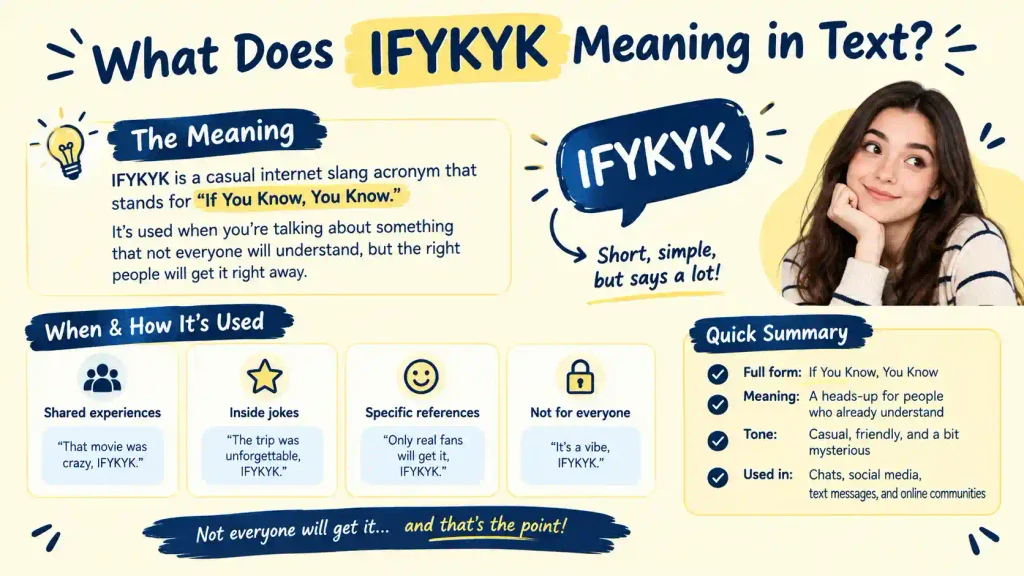
IFYKYK stands for “if you know, you know.” It is a spelling variant of the more common IYKYK. Dictionary.com describes the phrase as a way of marking an inside joke or a reference that only a select group of people understands, usually without any further explanation. Merriam-Webster defines the parent term as a way of acknowledging common knowledge or a shared experience.
People attach it to almost anything: a joke, a photo, a food order, a local habit, a fandom reference, or a piece of gossip. Whatever it follows, the message is the same. This is not meant for everyone, and no explanation is coming.
The phrase works because it flatters the reader. It assumes you are part of the group that already understands, and that small assumption creates a feeling of closeness.
What Does the Extra F Stand For?
This is the point on which most explainers disagree, so it deserves a careful answer.
The best-supported explanation
In IFYKYK Meaning in Text, the “I” already stands for “if.” IFYKYK simply spells that word out with two letters. Read this way, the extra F carries no hidden meaning. The two versions mean the same thing, and dictionary sources treat them that way.
The alternative reading
One parenting website defines IFYKYK Meaning in Text as “if you f***ing know, you know,” describing it as a more emphatic form of IYKYK. That reading is plausible, and some people may well type it as a joke or for emphasis. However, no dictionary I checked lists it, and the same website elsewhere calls “ifykyk” a common typo of “iykyk.” It is best treated as a minority interpretation rather than a fact.
What to do when it matters
If you are the sender, use IFYKYK Meaning in Text when you want to be sure that nobody reads a swear word into your message. If you are the reader, judge the sender’s intent from their tone and the rest of the message. When it truly matters, a quick question settles it.
IFYKYK vs IYKYK and Similar Phrases
| IYKYK | If you know, you know | The standard and most widely recognized form |
| IFYKYK | If you know, you know | A variant that some senders may intend as more emphatic |
| IKYK | If you know, you know | A shorter variant with the same meaning |
| YKYK | You know, you know | Often works like “you get it, right?” |
| “You had to be there” | Plain English | The older, spoken version of the same idea |
The differences are mostly a matter of style. None of them changes the core message.
Where You Will See IFYKYK
Texts and group chats
Friends use it to point at a shared memory without retelling the whole story. It works like a wink: one short word group replaces a long explanation.
Social media captions and comments
On Instagram, the image often supplies the context while the caption signals that only some viewers will understand. On TikTok and Snapchat, it commonly follows a clip that plays on something niche. It also appears in replies on X, Facebook, Reddit, and Discord, usually aimed at a specific community such as a fandom, a game, or a hometown.
Hashtags and spoken use
Dictionary.com notes that the parent term is often written as a hashtag. In speech, people usually say the full phrase, “if you know, you know,” rather than reading out the letters.
What People Really Mean When They Use It
The meaning is fixed, but the intent behind it changes from post to post. Four patterns come up again and again.
The warm nod. “Sunday pancakes at Dad’s. ifykyk.” This celebrates a shared memory and feels friendly.
The niche flex. “Ordered the off-menu one. ifykyk.” Here the writer shows that they are a regular, a fan, or an insider.
The hint. “Not saying who was late again. ifykyk.” This nudges at gossip or a complaint without naming anyone. Dictionary.com notes that the phrase can also accompany innuendo.
The dodge. Sometimes the phrase replaces an explanation that the writer would rather not give. If a serious topic is hidden behind it, asking directly is perfectly reasonable.
The surrounding words, the photo, and the comments usually reveal which pattern you are looking at.
How to Use IFYKYK Well
Good use of the phrase comes down to a few habits.
- Point to something specific. A vague post followed by ifykyk feels empty. A concrete detail gives the right people something to recognize.
- Know your audience. It works best where most readers share the reference. In a mixed group, it can feel like a closed door.
- Keep it light. The phrase is playful. Using it to tease someone who was not there can slide into exclusion.
- Choose IYKYK when unsure. It is the more familiar form, so fewer readers will stumble over it.
- Save it for casual settings. It suits texts, captions, and comments, not work emails or school assignments.
Before you post, ask yourself three quick questions. Would most of my readers recognize this? Does the detail I mention make them smile rather than feel excluded? Would I be comfortable if a relative or a coworker saw it? If the answer to any of these is no, rewrite the line or choose a plainer caption.
Examples You Can Copy
In a chat
Maya: Remember the ferry ride back from the island?
Jonas: The one with the missing life jackets and the seagull? IFYKYK Meaning in Text.
In a caption
“Sunrise hike, cold coffee, wrong trail again. ifykyk.”
A gentler version for a mixed audience
“That final scene ruined me. iykyk.”
A hint for a fandom
“Reading chapter twelve on the train was a mistake. ifykyk.”
Notice that each example names a small, concrete detail. The detail is what lets the right readers recognize themselves.
How to Reply When Someone Sends It
If you understand the reference
Join in with a detail that only the group would know, a laughing reaction, or a short line such as “still not over it.” A specific reply keeps the joke alive far better than a bare “lol.”
If you do not understand it
Start by checking the nearby messages, the photo, or the comments, because the answer is often sitting right there. If it is not, a light question works well: “Okay, I am lost. What is the story?” Most senders are happy to explain, and some are quietly hoping that you will ask.
Why It Can Feel Like Gatekeeping
The phrase builds closeness by drawing a line. People inside the joke feel included, while people outside it can feel shut out. That effect is not always intentional, but it is worth remembering when you post publicly.
If your audience includes people who were not there, consider adding a short hint or skipping the phrase altogether. A single extra sentence can turn a private joke into an invitation.
Where Did IFYKYK Come From?
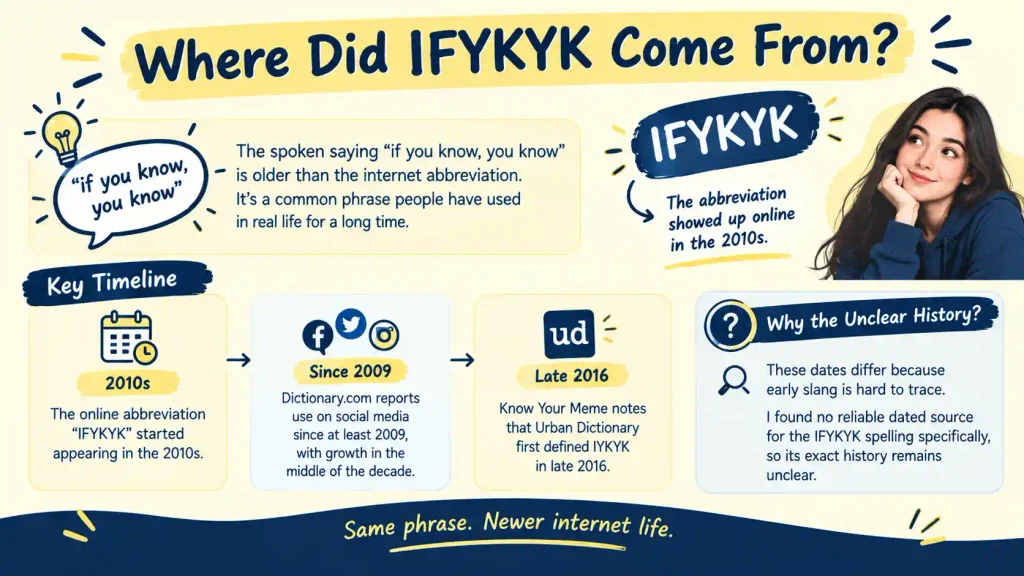
The spoken saying “if you know, you know” is older than the internet abbreviation. Sources place the online abbreviation in the 2010s. Dictionary.com reports use on social media since at least 2009, with growth in the middle of that decade. Know Your Meme notes that Urban Dictionary first defined IYKYK in late 2016.
These dates differ because early slang is hard to trace. I found no reliable dated source for the IFYKYK spelling specifically, so its exact history remains unclear.
Common Mistakes to Avoid
- Treating it as a question. It is a statement, not a request for an answer.
- Expecting an explanation later. The whole point is that none is coming.
- Using it with the wrong crowd. If nobody shares the context, the phrase falls flat.
- Overusing it. If every post carries the phrase, it stops feeling special and starts feeling like a habit.
- Assuming one fixed tone. Depending on the writer, it can be affectionate, boastful, or a little sly.
Frequently Asked Questions
What does IFYKYK Meaning in Text?
It means “if you know, you know.” The sender is hinting at something that only certain people will understand.
Is IFYKYK the same as IYKYK?
In everyday use, yes. IFYKYK is a spelling variant, and a few senders may intend a touch more emphasis.
Does the extra F stand for a swear word?
Dictionaries and most explainers treat IFYKYK as “if you know, you know.” One website reads the F as an expletive, so some senders may mean it that way. Context is your best guide.
Is IFYKYK rude?
No. It can feel exclusive to someone outside the joke, but it is playful by design.
Can I use IFYKYK at work?
Rarely. It suits casual chats with people who share your tone, not professional messages.
Can brands or businesses use IFYKYK?
Yes, but carefully. It suits a brand whose audience truly shares a niche, such as a local cafe with loyal regulars. Used by a company with a broad audience, it can feel forced or confusing.
How do I respond if I do not understand it?
Check the surrounding context first, then ask a short, friendly question.
Is IFYKYK pronounced as letters?
Usually people say the full phrase, although some spell out the letters.
Conclusion
IFYKYK is a tiny phrase with a clear job: it tells a group of people that they share something the rest of the world does not. The safest meaning is “if you know, you know,” and the extra F is best read as a spelling variant rather than a hidden swear word.
Use it when your audience shares the moment, add a specific detail so the right readers recognize themselves, and choose IYKYK when you are unsure. When you meet it and feel lost, read the context first, then ask. Above all, remember that the phrase works best as an invitation rather than a barrier, so use it kindly. A little curiosity usually turns an outsider into someone who knows.
Read More:TSTS Meaning in Text: 5 Secret Uses, Heartbreaking Examples & Chat Slang Decoded

Rachel is a passionate linguist and content writer with a love for the English language’s hidden nuances. With years of experience in teaching ESL students, she specializes in breaking down idioms and similes into simple, everyday examples. Her mission is to make English learning fun, not intimidating.