
ATM has always stood for “Automated Teller Machine.” In texting, DMs, and social media captions, it rarely refers to a cash machine anymore. Today, ATM meaning in text is “at the moment,” a quick, casual way of saying “right now” or “currently.”
So when a friend replies “busy ATM,” she’s not standing at a bank; she’s just occupied at the moment. Still, context matters, since ATM can occasionally mean something else entirely. This guide explains exactly what ATM means in every situation, how to instantly tell the meanings apart, where the slang came from, and how to use it correctly yourself.
The Two Main Meanings, Side by Side
| At the moment | “Driving ATM, call you later” | Describes a current action or state |
| Cash machine | “Meet me at the ATM on 5th” | Mentions location, cash, or fees |
If you remember nothing else from this article, remember that table. Everything below just fills in the details.
Scenario-by-Scenario: Real Texts, Decoded
Rather than a dry definition, here’s how ATM actually shows up in the wild.
Scenario 1: The one-word brush-off
“ATM”
Sent alone, as a reply to “you free?” or “wyd,” this is shorthand for “busy right now.” No cash machine in sight.
Scenario 2: The excuse for a slow reply
“Sorry, just saw this; work meeting ATM”
Here, ATM meaning in text explains why the response was delayed. Swap in “currently” or “right now” and the sentence reads the same.
Scenario 3: The actual bank errand
“need to swing by an ATM, don’t have cash on me”
The giveaway is “swing by,” a phrase you use with physical locations, not with a state of being.
Scenario 4: The ambiguous one that trips people up
“Can we split the bill? I’ll ATM meaning in text you”
This is a rare, informal verb use (“I’ll ATM you” = “I’ll get cash from a machine for you”), and it only makes sense because money was already the topic. Without that context, nobody would read it this way.
A Fast Mental Test You Can Run in Two Seconds
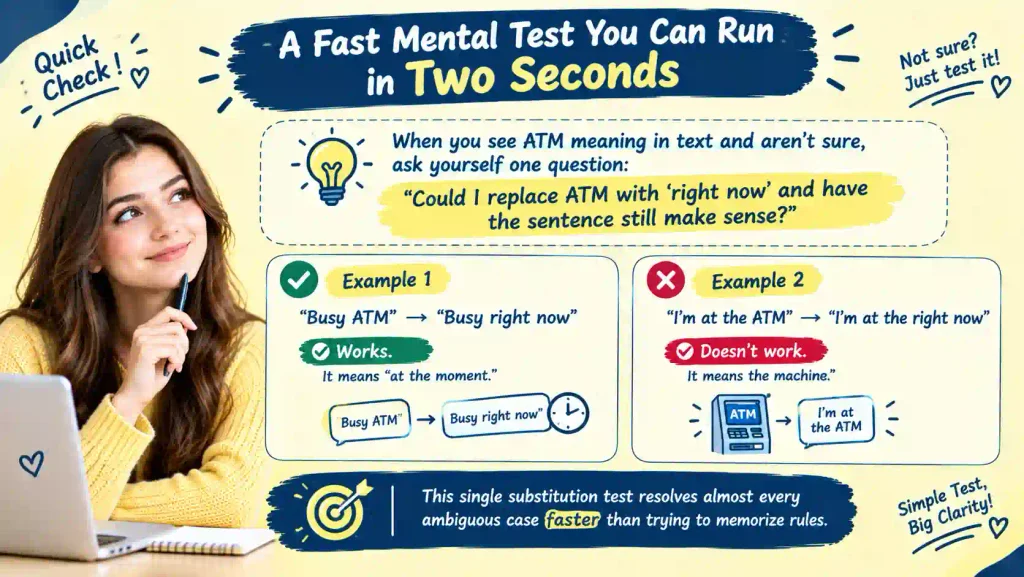
When you see ATM meaning in text and aren’t sure, ask yourself one question: “Could I replace ATM with ‘right now’ and have the sentence still make sense?”
- “Busy ATM” → “Busy right now” ✅ Works. It means “at the moment.”
- “I’m at the ATM” → “I’m at the right now” ❌ Doesn’t work. It means the machine.
This single substitution test resolves almost every ambiguous case faster than trying to memorize rules.
Does Capitalization Give It Away Too?
Here’s a smaller clue that most guides skip entirely: how ATM is typed can hint at which meaning is intended, even before you read the rest of the sentence.
- Lowercase “atm” tends to lean toward the slang meaning, “at the moment.” People typing fast and casually often don’t bother capitalizing abbreviations.
- Uppercase “ATM” more frequently signals the bank machine, since it’s a formal, recognized acronym the same way “FBI” or “NASA” stays capitalized regardless of context.
This isn’t a hard-and-fast rule. Phone keyboards auto-capitalize the first word of a sentence, and plenty of people type in all lowercase or all caps as a personal habit rather than a deliberate signal. But when the casing looks intentional say, someone who normally types in lowercase suddenly capitalizes ATM meaning in text it’s a small additional clue worth noticing alongside the sentence’s context.
Why Context Beats Memorization
It’s tempting to look for a single foolproof rule, but texting slang doesn’t work that way; meaning is built from the words around it, not the abbreviation itself. The same three letters can describe a mood, a location, a joke, or a relationship dynamic depending entirely on what’s being discussed. That’s actually good news: instead of memorizing a list of exceptions, you only need to ask what the rest of the sentence is about. Is it describing an action, a feeling, or an ongoing situation? Then it’s “at the moment.” Is it describing cash, a fee, or a specific place? Then it’s the machine. Everything else is a rare edge case that context will usually flag on its own.
Why Texters Started Using ATM This Way
Character limits are the short answer. Back when SMS plans charged by the message and screens were tiny, anything that saved keystrokes caught on fast. ATM meaning in text joined a wave of similarly clipped phrases, think BRB, TTYL, and JK, that let people narrate their availability without typing full sentences. Instant messenger status lines in the early 2000s (the “away message” era) helped cement it, since “on the phone ATM” was a common thing to post before stepping away from a computer.
Unlike a lot of slang from that era, ATM never really got replaced. Texting habits changed, apps changed, but the need to quickly say “I’m busy right now” never went away, so the abbreviation stuck around largely unchanged for two decades.
Where People Use It Differently
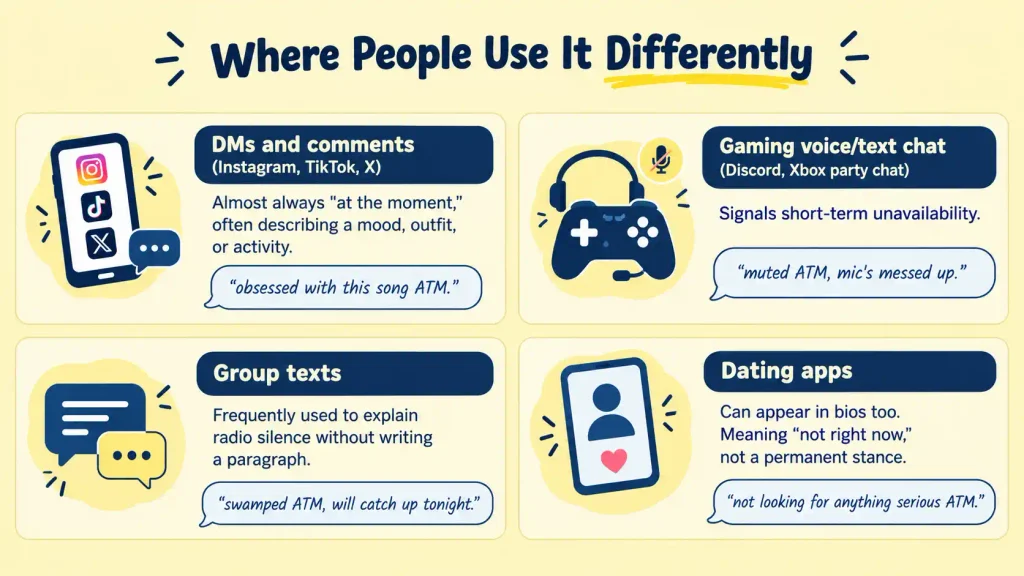
- DMs and comments (Instagram, TikTok, X): Almost always “at the moment,” often describing a mood, outfit, or activity: “obsessed with this song ATM.”
- Gaming voice/text chat (Discord, Xbox party chat): Signals short-term unavailability: “muted ATM, mic’s messed up.”
- Group texts: Frequently used to explain radio silence without writing a paragraph: “swamped ATM, will catch up tonight.”
- Dating apps: Can appear in bios too: “not looking for anything serious ATM,” meaning “not right now,” not a permanent stance.
Other Meanings You’ll Rarely But Occasionally Run Into
- A playful money flex. Some people use ATM meaning in text jokingly after listing purchases, implying they spent everything closer to a joke than a literal statement.
- An informal invite. In small, specific friend groups, “ATM?” can mean “come to my place?” This one is highly dependent on who’s texting; most people will never see it used this way.
- Gossip shorthand. Occasionally used between friends (not to someone’s face) to describe a partner mainly valued for their money, similar in spirit to “sugar daddy.” It’s descriptive slang, not a compliment, and it’s genuinely rare outside certain circles.
If a text doesn’t fit “at the moment” or “cash machine,” and none of the above apply either, it’s worth just asking what was meant; abbreviations drift between friend groups more than people realize.
ATM’s Closest Cousin: RN
If ATM has a twin, it’s RN (“right now”). They’re functionally interchangeable:
- “Busy ATM” = “Busy RN”
- “Can’t talk ATM” = “Can’t talk RN”
The choice between them is almost entirely personal habit rather than meaning. Some people default to one or the other; plenty of texters use both depending on the day.
Quick Reference: Abbreviations People Confuse With ATM
| BRB | Be right back | Implies a return, not an ongoing state |
| AFK | Away from keyboard | Tied specifically to stepping away from a device |
| OTW | On the way | Describes movement, not current status |
| RN | Right now | Nearly identical meaning to ATM |
| TBH | To be honest | About honesty, not timing |
When ATM Is the Wrong Choice
Texting slang has a time and place. Skip ATM (and lean on “currently” or “right now” instead) when:
- You’re writing a work email or professional message.
- You’re texting someone who might not text much themselves, like an older relative or a new contact.
- Money is anywhere in the conversation, since the ambiguity becomes a real problem, not just a style choice.
How to Reply When Someone Texts You “ATM”
Since ATM meaning in text (in this sense) simply means the other person is occupied right now, there’s no need to overthink your reply. A few natural options:
- “No worries, whenever you’re free!”
- “All good, talk soon.”
- “Okay, let me know when you’re done.”
There’s usually no reason to ask “doing what, exactly?” unless you’re genuinely curious; the phrase already tells you the conversation is paused, not over. Pushing for more detail can even come across as slightly demanding, since the whole point of ATM is to give a quick, low-pressure update without committing to a full explanation.
Frequently Asked Questions
Does ATM ever mean something other than “at the moment” or “cash machine”?
Rarely, yes. Depending on the group texting, it can be a joking way to imply spending a lot of money, an informal invite to hang out, or occasionally, and usually said about someone rather than to them, a description of a partner seen as mainly valued for their money. These uses are far less common than the two main meanings
How do I know which meaning someone intends?
Try the substitution test: swap ATM for “right now.” If the sentence still makes sense, that’s the meaning. If it doesn’t, and the sentence involves cash, a location, or a bank, it means the machine
Is ATM meaning in text considered rude or too casual?
Not among friends or in casual settings. It’s simply informal, so it’s best reserved for texts, DMs, and comments rather than professional writing
Did ATM used to mean something different?
No, the “at the moment” usage has stayed remarkably consistent since it emerged in early instant-messaging culture, even as the apps people use it on have changed completely.
Does the capitalization of ATM actually matter?
It can be a small clue: lowercase “atm” leans toward the slang meaning, while uppercase “ATM” more often points to the bank machine, but it’s not a reliable rule on its own. Always weigh it alongside the rest of the sentence.
What’s the safest way to use ATM if I’m not sure my reader will understand it?
When texting someone unfamiliar with slang, or in any semi-formal context, it’s safer to just spell out “at the moment” or “right now.” It costs a few extra characters but completely removes any chance of confusion with the bank machine
The Takeaway
ATM is a small piece of shorthand doing a big job: letting someone say “I’m busy right now” in three keystrokes, without a second thought. The bank-machine meaning hasn’t disappeared, but context the words sitting right next to ATM almost always makes the intended meaning obvious within seconds.
Run the quick “right now” substitution test whenever you’re unsure, and you’ll rarely be stuck guessing again. Whether you’re decoding a friend’s one-word reply or deciding how to use it yourself, ATM is here to stay as one of texting’s most efficient, everyday abbreviations simple, familiar, and easy to get right once you know the trick.
Read More: Awe Meaning in Text: Avoid This Simple Mistake in 2026

Rachel is a passionate linguist and content writer with a love for the English language’s hidden nuances. With years of experience in teaching ESL students, she specializes in breaking down idioms and similes into simple, everyday examples. Her mission is to make English learning fun, not intimidating.