

If someone just texted you “ion know” or “ion care,” here’s the short version: “Ion Meaning in Text” means “I don’t.” It’s a casual, phonetic spelling of how “I don’t” actually sounds when people say it quickly out loud, the same way “gonna” stands in for “going to.”
That covers most of what you’ll run into. But “ion” also has three other meanings you’ll bump into depending on where you see it: one in chemistry, one as a topic-changer, and one as an actual name. This guide walks through all of them, explains where the slang really comes from, and gives you a fast way to tell which “ion” you’re looking at, so you’re never stuck rereading a text three times trying to decode it.
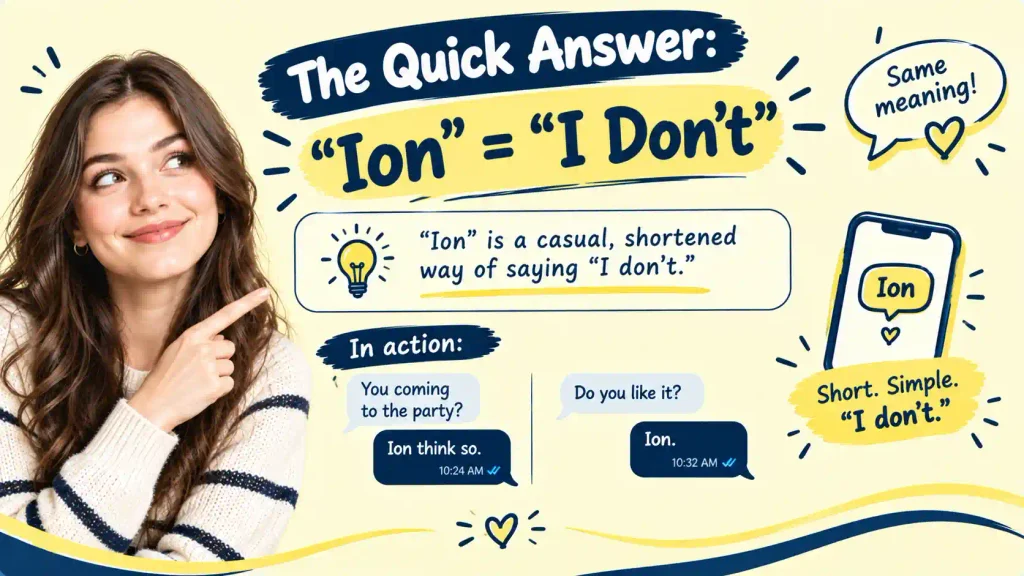
The Quick Answer: “Ion” = “I Don’t”
In texting, social media comments, and casual chat, “ion” is shorthand for “I don’t.” It’s almost always followed by a verb:
- “ion know” → I don’t know.
- “ion care” → I don’t care.
- “ion think so” → I don’t think so
- “ion feel like it” → I don’t feel like it.
Because “ion” replaces the whole phrase “I don’t” rather than one specific follow-up word, Ion Meaning in Text shifts slightly depending on what comes next. “Ion know” behaves like “IDK.” “Ion care” behaves like “IDC.” That flexibility is actually the main difference between “Ion Meaning in Text” and fixed abbreviations like those more on that below.
Where “Ion” Actually Comes From
“Ion” isn’t a random internet invention; it’s a written version of a real, long-standing feature of spoken African American Vernacular English (AAVE). In AAVE, and in fast casual speech generally, the “d” sound in “don’t” tends to drop when it’s sandwiched between two vowel-adjacent sounds (“I” and “on’t”), and the remaining sounds blend into a single syllable that comes out close to “ion.” Type it exactly as it sounds, and you get “ion.”
This is the same pattern behind other spoken contractions that have become standard texting shorthand:
| Spoken phrase | Sounds like | Written slang |
| I don’t | i-on | ion |
| I’m going to | i’m-uh-nuh | finna / imma |
| Trying to | try-nuh | tryna |
| About to | buh-tuh | boutta |
None of these are typos or “bad grammar”; they’re consistent, rule-governed sound patterns from spoken English carried directly into text. That’s also why ion meaning in text confuses autocorrect fights with them: spell-checkers are built for formal written English, not phonetic casual speech, so they try to “fix” ion into “on.” If a friend’s text suddenly reads oddly, autocorrect is usually overriding the slang, not creating a new meaning. This is one of the most common issues people face when learning ion meaning in text
Social platforms didn’t invent “ion”; they spread it. As Twitter/X and TikTok grew, short, phonetically written phrases like this traveled fast because they’re quick to type and instantly readable to anyone already familiar with the pattern. This is one of the most common issues people face when learning ion meaning in text.
The Other Three Meanings of “Ion”
Once you’re texting regularly, “I don’t” will cover most cases. But the word does double (and triple, and quadruple) duty elsewhere:
1. “In Other News” (used to change the subject)
Written in caps as This is one of the most common issues people face when learning ion meaning in tex, this is used the way people use “anyway” or “so, random, but” as a soft pivot to a new topic that has nothing to do with what was just said.
“ION, are we still doing dinner Friday?”
The giveaway is position and function: this “ION” usually opens a new, unrelated thought rather than answering a question that was just asked. If it comes right after someone asked “you coming?” and the reply is “ion know,” that’s “I don’t know,” not a topic change.
2. A Charged Atom or Molecule (chemistry)
This is actually the word’s original, formal meaning, and it has nothing to do with texting. An ion is an atom or molecule that has gained or lost electrons, giving it an overall electric charge:
- A cation is a positively charged ion (it has fewer electrons than protons).
- An anion is a negatively charged ion (it has more electrons than protons).
You’ll meet this “ion” in a chemistry textbook, not a group chat, so context makes it obvious almost instantly.
3. A Given Name
“Ion Meaning in Text” is also a real first name, most commonly in Romania. Romanian tennis player and businessman Ion Țiriac is a well-known example. If you see “Ion” capitalized in a sentence where it’s clearly labeling a person, you’re looking at a name, not slang or chemistry.
How to Tell Which “Ion” You’re Looking At
Use this quick decision path when a text has you stuck:
- Is it lowercase and followed by a verb (“ion know,” “ion care,” “ion think”)? → It means I don’t.
- Is it capitalized and introducing a brand-new, unrelated topic, rather than answering something? → It probably means In Other News.
- Is it in a science class, textbook, or sentence about atoms, charge, or electrons? → It’s the chemistry term.
- Is it capitalized and clearly labeling a person’s name? → It’s the given name.
In practice, meaning #1 covers the overwhelming majority of everyday texts. The other three are much rarer, and context almost always makes them obvious within a sentence or two.
Is “Ion” Rude, Flirty, or Fine to Use?
Rude: Not by default. “Ion” itself is neutral; it’s just a casual contraction. It can read as blunt or dismissive when it’s paired with a flat statement like “ion care” and no softening context, the same way “I don’t care” can sound cold in any spelling. The word isn’t doing that work; the sentence around it is.
Flirty: Not inherently, but it’s common in low-pressure, casual romantic texting because it signals an easy, unbothered tone. “ion usually text first, but you seem cool” reads as relaxed confidence rather than a hard declaration.
Professional: No. Save “ion” for texts, DMs, and casual chats with people who already text this way. In emails, job applications, school assignments, or any message to someone who might not recognize the slang, spell out “I don’t.” Using it in the wrong setting doesn’t just look too casual; it risks genuinely confusing a reader who reads it as “I’m on” or the chemistry term.
“Ion” vs. IDK vs. IDC vs. Ain’t
These get mixed up because they all mark negation, but they don’t work the same way:
| Term | Always means | Flexible? |
| Ion | I don’t (+ whatever follows) | Yes meaning depends on the next word |
| IDK | I don’t know | No fixed meaning |
| IDC | I don’t care | No fixed meaning |
| Ain’t | am not / is not / are not / haven’t / hasn’t | Yes but marks negation on “to be” or “to have,” not “to do” |
The key distinction: IDK and IDC are frozen abbreviations that only ever mean one thing. “Ion” is a live contraction; it works exactly like “I don’t” does in full sentences, so it can be followed by almost any verb and still make sense, which is why you’ll see it paired with dozens of different words rather than locked to one phrase.
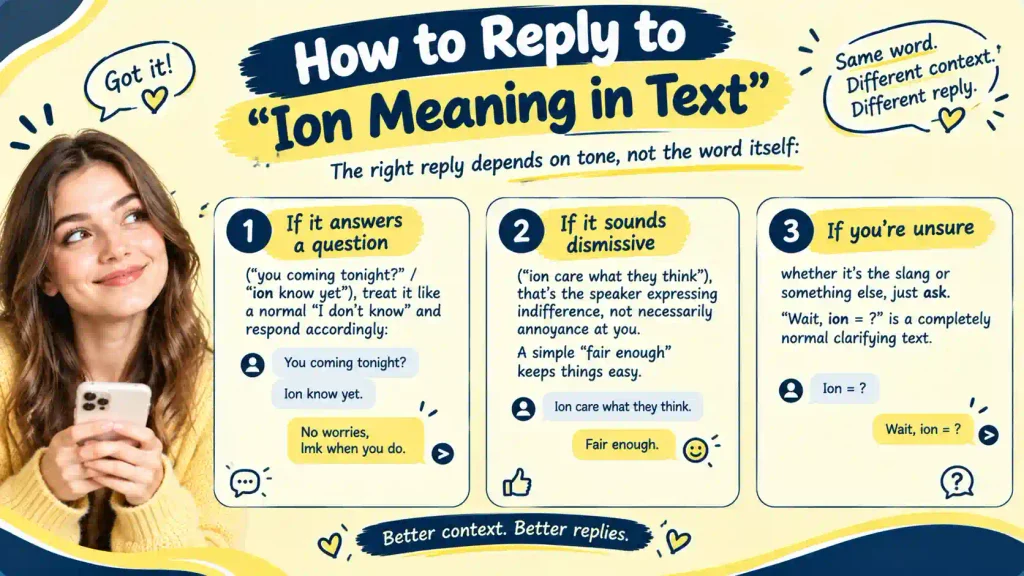
How to Reply to “Ion Meaning in Text”
The right reply depends on tone, not the word itself:
- If it answers a question (“you coming tonight?” / “ion know yet”), treat it like a normal “I don’t know” and respond accordingly: “no worries, lmk when you do.”
- If it sounds dismissive (“ion care what they think”), that’s the speaker expressing indifference, not necessarily annoyance at you. A simple “fair enough” keeps things easy.
- If you’re unsure whether it’s the slang or something else, just ask. “Wait, ion = ?” is a completely normal clarifying text.
Ion Meaning in Text
Common Mix-Ups to Avoid
A few small mistakes account for most of the confusion around this word:
Reading it as “I’m on.” These two look similar but behave differently in a sentence. “I’m on” is usually followed by a noun (“I’m on it,” “I’m on the phone”), while “ion” is followed by a verb (“ion know,” “ion care”). Noun after it: “I’m on.” Verb after it, “ion.”
Assuming it’s a typo. It’s intentional spelling, not an autocorrect error; treating it as a mistake is the fastest way to send back a confusing reply.
Overthinking the tone. Stripped-down spelling can look colder than it was meant to sound. Read the full sentence and consider the relationship before assuming someone’s upset; most of the time, they’re just typing fast and casually.
Forgetting who’s on the other end. It’s fine with friends who already text this way. It’s a poor choice with coworkers, teachers, or older relatives, who may not recognize the slang and could take it literally.
Frequently Asked Questions
What does Ion Meaning in Text?
It’s slang for “I don’t,” written the way the phrase sounds when spoken quickly and casually. “Ion know” means “I don’t know,” “ion care” means “I don’t care,” and so on.
Is “ion” the same as “IDK”?
Not exactly. IDK only ever means “I don’t know.” “Ion” is more flexible; its meaning depends on the word that follows it, so it can mean “I don’t know,” “I don’t care,” “I don’t think,” or any other “I don’t” phrase.
Does “ion” mean “I’m on”?
No, even though it looks similar. In casual texting, “ion” is almost always the phonetic spelling of “I don’t.” Context, usually the verb right after it, makes this clear immediately.
Where does “ion” come from?
It comes from a real pattern in spoken English, most associated with African American Vernacular English, where “I don’t” is pronounced quickly enough that the sounds blend into something close to “ion.” People began spelling the word the way it’s actually pronounced, and the spelling spread widely through texting and social media.
Is it rude to text someone “ion”?
No, not on its own. Tone comes from the full sentence, not the abbreviation. “Ion care” can sound blunt in any wording; the slang itself is neutral.
Can I use “ion” at work or in a formal email?
No. It’s strictly casual. Use the full phrase “I don’t” in professional, academic, or formal writing, and with anyone who might not recognize the slang.
The Bottom Line
“Ion” only looks confusing the first time you see it. After that, it’s one of the easiest pieces of texting shorthand to read because it isn’t really shorthand at all. It’s spoken English, spelled honestly, exactly the way it sounds rolling off the tongue. Every time it lands in your inbox, you’re looking at real language in motion: a natural, rule-based sound pattern from AAVE that rode the wave of texting and social media straight onto your screen, the same way “gonna,” “tryna,” and “finna” did before it.
So the next time someone texts you “ion,” there’s no need to pause, squint, or scroll back up hoping context saves you. Glance at the verb sitting right after it, and you’ll know in half a second whether you’re reading “I don’t,” a topic switch, a chemistry term, or someone’s name, and you’ll reply just as quickly and casually as the person who sent it. That’s the whole trick: once you can read it, “Ion Meaning in Text” stops being slang you’re decoding and starts being a language you speak.
Read More: TT Meaning in Text 2026: Clear Answers to This Confusing Abbreviation

Daniel is a former English literature teacher turned digital educator. He believes that grammar rules stick best when tied to real-life stories, which is why his articles focus on practical usage, antonyms, metaphors, and word meanings explained the way you’d actually use them in conversation.


