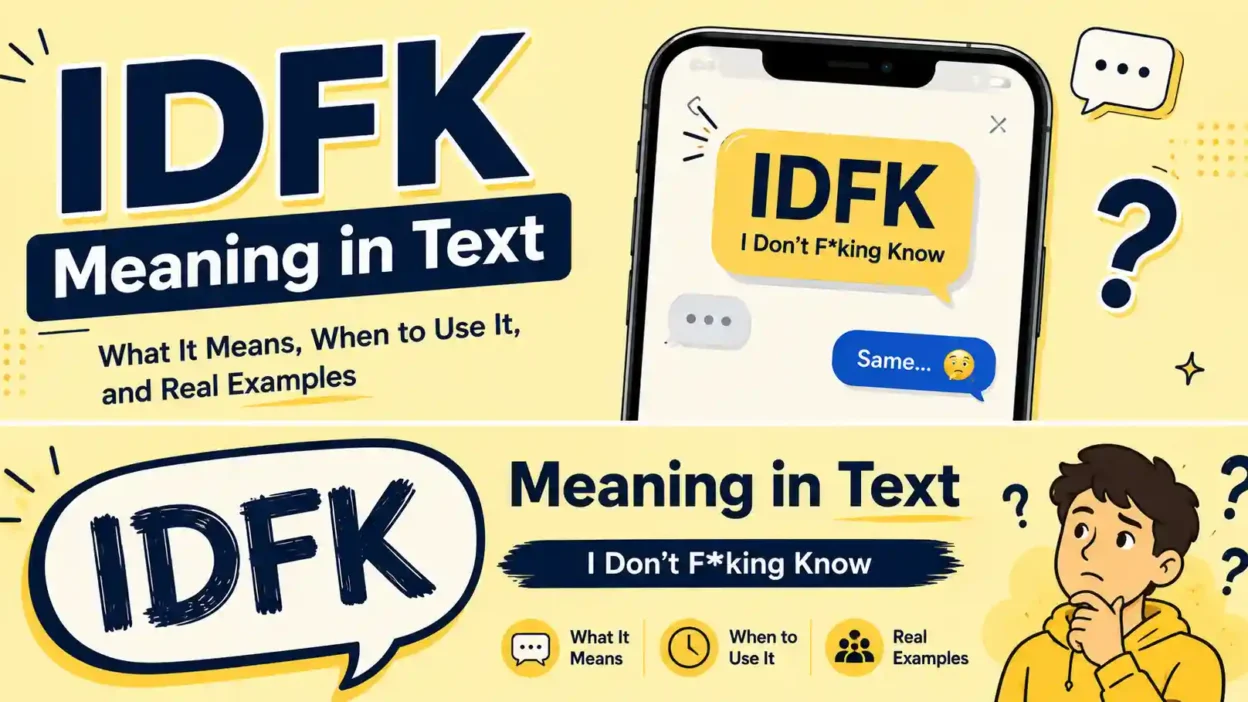
IDFK Meaning in Text means “I don’t fing know.”* It’s a stronger, more emotional version of IDK (“I don’t know”), used when someone wants to add emphasis, frustration, or blunt honesty to an admission that they have no idea about something.
You’re mid-conversation, someone fires back “idfk,” and you’re left staring at four letters trying to guess whether they’re annoyed, joking, or just genuinely clueless. It happens to almost everyone the first time they see it.
The definition is the easy part. The part people actually struggle with is figuring out how to read it and when it’s okay to use it yourself because the same four letters can be a joke between best friends or a red flag in a work chat. This guide covers both: the exact meaning, where it came from, how to tell whether it’s rude in a given message, and how to reply without guessing.
What IDFK Stands For
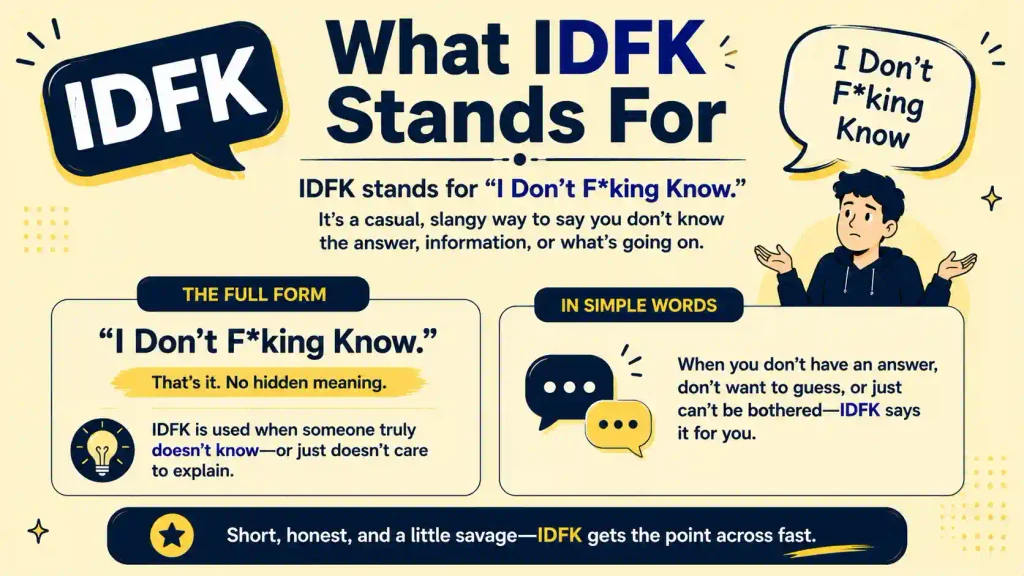
IDFK is a letter-for-letter acronym:
- I — I
- D — don’t
- F — f***ing
- K — know
Put together, IDFK Meaning in Text reads as “I don’t fing know” a flat statement of not knowing, with a swear word inserted purely for emphasis. Linguists call this kind of insertion “infixation”: slipping a word into the middle of a phrase to intensify it, the same trick behind terms like “abso-fing-lutely.” IDFK does the same thing to “I don’t know,” just compressed into an acronym.
Because the swear word doesn’t change the literal meaning, it just turns up the volume. IDFK and IDK answer the same question. The only difference is emotional temperature.
IDFK vs. IDK and Other “I Don’t Know” Slang
IDFK isn’t the only way people shorten “I don’t know” online. Here’s how the main variants compare, since mixing them up is one of the most common sources of confusion:
| Term | Full Meaning | Tone | Best Used With |
| IDK | I don’t know | Neutral, plain | Anyone, any setting |
| IDFK | I don’t f***ing know | Frustrated, blunt, emphatic | Close friends, informal chats |
| IDEK | I don’t even know | Overwhelmed, exasperated (no swearing) | Friends, casual settings |
| IONO / IDNO | I don’t know | Playful, phonetic spelling of “I dunno” | Texting, captions |
| IDC | I don’t care | Dismissive (about caring, not knowing) | Casual chats |
| IDGAF | I don’t give a f*** | Strong indifference, not uncertainty | Very informal, close relationships |
The mix-up worth flagging: IDFK is about not knowing something. IDC and IDGAF are about not caring. They get lumped together because they all sound blunt, but they answer different questions. If someone asks “Do you know where Sam went?” and you reply IDGAF instead of IDFK Meaning in Text, you’re saying you don’t care where Sam went, not that you’re unaware.
IDEK is worth a special mention because it’s the version people reach for when they want IDFK’s intensity without the profanity a genuinely useful swap for texting with parents, younger siblings, or anyone in a semi-formal group chat.
Is IDFK Rude? A Practical Way to Read the Tone
Texting strips out tone of voice and facial expression, so a lot of the guesswork in reading IDFK Meaning in Text comes down to context clues rather than the word itself. IDFK isn’t rude by default, but it also isn’t automatically harmless. Four things determine which way it lands.
That same context-first approach matters with other short forms too. For example, HM can signal that someone is thinking or unsure, while YKW often assumes shared context without spelling everything out. Just like IDFK, the meaning of these short expressions becomes clearer when you look at the conversation around them rather than reading the letters in isolation.
- Who sent it. A close friend and a near-stranger sending the same word carry very different weight.
- Where it was sent. A gaming Discord and a work Slack channel are not the same audience.
- What surrounds it. An emoji, “lol,” or lowercase softens it. A capitalized “IDFK” with a period reads sharp and final.
- What came before it. A light question (“what should we watch?”) versus a tense or emotional one changes everything.
When It Reads as Casual and Harmless
- Sent between friends who text this way regularly
- Paired with a laughing emoji or “lol”
- Responding to a low-stakes question, like picking food or a movie
- Used in a gaming chat, Discord server, or meme comment section
When It Can Come Across as Cold or Dismissive
- Sent with no emoji, capitalized, and ending in a period
- Used in response to something the other person clearly cares about
- Sent by someone you don’t know well, like a new match on a dating app
- Used right after an argument, where it can read as shutting the conversation down
A useful mental shortcut: IDFK amplifies whatever mood is already in the conversation. If the exchange is light, it stays light. If the exchange is tense, IDFK Meaning in Text tends to make it feel more tense, not less, because the built-in profanity reads as an exclamation point on frustration, even when the sender didn’t mean it that way.
Where IDFK Came From
IDFK Meaning in Text grew directly out of IDK, one of the earliest texting abbreviations, popularized during the SMS and instant-messaging era of the early-to-mid 2000s when character limits and slow typing on physical keypads rewarded short forms.
As messaging shifted to smartphones and social platforms with more room for personality, users started adding intensifiers to plain acronyms to carry more emotional weight in fewer characters, the same pattern that turned “lol” into “lmao” and “omg” into “omfg.”
IDFK Meaning in Text is part of that same family: an existing shorthand with a swear word spliced in to signal that the speaker isn’t just uninformed, they’re emphatic about it. It’s now common across texting, gaming voice and text chat, and comment sections on platforms like TikTok, Instagram, and Reddit, and it shows up especially often among younger users who grew up texting in acronyms rather than full sentences.
How to Reply to IDFK
The right reply depends on matching the energy behind the message rather than overanalyzing it.
If it’s clearly casual:
- “Lol same”
- “Fair enough”
- “Guess we’re both stuck then”
If the person seems frustrated or stressed:
- “No worries, we’ll figure it out”
- “That’s fine, let me know if it comes to you”
- Avoid piling on more questions right away; that’s usually what triggered the frustrated IDFK in the first place.
If it’s obviously a joke:
- “Big mystery, huh?”
- “Classic idfk moment”
There’s rarely a wrong way to respond as long as you’re reading the surrounding tone rather than the four letters in isolation.
Using IDFK at Work or School (and What to Say Instead)
IDFK contains a swear word, which makes it a poor fit for email, Slack channels visible to managers, school assignments, or any conversation with someone who doesn’t already text you casually. Beyond the tone issue, there’s a practical one many guides skip: some workplace chat tools and email filters flag profanity automatically, which means an IDFK sent in the wrong channel can get logged or reviewed even if nobody intended offense.
Safer, equally quick alternatives:
- “Not sure I’ll check and get back to you.”
- “I don’t have that info yet.”
- “Let me look into it.”
These carry the same honest admission of not knowing, minus the risk of the message landing badly with someone who doesn’t share your texting style.
The Other Meaning of IDFK
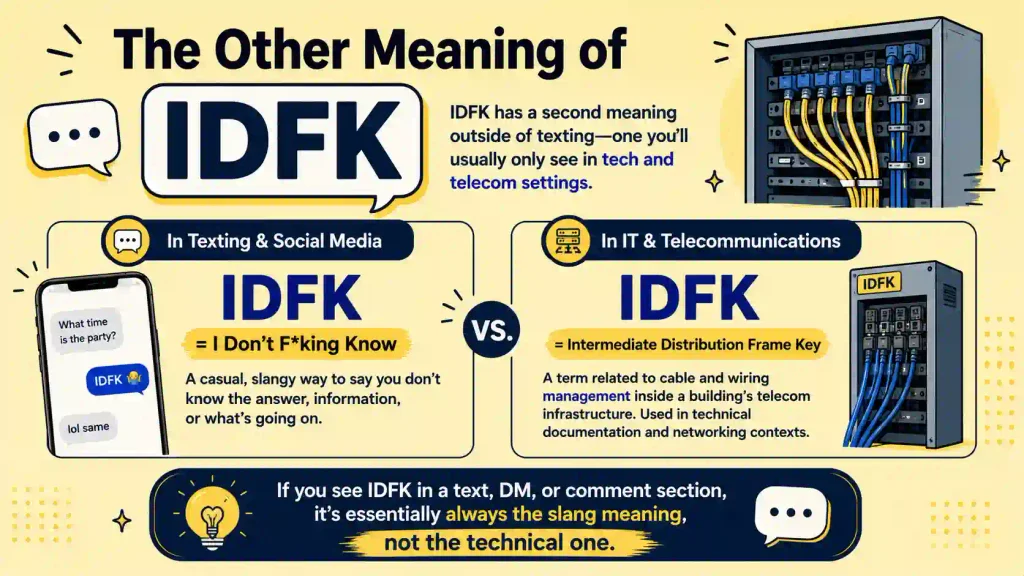
Outside of texting, IDFK also appears in IT and telecommunications as shorthand for “Intermediate Distribution Frame Key,” a term related to cable and wiring management inside a building’s telecom infrastructure. This meaning shows up almost exclusively in technical documentation and networking contexts. If you see IDFK in a text, DM, or comment section, it’s essentially always the slang meaning, not the technical one.
Common Misconceptions, Cleared Up
“IDFK Meaning in Text always means the person is angry.”
Not necessarily. It’s just as often used lightly among friends as it is used in frustration; the surrounding tone decides which one it is.
“IDFK and IDC mean the same thing.”
They don’t. IDFK is about lacking information. IDC is about lacking interest in the topic altogether.
“It’s fine to use anywhere since everyone knows it.”
Wide recognition doesn’t make it appropriate everywhere. Familiarity and formality are separate questions; plenty of people who instantly understand IDFK would still find it out of place in a professional message.
“It’s a new term.”
It’s a fairly natural extension of IDK, which has been part of texting shorthand since the early days of SMS. The core idea of shortening “I don’t know” isn’t new; only the added emphasis is.
Frequently Asked Questions
What does IDFK Meaning in Text?
IDFK stands for “I don’t f***ing know.” It’s a more emotionally intense version of IDK, used when someone wants to emphasize that they truly have no idea, often out of frustration, honesty, or bluntness.
Is IDFK rude?
Not automatically. Among friends in casual settings, it usually reads as normal or even funny. In professional, unfamiliar, or already tense conversations, the built-in swear word can make it feel sharp or dismissive.
What’s the difference between IDK and IDFK?
They mean the same thing at the core; both admit not knowing something. IDK is neutral and plain. IDFK adds emotional intensity through the inserted profanity.
Can I use IDFK Meaning in Text at school or work?
It’s best avoided. The swear word makes it inappropriate for formal or professional communication, even if the recipient wouldn’t personally be offended. “Not sure, I’ll check” carries the same meaning without the risk.
How should I reply to IDFK?
Match the tone it was sent in. A light, joking IDFK deserves a light reply like “lol same.” A stressed or frustrated one is better met with reassurance, like “no worries, we’ll figure it out.”
Is IDFK the same as IDGAF?
No. IDFK means not knowing something. IDGAF means not caring about something. They’re often used in similarly blunt tones, but they answer different questions.
Does IDFK have any other meaning?
Yes, in technical and telecom contexts it can stand for “Intermediate Distribution Frame Key,” an unrelated cabling term. In everyday texting and social media, it’s essentially always used as slang for “I don’t f***ing know.”
Conclusion
IDFK is a simple idea dressed up in an intense package: it means exactly what IDK means “I don’t know” with a swear word inserted for emphasis. Whether it lands as funny, blunt, or dismissive has almost nothing to do with the acronym itself and everything to do with who sent it, where, and what tone surrounds it.
The safest approach is the one that applies to most internet slang: use it with people who already text this way, skip it in professional or unfamiliar settings, and when in doubt about how it was meant, read the message around it rather than the four letters alone. Once you’ve got that framework down, you’ll never have to pause and wonder what “idfk” means again.
Read More: YKW Meaning in Text Warning | Common Mistake 2026

Daniel is a former English literature teacher turned digital educator. He believes that grammar rules stick best when tied to real-life stories, which is why his articles focus on practical usage, antonyms, metaphors, and word meanings explained the way you’d actually use them in conversation.