

Cf. is a short abbreviation of the Latin word confer. It means “compare.” In simple terms, the Cf. Meaning in text is this: a writer is asking you to compare two ideas, not just look at one extra source.
There is another “CF” you may have seen in texts or on Instagram. This Cf. Meaning in text is a completely different word. It has nothing to do with the “compare” meaning above. We’ll cover that texting meaning later in this article, so you know which one someone means.
Here’s the biggest mistake people make: they use cf. when they mean “see.” Those two words do not mean the same thing. Let’s clear that up first, then walk through everything else you need to know.
What Does Cf. Meaning in text? (Definition & Etymology)
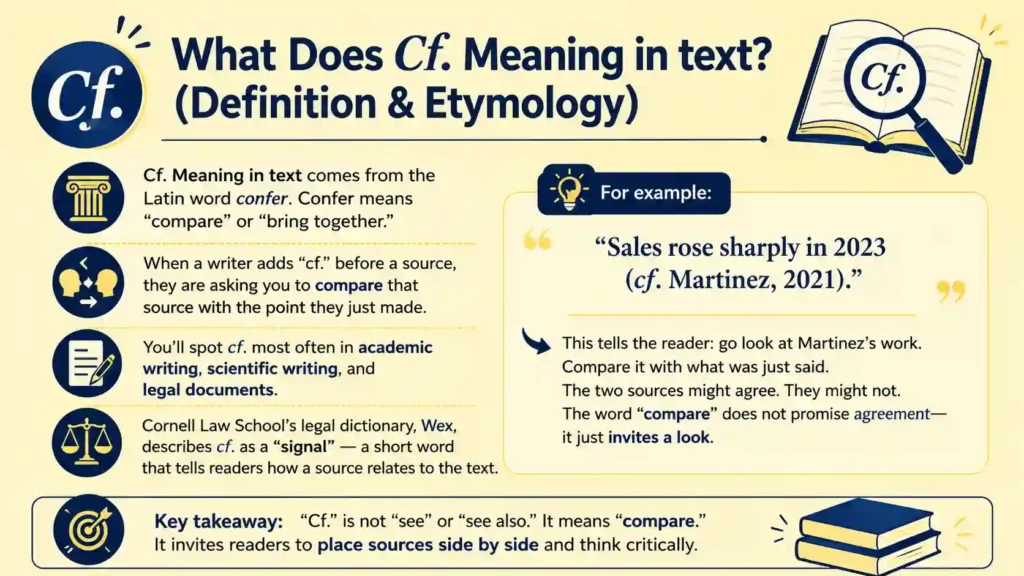
Cf. Meaning in text comes from the Latin word confer. Confer means “compare” or “bring together.” When a writer adds “cf.” before a source, they are asking you to compare that source with the point they just made.
For example: “Sales rose sharply in 2023 (cf. Martinez, 2021).” This tells the reader: go look at Martinez’s work. Compare it with what was just said. The two sources might agree. They might not. The word “compare” does not promise agreement it just invites a look.
You’ll spot cf. most often in academic writing, scientific writing, and legal documents. Cornell Law School’s legal dictionary, Wex, describes cf. as a “signal” a short word that tells readers how a source relates to the text.
Where Cf. Comes From (Latin Confer)
Latin was once the main language of scholars. Many old Latin words stuck around in modern writing. Confer is one of them. Over time, writers shortened it to two letters and a period: cf.
Other Latin terms survived the same way. You may already know e.g., and i.e. We’ll compare those to cf. soon.
How to Pronounce “Cf.”
Most people do not try to pronounce “cf.” as one word. Instead, they say the two letters out loud: “C-F.” Or, even more often, they simply read it as its English meaning: “compare.”
Reading it as “compare” is the safest, clearest choice. It works well both in speech and in your own head while reading.
Cf. vs. “See Also” The Most Common Mistake
Here’s the direct answer: cf. does not mean “see” or “see also.” This mix-up is the single most common mistake writers make with this abbreviation.
“See also” points a reader toward extra support. It says, “here is more proof.” Cf. does something different. It says, “here is something worth comparing.” The source might support the writer’s point. It might offer a different angle instead. Either way, comparison is the goal not simple backup.
What “See Also” Actually Means
“See also” tells the reader that a second source backs up or adds to the first one. Both sources point in the same direction. There is no need to think hard about differences.
Why the Two Get Confused
Both terms show up in the same spot: inside parentheses, right after a claim. Both point to another source. Understanding the CF meaning in text is important because similar placement is probably why writers mix up cf. and “see also.” The two terms are not interchangeable, though.
A simple rule fixes this. Ask yourself: “Am I telling the reader to compare, or am I telling them to see more proof?” If the answer is “compare,” use cf. If the answer is “more proof,” use “see” or “see also” instead.
Cf. vs. E.g. vs. I.e.: How They’re Different
Cf., e.g., and i.e. look alike. They are all short Latin terms with periods. But they do three completely different jobs.
Cf. (Compare)
Cf. means “compare.” Use it when you want a reader to look at two sources side by side.
Example: “The results were unexpected (cf. Chen, 2020).”
E.g. (For Example)
E.g. is short for exempli gratia. It means “for example.” Use it when you list a few sample items, not every possible item.
Example: “Some fruits are high in vitamin C (e.g., oranges, kiwis).”
I.e. (That Is)
I.e. is short for id est. It means “that is.” Use it to restate or clarify a point, not to give examples.
Example: “The trial lasted one week, i.e., seven days.”
| Abbreviation | Meaning | Use It To… | Example |
| cf. | Compare | Point to a source worth comparing | (cf. Smith, 2019) |
| e.g. | For example | Give a sample, not a full list | (e.g., apples, pears) |
| i.e. | That is | Restate or clarify a point | (i.e., over 18 years old) |
[Internal link suggestion: link to a dedicated “e.g. vs. i.e.” explainer]
How to Use Cf. Correctly (With Examples)
Here’s the short version: put cf. inside parentheses, right before the source you want the reader to compare. Follow it with a period. Keep it in plain (roman) type, not italics.
Cf. in Parenthetical Citations
When it comes to CF meaning in text, most writers place cf. inside parentheses, often next to a page number or year
Example: “Herbivore numbers rose sharply (cf. Ramirez 2018, 45–47).”
This tells the reader exactly where to look and what to compare.
Punctuation and Formatting Rules
A few small rules make a big difference:
- Always add a period after “cf.” it is a shortened word.
- Write it in plain, non-italic type, unless your style guide says otherwise.
- Add a comma after “cf.” only if your style guide asks for one before the source name.
- Never start a sentence with “cf.” Rewrite the sentence instead.
Cf. in Running Text vs. Footnotes
Most style guides prefer cf. stay inside parentheses, footnotes, or endnotes. In the main flow of a sentence, it’s often clearer to write “compare” instead.
Instead of: “Cf. Johnson (2020) for more on this.”
Try: “Compare this with Johnson’s 2020 findings.”
The second version reads more naturally for readers outside your field.
Cf. Across Style Guides (MLA, APA, Chicago, Legal)
Different style guides treat cf. in slightly different ways. Always check the current rules for the guide you’re using, since editions do get updated.
Cf. in MLA Style
The MLA Style Center confirms that MLA allows cf. inside parenthetical citations. The rule is simple: only use it to mean “compare,” never “see also.” A published example from the journal PMLA uses it this way: “(Fraser 53; cf. Wood 79–83).” Here, Fraser is the main source, and Wood is worth comparing.
Cf. in APA Style
APA style leans away from Latin abbreviations in body text. Many APA-based papers skip “cf.” entirely and use the plain word “compare” instead. This choice helps readers outside academia follow along more easily.
Cf. in Chicago Style
Chicago style permits cf. in notes and bibliographies. It follows the same “compare, not see” rule as MLA. As always, check your specific publisher’s or journal’s instructions first.
Cf. in Legal Citation (Bluebook Signal Words)
In legal writing, cf. is one kind of signal word. Writers place signal words before a case citation. A signal word tells the reader how a cited case relates to the point just made. Other signal words include “see,” “accord,” and “contra.” Cf. signals a case worth comparing. That case does not have to directly support the claim.
| Style Guide | Is Cf. Permitted? | Where It Goes | Notes |
| MLA | Yes | Parenthetical citations | Must mean “compare,” not “see also” |
| APA | Often avoided | Rarely used in body text | “Compare” is preferred in plain writing |
| Chicago | Yes | Notes and bibliographies | Follow the same “compare” rule |
| Legal (Bluebook) | Yes | Case citations | One of several signal words |
[Internal link suggestion: link to a full guide on legal citation signal words]
Specialized Uses of Cf. (Beyond Citations)
Cf. shows up in a few fields outside standard citations. These uses are less common, but knowing them shows real depth.
Cf. in Scientific Taxonomy
In biology, scientists sometimes write a species name like Musca cf. domestica. Here, “cf.” does not mean “compare two sources.” It means the scientist believes the specimen is probably the named species. However, the scientist has not fully confirmed this identification yet.
Cf. in Historical Writing (Historiography)
Historians sometimes use cf. in a sharper way. Placing “cf.” before a source can quietly hint that the source disagrees with the writer’s point. It can also hint that the writer thinks that source is wrong. This use shows up more often in older or more traditional historical writing.
Semantic Drift Why Some Writers Avoid Cf. Entirely
Word meanings can shift over time. This is called semantic drift. Because so many people now use cf. to mean “see,” some writers argue its “correct” meaning is fading. As a result, several style guides now suggest skipping cf. altogether and simply writing “compare.”
Related Latin Abbreviations You Should Know
Many other Latin terms appear alongside Cf. Meaning in text in academic writing. Here’s a quick glossary.
| Abbreviation | Meaning |
| et al. | “And others” (for author lists) |
| ibid. | “In the same place” (repeats the last citation) |
| n.b. | “Take notice” (flags something important) |
| vs. | “As opposed to” |
| ca. or c. | “Around” or “approximately” (for dates) |
| sensu | “As used by” a certain person or source |
| f./ff. | “And the following page(s)” |
[Internal link suggestion: link to a full Latin abbreviations glossary]
Note: “CF” Also Means Something Different in Texting and on Social Media
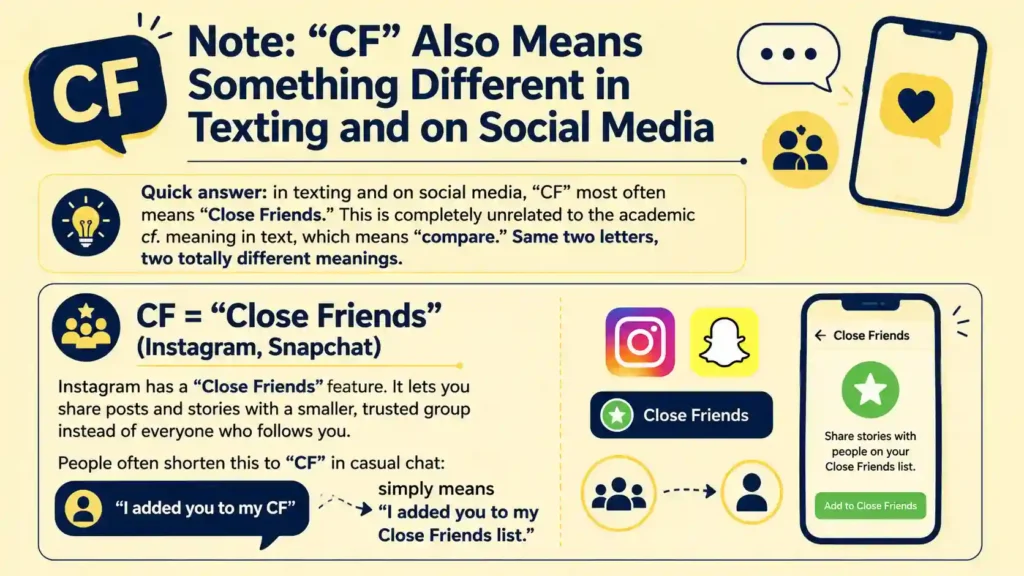
Quick answer: in texting and on social media, “CF” most often means “Close Friends.” This is completely unrelated to the academic cf. meaning in text,which means“compare.” Same two letters, two totally different meanings.
CF = “Close Friends” (Instagram, Snapchat)
Instagram has a “Close Friends” feature. It lets you share posts and stories with a smaller, trusted group instead of everyone who follows you. People often shorten this to “CF” in casual chat: “I added you to my CF” simply means “I added you to my Close Friends list.”
Other Slang Meanings (CrossFit, Crowdfunding)
“CF” can also stand for CrossFit (a fitness program) or crowdfunding (raising money online), depending on where you see it. Context clues like whether the conversation is about workouts, money, or friendships usually make the meaning clear.
How to Tell Which “CF” Someone Means
I first came across “CF” while reading a casual online conversation, and I honestly wasn’t sure what it meant. Short forms like that can carry different meanings depending on the situation. So I went back and read the rest of the message. Once I looked at the full sentence around it, the meaning became clear right away.
Since then, I’ve noticed “CF” pop up again and again in different texts, comments, and online discussions. Each time, the surrounding words told me exactly which meaning was meant. My advice, based on that experience: never guess from the letters alone. Read the whole sentence first, especially when you’re chatting with someone who uses a lot of abbreviations. The context almost always answers away.
Frequently Asked Questions
What does Cf. Meaning in text?
Cf. is a short form of the Latin word confer, which means “compare.” Writers add cf. before a source to ask readers to set that source next to the point just made and compare the two. It does not promise the source agrees only that it is worth comparing.
Is cf. short for “see” or “see also”?
No, cf. and “see” do not mean the same thing. “See” or “see also” points readers toward extra support for a claim. Cf. asks readers to compare two sources instead, since the second source might agree or offer a different view. Mixing up these two is the most common cf. mistake.
What is the difference between cf. and e.g.?
Cf. and e.g. do different jobs. Cf. Meaning in text. means “compare” and points to a related but separate source. E.g. is short for exempli gratia, meaning “for example,” and it introduces a sample item, not a full list. The two should never be swapped for each other in formal writing.
How do you use cf. in a sentence?
Cf. usually appears inside parentheses, footnotes, or endnotes, right before the source a reader should compare. A period always follows the abbreviation, and it stays in plain, non-italic type unless a style guide says otherwise. For example: “Sales rose sharply in 2023 (cf. Martinez, 2021).”
Is cf. acceptable in MLA, APA, or Chicago style?
MLA style allows cf. in parenthetical citations, as long as it means “compare” rather than “see also.” Chicago style follows a similar rule in notes and bibliographies. APA style leans away from Latin abbreviations and often prefers the plain word “compare.” Always check your publisher’s current rules.
How do you pronounce “cf.”?
Most people do not try to pronounce cf. as a single word. Instead, they say the two letters out loud, “C-F,” or simply read the abbreviation as its meaning, “compare.” Reading it as “compare” is the clearest choice, both when speaking and reading silently.
What does Cf. Meaning in text messages or on Instagram?
In texting and on social media, CF usually stands for “Close Friends,” Instagram’s feature for sharing posts with a smaller, trusted group instead of all followers. This everyday CF has nothing to do with the academic abbreviation cf., which means “compare.”
Cf. Meaning: The Short Version
Cf. Meaning in text means “compare.” It never means “see” or “see also,” even though people mix them up constantly. Use it in parentheses, keep it in plain type, add a period, and check your specific style guide before you submit any academic or legal writing.
And if someone texts you “CF” instead? Chances are, they’re talking about their Close Friends list not asking you to compare two sources. Read the full message, and the meaning will almost always be obvious.

Rachel is a passionate linguist and content writer with a love for the English language’s hidden nuances. With years of experience in teaching ESL students, she specializes in breaking down idioms and similes into simple, everyday examples. Her mission is to make English learning fun, not intimidating.


[…] reaction. Often used almost reflexively, without much behind it..Like replying p meaning in text or CF meaning in […]