NWS most often means “no worries” or “not work safe.” Outside of texting, it is the standard abbreviation for the National Weather Service, the official weather agency of the United States. These two meanings are casual slang with very different effects, so guessing wrong can lead to an awkward reply or opening something at the worst possible moment.
This guide explains what NWS Meaning in Text, where each meaning comes from, and how the official weather meaning fits in. You will also find realistic chat examples, a simple method for decoding a message that could mean two things, and advice on how to reply. By the end, you will know how to read NWS with confidence and when it is smarter to type the full phrase instead, so nothing gets lost in translation.
NWS Meaning in Text at a Glance
Here is the short version before we go deeper. Because two of the three meanings are slang, the letters alone will never settle it. The context does.
| No worries | Everything is fine; no apology needed | Replies to a sorry or a thank-you |
| Not work safe | Be careful where you open this | Next to a photo, video, or link |
| National Weather Service | The U.S. weather agency | News stories, weather apps, official alerts |
NWS as “No Worries”
How People Use It
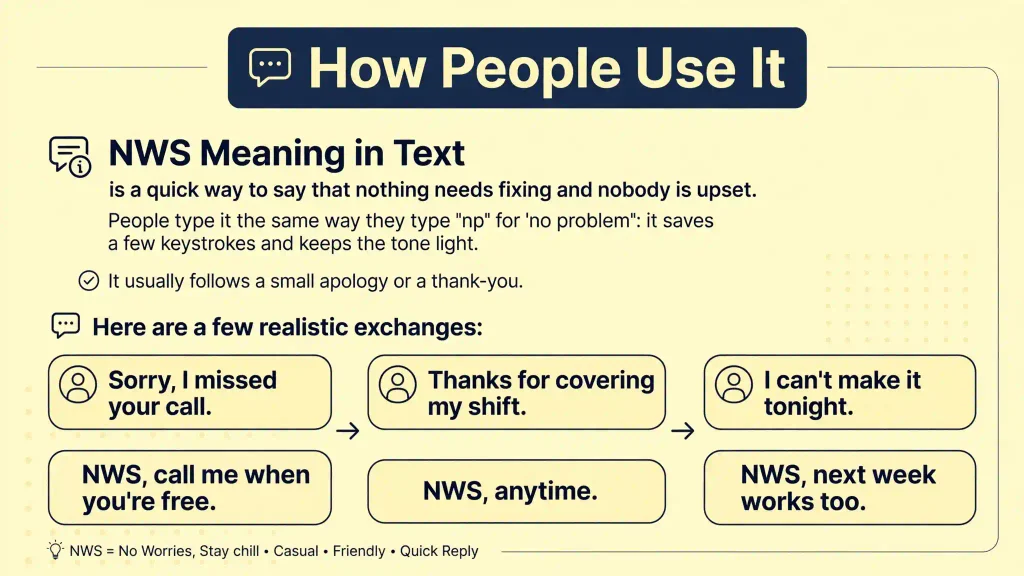
In this sense NWS Meaning in Text is a quick way to say that nothing needs fixing and nobody is upset. People type it the same way they type “np” for “no problem”: it saves a few keystrokes and keeps the tone light. It usually follows a small apology or a thank-you. Here are a few realistic exchanges:
- “Sorry, I missed your call.” → “NWS, call me when you’re free.”
- “Thanks for covering my shift.” → “NWS, anytime.”
- “I can’t make it tonight.” → “NWS, next week works too.”
A Note on Tone
Reassurance is not always welcome. If someone is genuinely upset or anxious, a clipped “NWS” can feel like you are brushing off their feelings. In those moments, a full sentence such as “No worries, I completely understand” sounds warmer and shows you are paying attention.
Where “No Worries” Comes From
The phrase is Australian in origin. The Macquarie Dictionary notes that it has been part of Australian English since the 1960s, and the Oxford English Dictionary’s earliest recorded example, from a 1965 Sydney magazine, actually reads “no worry” rather than “no worries.” British use became widespread from the late 1980s, partly because Australian soap operas such as Neighbours were popular on UK television. Texting then did what it does to most common phrases: it shortened them.
NWS as “Not Work Safe”
What It Means
Here, NWS Meaning in Text works as a content warning. It tells you that a photo, video, meme, or link may not be appropriate to open at work, at school, or anywhere else a screen might be seen by others. Wiktionary lists it as a computing initialism of “not work safe,” and a close variant, “not work suitable,” also appears in acronym dictionaries. In practice, it looks like this:
- “Great meme, but NWS. Maybe wait until you’re home.”
- “Sending that video now. NWS, you’ve been warned.”
How It Differs From NSFW
NWS expresses the same idea as NSFW, which stands for “not safe for work.” The difference is reach. NSFW is the standard label: Merriam-Webster added it in 2015, and the Oxford English Dictionary cites usage from 2002. Platforms and websites commonly use it to mark sensitive content. NWS is a looser variant that you are more likely to meet in a private chat. No reliable source shows that NWS came first or that it was the original form of NSFW, so be cautious with any page that claims otherwise.
What to Do When You See It
Treat the warning as a favor. A few habits help:
- Pause before tapping, so you can open the content somewhere private.
- Be careful with links from unfamiliar senders. A warning label says nothing about whether a link is safe to click.
- Remember that work devices and networks are often monitored, so what you open may be visible to your employer.
NWS as the National Weather Service
The National Weather Service is a United States federal agency and part of the National Oceanic and Atmospheric Administration (NOAA). Its history goes back to 1870, when President Ulysses Grant signed a law that started the country’s first official weather service, run at first by the Army Signal Service. Today, the agency works through national and regional centers and 122 local Weather Forecast Offices. You will see its abbreviation in news stories, forecast pages, and alerts, usually near words such as forecast, storm, or warning.
Watch, Warning, and Advisory: What the Alert Terms Mean
If you arrived here after seeing an NWS alert, this part matters most. The agency’s own FAQ explains the three levels simply:
- Watch: Certain weather is possible, but not certain. A Tornado Watch means tornadoes could develop, not that one is expected.
- Warning: Life-threatening weather is expected, and you should take action
- Advisory: Similar to a warning but less severe, such as a Winter Weather Advisory for light snow or ice that will make travel difficult.
For official alerts, rely on weather.gov or your local forecast office instead of a forwarded message or screenshot.
Other Meanings You Might Run Into
Dictionaries list a few more uses of NWS Meaning in Text, though they rarely appear in casual chats. Wikipedia’s disambiguation page includes NWS Holdings, a listed company in Hong Kong, and the North Warning System, a chain of radar stations across Arctic North America. Dictionary entries also list “nuclear weapons state” and “North-West Semitic,” a branch of languages. If your conversation is about business, defense, or linguistics, one of these may fit better than the slang.
How to Tell Which NWS Someone Means
Instead of guessing, run through three quick checks in this order.
1. Is Something Attached?
A photo, video, or link right next to NWS points to “not work safe.” If nothing is attached, that meaning becomes much less likely.
2. What Did the Previous Message Say?
An apology or a thank-you suggests “no worries.” Words like “sorry,” “thanks,” or “my bad” are the strongest clues you will get.
3. What Is the Conversation About?
Talking about storms, forecasts, or alerts points to the agency. If the conversation is about something else entirely, lean toward one of the slang meanings.
Here is how the checks work on some realistic messages:
| “Sorry I’m late!” → “NWS” | No worries | Reply to an apology |
| “Funny clip, NWS 😬” | Not work safe | Attached to shared content |
| “NWS says storms by 6” | National Weather Service | Weather topic |
| “Sorry for the meme. NWS lol” | Unclear | Fits both meanings |
Platform and region can add small hints, but they are unreliable. Sources even disagree about Snapchat: some say NWS there usually means “no worries,” while others claim “not work safe.” Do not rely on the app alone.
When the checks still leave you unsure, ask. A quick “NWS as in no worries, or a content warning?” takes a few seconds and can save you an awkward moment.
How to Reply to NWS
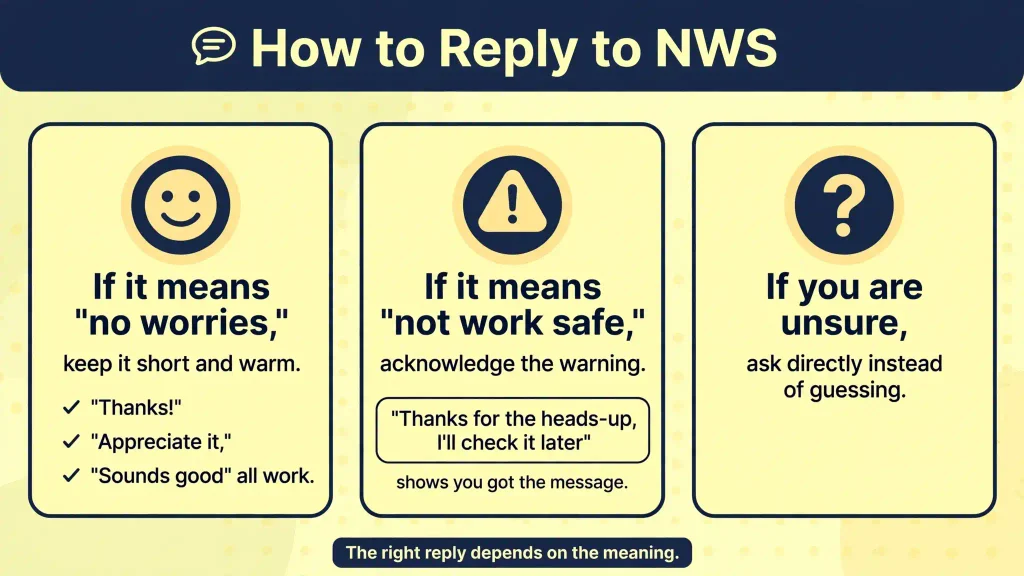
The right reply depends on the meaning.
If it means “no worries,” keep it short and warm. “Thanks!” “Appreciate it,” or “Sounds good” all work.
If it means “not work safe,” acknowledge the warning. “Thanks for the heads-up, I’ll check it later” shows you got the message.
If you are unsure, ask directly instead of guessing.
Common Mistakes to Avoid
- Assuming one meaning fits every chat. The same three letters can reassure in one conversation and warn in another.
- Treating the label as a safety guarantee. “Not work safe” describes the content, not whether a link is secure.
- Using NWS where NSFW is expected. For a content warning that everyone will recognize, use the standard form.
- Forgetting the weather meaning. In news stories and alerts, NWS refers to the agency.
Should You Use NWS Yourself?
With friends who know the slang, NWS is harmless. Still, because it carries two slang meanings with opposite effects, spelling things out is usually safer. For reassurance, “no worries” or “np” is clearer. For a content warning, NSFW is the label most people recognize. In work emails, messages to teachers, or chats with people you do not know well, skip the abbreviation altogether. Clear writing never confuses anyone, and it costs you only a few extra seconds.
Related Abbreviations
These shortcuts often appear near NWS in chats:
| NSFW | Not safe for work, the standard content warning |
| SFW | Safe for work |
| NSFL | Not safe for life, a stronger warning for disturbing content |
| NP | No problem |
| NBD | No big deal |
| DW | Don’t worry |
Frequently Asked Questions
Which meaning of NWS is most common?
Reliable usage data that ranks the meanings does not exist, and dictionaries list them without ranking them. In practice, the message before it decides.
Is NWS the same as NSFW?
They express the same warning, but NSFW is the standard, widely recognized form. NWS is a less common variant, so some people may not understand it.
What does NWS mean on Snapchat?
Sources disagree. Some say it usually means “no worries,” while others say “not work safe.” Judge it by the message it replies to, not by the app.
Is it rude to send NWS?
No, but it is informal. It can also sound dismissive if the other person is upset, so use a full sentence when feelings are involved.
Does NWS ever refer to the weather in a text?
Yes. It is the agency’s standard abbreviation, so in a message about forecasts or alerts, that is almost certainly the meaning.
Is it safe to open a link marked NWS?
The label only warns about content, not about security. Open links from people you trust, and avoid links from unknown senders no matter how they are labeled.
The Bottom Line
NWS is a small abbreviation with three real jobs. In casual chats, it can mean “no worries,” a friendly way to say nothing needs fixing, or “not work safe,” a heads-up about content that is better opened in private. Outside texting, it points to the National Weather Service and its forecasts and alerts. The letters alone will not tell you which one you are looking at, but the context almost always will. Check for an attachment, read the message before it, and think about the topic. When you are still unsure, a quick question beats a wrong guess. And when you are the one writing, choosing the full phrase keeps your message clear for everyone. Bookmark this guide for later.
Read More:TTYL Meaning in Text: 5 Amazing Secrets You’ll Love

Daniel is a former English literature teacher turned digital educator. He believes that grammar rules stick best when tied to real-life stories, which is why his articles focus on practical usage, antonyms, metaphors, and word meanings explained the way you’d actually use them in conversation.