
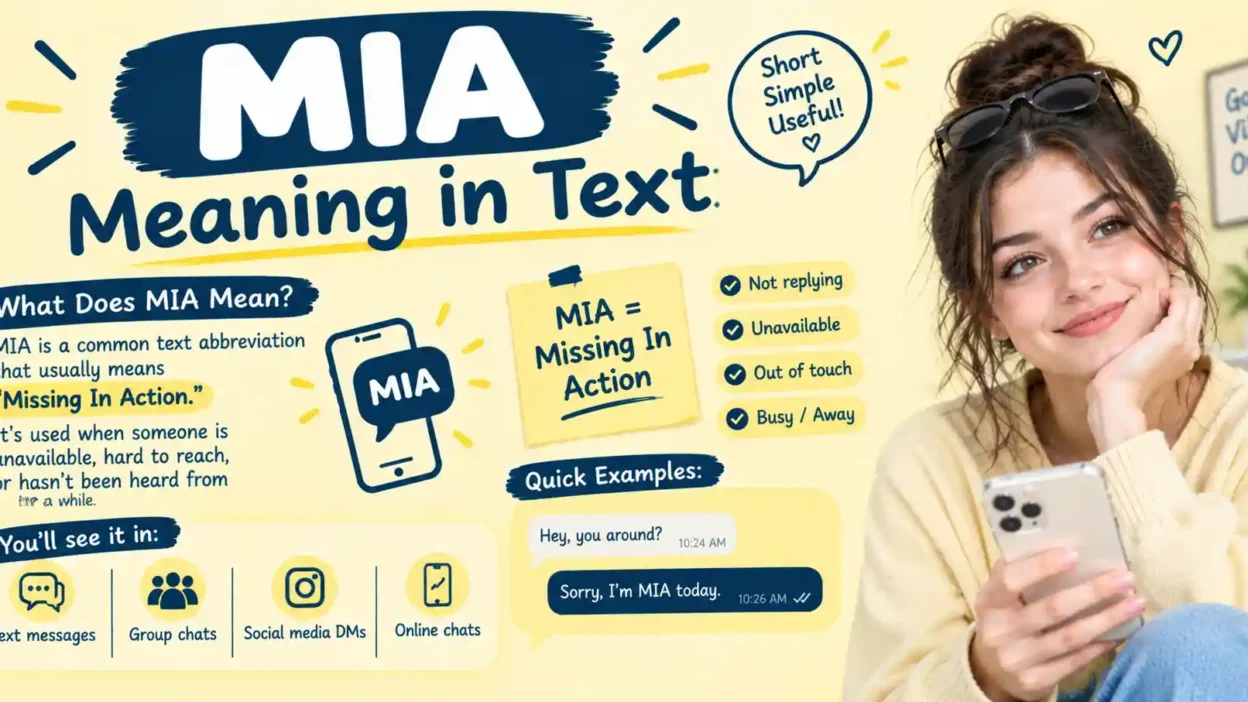
MIA is short for “missing in action,” a phrase that began in the military and later found its way into everyday texting. Today it appears in group chats, Instagram captions, dating conversations, gaming lobbies, and even casual office messages. Because the original meaning sounds serious, many people are unsure whether the slang version is rude, worried, or simply playful.
This guide clears up that confusion. You will learn what MIA Meaning in Text, where the phrase comes from, and how to read its tone. You will also find ready-to-use replies for different situations, a comparison with terms like ghosting and AFK, and other meanings of MIA, including the airport code. It takes only a few minutes to read and answers the questions people ask most often. Whether you are the one who went quiet or the one waiting for a reply, you will know exactly what to say next.
Quick Answer
MIA Meaning in Text means “missing in action.” In texting and on social media, it describes someone absent, unresponsive, or inactive for a while.
- Usually means: “You have been quiet” or “I have not heard from you.”
- Typical tone: Casual, teasing, or mildly curious.
- Does not mean: That something is wrong, or that a person is truly missing.
- Where you will see it: Text messages, group chats, Instagram, Snapchat, Discord, dating apps, and informal work chats.
How MIA Works in a Sentence
In casual writing, MIA Meaning in Text is almost always an adjective. Three patterns cover nearly every use:
- “Been MIA” describes an ongoing stretch of silence. Example: “Sorry I’ve been MIA. Work has been chaotic.”
- “Went MIA” or “gone MIA” describes the moment someone disappeared. Example: “He went MIA right after we made plans.”
- “Is MIA” describes a current absence. Example: “Half the team is MIA today.”
The phrase also works for objects. A missing charger, a delayed package, or a show that vanished from a streaming service can all be “MIA.”
Where MIA Comes From
“Missing in action” began as a military classification. It describes a service member who did not return from an operation and whose fate is unconfirmed, meaning the person is not known to be dead or captured. According to Merriam-Webster, the phrase itself dates back to 1808, while the abbreviation “MIA” first appeared in the 1940s.
The label stayed in public view through later conflicts because of news coverage, memorials, and symbols such as the POW/MIA flag, which was adopted in 1972 and remains familiar in the United States.
Over time, ordinary speakers borrowed the phrase for anyone conspicuously absent: a manager who skipped a meeting, an actor who vanished from public life, or a friend who stopped answering messages. Major dictionaries now recognize this figurative sense, and Cambridge even includes examples about people who stop answering calls.
Nobody invented the casual meaning on a specific app or in a viral trend. It spread gradually, the way many military phrases do. That heritage explains why the abbreviation can still carry a faint hint of seriousness.
How to Read the Tone Behind MIA
The word is the same every time, so the tone comes from context. Here are the three most common versions.
The Playful Version
This is the most common one. Look for emojis, exclamation marks, and a joking setup.
Example: “Ah, the MIA friend returns 😄”
Nothing needs fixing here. A quick reply with a little humor is enough.
The Concerned Version
Here, the sender is checking in. Look for a follow-up question and a lack of jokes.
Example: “You’ve been MIA all week. Is everything okay?”
Answer this one honestly, even if you only say you have been overwhelmed. The person is reaching out, and a real answer matters more than the slang.
The Frustrated Version
Sometimes MIA Meaning in Text carries a complaint. Look for repetition, words like “always” or “again,” and no warmth.
Example: “You’re always MIA when I actually need something.”
This message is less about silence and more about feeling let down. A joke will not help. Acknowledge the feeling and offer a specific fix, such as a time to talk.
MIA in Different Situations
With Friends and in Group Chats
This is where MIA is most relaxed. Friends use it to nudge each other, and it rarely needs a serious answer. If you disappear for a few days during a busy week, expect a light mention and nothing more.
In Dating
Here, MIA sits in a gray area. When someone “goes MIA” after a date, it usually means they stopped replying without explanation. Compared with ghosting, the phrase is softer and leaves room for the person to return.
The difference is about certainty. Ghosting implies a decision to end contact. MIA only describes the silence, and the reason could be a busy schedule, stress, or lost interest. If you are the one waiting, a short and direct message asking where things stand usually gives a clearer answer than guessing.
At Work
Coworkers sometimes use MIA casually, as in “Dan’s been MIA since the meeting.” That is fine among people who know each other well. In emails to clients, managers, or HR, choose plain wording such as “unavailable” or “out of the office.”
On Social Media
Creators often open a comeback post with “Sorry I’ve been MIA.” Followers use it in comments to ask when a favorite account will return. In each case, it simply means “inactive for a while.”
In Gaming
Many multiplayer games use MIA as a callout. In League of Legends, for example, players say an enemy is MIA when that opponent has left their lane and could be heading somewhere else. It works as a warning to teammates. Outside that setting, gamers use the everyday meaning.
How to Reply When Someone Calls You MIA
Match your answer to the tone you read above.
If the tone is playful:
- “Guilty! Life got loud. What did I miss?”
- “I’m back. Did you miss me?”
If the tone is concerned:
- “Thanks for checking in. It has been a rough few days, but I’m okay. Can we talk this weekend?”
- “Sorry for the silence. I was overwhelmed, but I’m catching up now.”
If the tone is frustrated:
- “You’re right, and I’m sorry. Can I call you tonight?”
- “That’s fair. I’ve been slow to reply, and I’ll do better.”
In a professional setting:
- “Apologies for the delay. I was tied up with a deadline.”
- “I was out of the office yesterday and am catching up on messages now.”
A good reply does three things: it acknowledges the silence, gives a short reason if you are comfortable sharing one, and points to what happens next. You do not owe anyone a detailed explanation.
What to Do When Someone Goes MIA on You
Start by giving the person time. A day or two of silence is normal, and most people are simply busy. If the quiet continues, send one friendly follow-up instead of several messages in a row. A note such as “Hey, no pressure, just checking in” keeps the door open without adding guilt.
MIA vs. Similar Terms
| AFK | Away from keyboard | Short and temporary, usually a few minutes |
| AWOL | Absent without leave | Suggests leaving without permission |
| OOO | Out of office | Formal and planned; the person announces it |
| Ghosting | Deliberately cutting off contact | Implies a decision to stop replying |
| Radio silence | No communication for a period | Similar, but more neutral and less playful |
The clearest divide is intent. AFK and OOO are usually announced ahead of time. AWOL and ghosting suggest a choice. MIA describes an absence without claiming to know the reason.
When Not to Use MIA
Avoid the phrase in these situations:
- Real emergencies. If someone is truly unreachable and it is out of character, use direct language. Call them, contact people close to them, and if you believe they are in danger, contact local authorities.
- Conversations about war or missing persons. The original meaning is heavy for many families, so joking about it can land badly.
- Formal writing. Contracts, reports, and official emails call for words like “absent,” “unavailable,” or “unreachable.”
Other Meanings of MIA
Context almost always makes the meaning clear:
- Miami International Airport. MIA is the airport’s IATA code, so you will see it on tickets and baggage tags.
- Mia. A common first name. Capitalization and context usually give it away.
- M.I.A. The stage name of a British recording artist, written with periods.
- Master of International Affairs. A graduate degree that some dictionaries list under the same abbreviation.
Frequently Asked Question
What does MIA Meaning in Text message?
It stands for “missing in action” and means a person has been out of touch, slow to reply, or inactive.
Is MIA rude?
Not by default. Most uses are friendly or teasing. It turns sharp only when repeated with frustration, as in “you’re always MIA.”
What does “going MIA” mean?
It means suddenly becoming unreachable or inactive, often without warning or explanation.
Is MIA the same as ghosting?
No. MIA describes silence without judging the cause, while ghosting means deliberately ending contact.
Can I use MIA in a work email?
Not in formal messages. It is fine in casual chat with familiar coworkers, but a clearer word such as “unavailable” is safer when writing to clients or managers.
Does MIA mean someone is in danger?
No. In everyday texting, it is not a signal of danger. If you are genuinely worried about someone, check in with them directly.
Is MIA a noun or an adjective?
In casual use, it is an adjective, as in “she’s MIA.” Some dictionaries also list a noun sense for a military member reported missing, with the plural “MIAs.
Conclusion
MIA may have started on the battlefield, but in your chats it simply means, “You have been quiet for a while.” Most of the time, it is a small, friendly nudge rather than a complaint. What matters is the tone around the word, so read the whole message before you decide how to respond.
If you are the one who disappeared, a short and honest reply is usually enough. If you are the one waiting, remember that silence rarely tells the full story. Keep MIA for relaxed conversations, and choose clear, plain words when the situation is formal or serious. Now that you know exactly what it means, you can reply with confidence the next time someone calls you MIA.
Read More:OFNG Meaning in Text: The 3 Hidden Meanings That Will Shock You in 2026